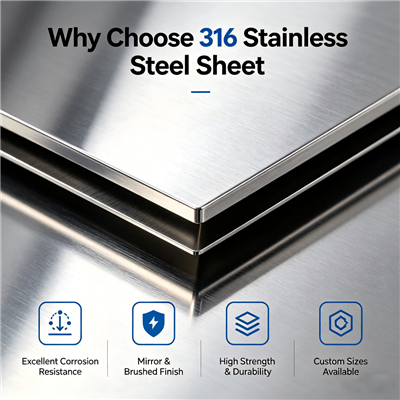


Xi'an Dongmeng Group Co., Ltd. is one of the most reliable manufacturers and suppliers of 316 stainless steel sheet in China, also supports customized service. With abundant experience, we warmly welcome you to wholesale cheap products in stock here and get free sample from our factory. For price consultation, contact us.

316 Stainless Steel Sheet Manufacturer
ASTM A240 / UNS S31600 Stainless Steel Sheets for Industrial Procurement
Dongmeng Group supplies AISI 316 stainless steel sheets for industrial fabrication, chemical processing, food equipment, coastal construction, water treatment and general engineering projects.
Available supply options include cold-rolled and hot-rolled sheets, standard or cut-to-size dimensions, multiple surface finishes, protective film, precision cutting and project-specific inspection documentation.
Our technical and sales teams review the material grade, standard, dimensions, finish, tolerance, processing, inspection and export packing requirements before order confirmation.
What Is 316 Stainless Steel Sheet?
316 stainless steel is a chromium-nickel-molybdenum austenitic stainless steel identified as UNS S31600 and EN 1.4401.
The addition of approximately 2–3% molybdenum gives 316 better resistance than standard 304 stainless steel to pitting and crevice corrosion in many chloride-bearing environments.
Grade 316 also provides good formability, weldability, toughness and surface-finishing performance. It can be cut, bent, roll formed, welded, polished and fabricated into industrial components.
Typical applications include:
Chemical processing equipment
Food and beverage machinery
Heat exchangers
Laboratory equipment
Water treatment equipment
Coastal architectural components
Boat fittings and marine hardware
Industrial tanks and enclosures
Pharmaceutical production equipment
Filtration screens and machinery components
Quick Procurement Specifications
| Procurement Item | Available Specification |
| Product | 316 stainless steel sheet |
| Material family | Molybdenum-alloyed austenitic stainless steel |
| Grade | AISI 316 |
| UNS designation | UNS S31600 |
| EN designation | EN 1.4401 / X5CrNiMo17-12-2 |
| JIS designation | SUS 316 |
| Main standards | ASTM A240, ASME SA240, EN 10088-2, JIS G4304, JIS G4305 |
| Production route | Cold rolled or hot rolled |
| Thickness | 0.30–6.00 mm or customized |
| Width | 1000, 1219, 1250, 1500 and 2000 mm or customized |
| Length | 2000, 2438, 2500, 3000 and 6000 mm or cut to length |
| Surface finishes | No.1, 2B, 2D, BA, No.4, hairline, satin and mirror |
| Edge | Mill edge, slit edge, sheared edge or deburred edge |
| Surface protection | Paper interleaving, PE film, PVC film or laser film |
| Processing | Cutting, slitting, shearing, bending, polishing, perforating and custom fabrication |
| Material documentation | EN 10204 3.1 Mill Test Certificate |
| Optional inspection | PMI, dimensional inspection and independent third-party inspection |
| Packaging | Standard export seaworthy packing or project-specific packing |
| Trade terms | EXW, FOB, CFR or CIF |
| MOQ | Confirmed according to grade, thickness, finish, size and stock status |
| Lead time | Confirmed after specification, processing and inspection requirements are reviewed |
Important Material Selection Note
316 is commonly described as a marine-grade stainless steel, but it is not completely immune to seawater corrosion.
Actual performance depends on:
Chloride concentration
Operating temperature
Surface finish
Crevice geometry
Oxygen availability
Chemical concentration
Cleaning and maintenance
Welding quality
Surface contamination
Contact with dissimilar metals
For continuous seawater immersion, warm chloride solutions, stagnant conditions or severe crevices, a duplex or higher-alloy stainless steel may be more suitable. Send Dongmeng Group the operating conditions for a preliminary material review.
316 Stainless Steel Sheet Standards and Grade Designations
| System | Grade or Designation |
| AISI / ASTM type | 316 |
| UNS | S31600 |
| EN material number | 1.4401 |
| EN designation | X5CrNiMo17-12-2 |
| JIS | SUS 316 |
| ASTM flat-product standard | ASTM A240 / A240M |
| ASME flat-product standard | ASME SA240 / SA240M |
| European flat-product standard | EN 10088-2 |
| Japanese hot-rolled standard | JIS G4304 |
| Japanese cold-rolled standard | JIS G4305 |
Grade equivalents should be treated as technically comparable designations rather than automatic contractual substitutes. The purchase order should state the required governing standard.
Chemical Composition of ASTM A240 Type 316
| Element | ASTM A240 Type 316 Requirement |
| Carbon, C | ≤ 0.08% |
| Manganese, Mn | ≤ 2.00% |
| Silicon, Si | ≤ 0.75% |
| Phosphorus, P | ≤ 0.045% |
| Sulfur, S | ≤ 0.030% |
| Chromium, Cr | 16.00–18.00% |
| Nickel, Ni | 10.00–14.00% |
| Molybdenum, Mo | 2.00–3.00% |
| Nitrogen, N | ≤ 0.10% |
The actual heat analysis should be verified against the Mill Test Certificate supplied with the production batch.
Chemical composition should not be confirmed only through a handheld alloy analyser when carbon content or full specification compliance is critical. PMI is useful for grade verification, while the MTC and appropriate laboratory testing provide the complete composition record.
Mechanical Properties of ASTM A240 Type 316
The following values apply to annealed flat-rolled Type 316 products under the referenced ASTM specification.
| Property | ASTM A240 Type 316 Requirement |
| Tensile strength | ≥ 515 MPa |
| 0.2% proof yield strength | ≥ 205 MPa |
| Elongation in 50 mm | ≥ 40% |
| Rockwell hardness | ≤ 95 HRB |
| Brinell hardness | ≤ 217 HB |
Mechanical requirements can differ for bars, pipes, castings, cold-worked products and fabricated components. Always specify the required product standard in the purchase order.
Typical Physical Properties
| Property | Typical Value |
| Density | Approximately 8.0 g/cm³ |
| Elastic modulus | Approximately 193 GPa |
| Thermal conductivity at 100°C | Approximately 16.3 W/m·K |
| Specific heat | Approximately 500 J/kg·K |
| Magnetic response | Generally low in the annealed condition |
Cold working, forming and welding can increase the magnetic response of austenitic stainless steel. Magnetic testing alone should not be used to confirm whether a sheet is Grade 316.
316 vs 316L vs 304 vs Duplex 2205
| Selection Factor | 304 | 316 | 316L | Duplex 2205 |
| Structure | Austenitic | Austenitic | Austenitic | Austenitic-ferritic duplex |
| Molybdenum | Normally none | 2–3% | 2–3% | Approximately 3% |
| Maximum carbon | 0.08% | 0.08% | 0.03% | Low |
| Chloride pitting resistance | Lower | Higher than 304 | Similar to 316 | Generally higher than 316 |
| General formability | Excellent | Very good | Very good | Lower than 316 |
| Weldability | Excellent | Good | Preferred for many welded fabrications | Good with controlled procedures |
| Weld sensitisation risk | Higher than 304L | Higher than 316L | Reduced due to lower carbon | Different duplex welding controls apply |
| Strength | Standard austenitic level | Standard austenitic level | Standard austenitic level | Significantly higher |
| Typical choice | Mild indoor and general environments | Chloride-bearing and chemical environments | Welded equipment in corrosive service | Higher loads and more severe chloride service |
| Procurement concern | Do not use where chloride exposure requires 316 | Heavy welded sections require engineering review | Confirm dual certification and operating temperature | Welding procedure and phase balance require control |
Choose 304 When
The environment is relatively mild.
Chloride exposure is limited.
General fabrication and lower material cost are priorities.
Molybdenum-bearing stainless steel is not required.
Choose 316 When
Better pitting and crevice corrosion resistance than 304 is required.
The component is used in coastal, food-processing or chemical environments.
Grade 316 is specified by the project or customer.
Welding exposure is limited or properly controlled.
Choose 316L When
Extensive welding is required.
The welded component will operate in a corrosive environment.
Post-weld solution annealing is not practical.
Lower carbon content is specified to reduce sensitisation risk.
Consider Duplex 2205 When
Higher mechanical strength is required.
The environment contains higher chloride levels.
Resistance to chloride stress corrosion cracking is a major design consideration.
The project can accommodate more controlled forming and welding procedures.
Material selection must be based on the complete service environment rather than grade name alone.
Application and Grade Selection Guide
| Service Condition | Initial Material Direction | Procurement Note |
| Indoor equipment with limited chloride exposure | 304 may be sufficient | Compare lifecycle requirement and cleaning chemicals |
| Food equipment exposed to salt or aggressive cleaning | 316 or 316L | Specify finish, weld treatment and cleaning method |
| Welded chemical tanks | 316L is commonly preferred | State chemical, concentration, temperature and welding standard |
| Coastal architectural panels | 316 or 316L | Specify smooth finish, drainage, cleaning and grain direction |
| Boat fittings above the splash zone | 316 or 316L | Avoid crevices and carbon-steel contamination |
| Continuous seawater immersion | Engineering review required | Consider duplex or higher-alloy grades |
| Warm chloride-bearing water | Engineering review required | 316 may be insufficient at higher temperature |
| Heat exchangers | 316, 316L or higher alloy | State both fluid compositions, pressure and temperature |
| Pharmaceutical equipment | Often 316L | Specify surface roughness, weld finish and cleaning validation |
| High-temperature structural service | 316H or 316Ti may be considered | Confirm design code and temperature range |
Dongmeng Group should be provided with the actual fluid, concentration, temperature, pressure, cleaning process and design life whenever corrosion performance is critical.
Available Surface Finishes
| Finish | Production Description | Appearance | Typical B2B Applications | Details to Specify |
| No.1 | Hot rolled, annealed and pickled | Dull and comparatively rough | Tanks, industrial equipment and heavy fabrication | Pickled condition, allowable surface marks |
| 2D | Cold rolled, annealed and pickled | Smooth matte finish | Engineering components and further processing | Thickness, flatness and surface acceptance |
| 2B | Cold rolled, annealed, pickled and skin passed | Smooth grey reflective finish | Food equipment, tanks, enclosures and fabrication | Film, surface defects and grain requirement |
| BA | Bright annealed in a controlled atmosphere | Brighter and more reflective than 2B | Appliance panels and decorative components | Reflectivity, film and visual sample |
| No.4 | Mechanically polished | Directional brushed finish | Food equipment, wall panels and machinery covers | Abrasive grit, grain direction and Ra |
| Hairline | Continuous linear polish | Fine directional lines | Elevators, interiors and architectural panels | Grain direction and approved sample |
| Mirror / No.8 | Progressively polished and buffed | Highly reflective | Interior decoration and display panels | Mirror level, distortion, film and sample |
Surface Finish Requirements for Purchase Orders
"2B," "No.4," "hairline" or "mirror" alone may not be sufficient for appearance-critical orders.
The purchase specification should also state:
Required roughness or polishing grit
Grain direction
Acceptable colour variation
Surface defect acceptance
One-side or two-side finish
Protective film type and thickness
Laser-film requirement
Whether an approved sample is required
Whether sheets in one project must come from the same production batch
For architectural or decorative projects, sample approval before mass production is strongly recommended.
Common Sizes
| Thickness | Common Widths | Common Lengths | Typical Use |
| 0.30–0.50 mm | 1000, 1219, 1250 mm | 2000, 2438, 2500 mm | Liners, covers and light fabrication |
| 0.60–1.00 mm | 1000, 1219, 1250, 1500 mm | 2000, 2438, 2500, 3000 mm | Panels, enclosures and equipment covers |
| 1.20–1.50 mm | 1219, 1250, 1500 mm | 2438, 2500, 3000, 6000 mm | Food equipment and fabricated panels |
| 2.00–3.00 mm | 1219, 1500, 2000 mm | 2438, 3000, 6000 mm | Tanks, chemical equipment and machinery |
| 4.00–6.00 mm | 1500 or 2000 mm | 3000 or 6000 mm | Heavy fabrication and industrial components |
Availability depends on the selected finish, mill source, quantity and current stock. Non-standard widths and lengths should be confirmed before the final quotation.
Custom Processing Services
Dongmeng Group can supply standard sheets or processed components according to drawings and purchase specifications.
| Processing Service | Information Required from Buyer | Main Control Point |
| Cut to length | Final dimensions and quantity | Length, squareness and edge condition |
| Slitting | Strip width, coil ID and quantity | Width tolerance, burr and camber |
| Shearing | Sheet dimensions | Squareness, burr and edge deformation |
| Laser cutting | CAD drawing and tolerance | Heat tint, dross, edge quality and film |
| Bending | Drawing, radius and grain direction | Springback, tooling marks and bend cracking |
| Perforating | Hole size, pitch and pattern | Hole position and sheet distortion |
| No.4 polishing | Grit, direction and sample | Roughness and visual consistency |
| Hairline finishing | Line pattern and direction | Pattern uniformity |
| Mirror polishing | Required mirror grade | Reflectivity, distortion and scratches |
| Protective film | Film type and removal conditions | Adhesion, residue and laser compatibility |
| Custom fabrication | Complete drawing and inspection plan | Tolerance stack-up, weld treatment and final finish |
For fabricated parts, submit PDF, DWG, DXF, STEP or another agreed drawing format together with dimensional tolerances and surface requirements.
Dimensional Tolerance and Surface Acceptance
Dongmeng Group does not recommend applying one universal tolerance to every sheet thickness and processing method.
Tolerance should be agreed according to:
Governing material standard
Nominal thickness
Sheet width and length
Cold-rolled or hot-rolled condition
Mill edge or slit edge
Cut-to-length method
Flatness requirement
Final fabrication process
End-use assembly tolerance
| Inspection Characteristic | What the Purchase Order Should State |
| Thickness | Nominal thickness and applicable standard tolerance |
| Width | Standard mill tolerance or project-specific tolerance |
| Length | Standard cut length or agreed cut-to-length tolerance |
| Flatness | Standard requirement or maximum deviation |
| Squareness | Maximum diagonal or angular deviation |
| Edge condition | Mill, slit, sheared, deburred or rounded |
| Burr | Maximum acceptable burr height |
| Surface | Reference finish and defect acceptance |
| Grain direction | Parallel to length, parallel to width or as drawing |
| Protective film | Film type, side and removal requirement |
Project-specific tolerances should be reviewed before the order is accepted. Tighter tolerances can affect processing route, yield, cost and lead time.
Quality Control and Material Traceability
Quality control should be linked directly to the agreed purchase specification.
| Inspection Stage | Typical Verification |
| Material document review | Grade, heat number, standard and chemical composition |
| Incoming material identification | Grade marking and heat-number traceability |
| PMI, when requested | Verification of alloy family and molybdenum content |
| Dimensional inspection | Thickness, width, length and processed dimensions |
| Flatness and squareness | Verification against agreed tolerances |
| Surface inspection | Scratches, pits, dents, stains and finish consistency |
| Edge inspection | Burr, damage and edge deformation |
| Protective-film inspection | Film type, adhesion and surface coverage |
| Final quantity check | Piece count, bundle count and weight |
| Packing inspection | Waterproofing, edge protection, labels and strapping |
| Pre-shipment inspection | Documentation and finished-product verification |
Available Quality Documents
| Document | Availability |
| EN 10204 3.1 Mill Test Certificate | Available according to the supplied material |
| Chemical composition record | Included in the applicable MTC |
| Mechanical property record | Included where required by the material standard |
| Dimensional inspection report | Available when specified |
| PMI report | Available upon request |
| Surface inspection record | Available according to order requirements |
| Packing list | Standard export document |
| Certificate of origin | Available according to shipment requirements |
| Third-party inspection report | SGS, BV, TÜV or another agreed agency upon request |
Third-party inspection scope, witness points, acceptance criteria and associated cost should be confirmed before production.
What Dongmeng Group Confirms Before Order Production
| Confirmation Item | Why It Matters |
| Exact grade and standard | Prevents confusion between 316, 316L and dual-certified material |
| Dimensions and tolerance | Determines rolling, cutting and inspection route |
| Required finish | Controls appearance, roughness and downstream fabrication |
| Grain direction | Important for decorative appearance and bending |
| Protective film | Prevents scratching and must suit the cutting process |
| Quantity and acceptable overrun | Affects production yield and final shipment quantity |
| MTC and inspection scope | Ensures documents match the buyer's quality plan |
| Packing method | Reduces edge damage, moisture exposure and scratches |
| Incoterm and destination | Determines quotation basis and export arrangement |
| Delivery schedule | Confirms stock, processing and inspection time |
This confirmation process helps prevent specification misunderstandings before material is processed or shipped.
Export Packaging
Packaging is selected according to finish, dimensions, processing condition and shipment method.
| Product Condition | Recommended Protection |
| No.1 industrial sheets | Waterproof wrapping, edge protectors, straps and pallet |
| 2B sheets | Waterproof paper, surface protection and reinforced pallet |
| BA sheets | Paper interleaving or protective film and scratch protection |
| No.4 or hairline sheets | Protective film, grain-direction labels and rigid pallet |
| Mirror sheets | Laser film, paper interleaving and reinforced wooden case |
| Cut components | Layer separation, part identification and secure boxes |
| LCL shipment | Stronger external protection against repeated handling |
| FCL shipment | Pallet securing and container-loading inspection |
Standard export packaging may include waterproof paper, PE wrapping, corner protection, steel straps, wooden pallets or wooden cases.
Any special requirements for ISPM 15 wood treatment, lifting points, maximum bundle weight, barcode labels or project marks should be included in the purchase order.
316 Stainless Steel Sheet Weight Calculation
A nominal density of 8.0 g/cm³ can be used for estimating sheet weight.
Metric formula:
Weight in kg = Thickness in mm × Width in mm × Length in mm × 0.000008
Example
A 2.0 mm × 1219 mm × 2438 mm sheet has an approximate theoretical weight of:
2.0 × 1219 × 2438 × 0.000008
= approximately 47.5 kg
The final invoiced or shipping weight may differ because of dimensional tolerance, cutting loss, protective film and packaging.
What Determines the Price of 316 Stainless Steel Sheet?
Dongmeng Group does not recommend using a fixed price difference between 304 and 316 because stainless steel prices change with alloy costs and order specifications.
| Price Factor | Purchasing Impact |
| Nickel and molybdenum market conditions | Major influence on the base material price |
| Grade | 316, 316L and dual-certified material may be priced differently |
| Thickness | Thin gauges may require additional rolling control |
| Width and length | Non-standard dimensions may affect yield |
| Surface finish | Polishing, mirror finishing and film add processing cost |
| Quantity | Affects production efficiency and freight allocation |
| Cutting and fabrication | Adds machine time, programming and inspection |
| Tolerance | Tight tolerances may require additional processing |
| Inspection | PMI and third-party inspection add cost |
| Documentation | Special certificates may require advance arrangement |
| Packing | Decorative sheets and LCL shipments require stronger protection |
| Trade term | EXW, FOB, CFR and CIF include different cost elements |
| Destination | Ocean freight, local charges and container selection vary |
For an accurate quotation, provide the complete specification rather than requesting only a price per kilogram.
How to Request an Accurate Factory Quotation
Please provide the following information:
| Required RFQ Information | Example |
| Grade | AISI 316 / UNS S31600 |
| Standard | ASTM A240 |
| Thickness | 2.0 mm |
| Width | 1219 mm |
| Length | 2438 mm |
| Surface | 2B |
| Quantity | 10 metric tons |
| Edge | Slit edge |
| Film | One-side laser film |
| Processing | Cut to size |
| Tolerance | According to ASTM A480 or drawing |
| Documentation | EN 10204 3.1 MTC and PMI report |
| Inspection | SGS pre-shipment inspection |
| Packing | Export seaworthy pallet |
| Trade term | CIF |
| Destination | Buyer's destination port |
| Application | Food-processing equipment |
A complete RFQ allows Dongmeng Group to confirm material availability, production route, processing, inspection, packing and delivery more accurately.
Why Work with Dongmeng Group?
Specification-Based Quotations
Quotations are prepared according to the actual grade, dimensions, surface, quantity, tolerance, processing and inspection scope rather than a generic price list.
Multiple Processing Options
Standard sheets can be supplied together with cutting, slitting, polishing, bending, perforation, protective film and customized fabrication support.
Material Traceability
EN 10204 3.1 Mill Test Certificates and heat-number identification can be supplied according to the order and material source.
Inspection Support
PMI, dimensional inspection and independent third-party inspection can be arranged when included in the purchase specification.
Export-Oriented Packaging
Packing can be adapted for industrial sheets, polished sheets, cut components, LCL shipments and full-container shipments.
Technical Communication
Dongmeng Group helps buyers review grade, standard, finish, dimensions, tolerance, documentation and packaging before production.
Frequently Asked Questions
Is 316 stainless steel better than 304?
316 provides better resistance than 304 to pitting and crevice corrosion in many chloride-bearing environments because it contains molybdenum.
However, 304 may remain the more economical choice for mild environments where chloride exposure is limited. Material selection should be based on the actual service conditions.
What is the difference between 316 and 316L?
316L has a lower maximum carbon content than standard 316.
The lower carbon content reduces the risk of carbide precipitation during welding and generally makes 316L preferable for welded components that will operate in corrosive environments.
Is 316 stainless steel completely resistant to seawater?
No. Grade 316 can experience staining, pitting and crevice corrosion in seawater, particularly under warm, stagnant or poorly maintained conditions.
For continuous immersion or severe chloride exposure, provide the operating conditions so that 2205, 2507, 904L or another alloy can be considered.
Is 316 stainless steel magnetic?
Annealed 316 is generally considered to have a low magnetic response. Cold working, bending and welding can produce a measurable magnetic response.
Magnetism is not a reliable method for confirming the exact stainless steel grade.
Can Dongmeng Group provide an EN 10204 3.1 certificate?
Yes. An EN 10204 3.1 Mill Test Certificate can be supplied according to the material source and purchase order.
State the document requirement before order confirmation.
Can you provide PMI testing?
PMI can be arranged for grade verification. The required testing percentage, locations, acceptance criteria and report format should be agreed before production.
PMI does not replace every test required by a full material specification.
Can 316 sheet be cut to custom sizes?
Yes. Cut-to-length, shearing, slitting, laser cutting and other processing options are available according to the drawing and tolerance requirements.
What finish should be used for food equipment?
2B and mechanically polished finishes are commonly used, but grade and finish alone do not guarantee suitability.
The buyer should also specify surface roughness, weld finishing, cleanability, fabrication method, cleaning chemicals and applicable hygiene regulations.
Is 316 the same as food-grade or medical-grade stainless steel?
"Food grade" and "medical grade" are application descriptions rather than complete material specifications.
Suitability depends on the exact grade, surface, fabrication, cleaning process, design, documentation and applicable regulatory requirements.
Can 316 sheet be welded?
Yes. Grade 316 has good weldability.
For extensive welding or heavy welded sections in corrosive service, 316L may be preferred. Welding procedures, heat input, filler material, weld cleaning and passivation should be controlled.
What information is needed for a quotation?
Provide grade, standard, thickness, width, length, finish, quantity, processing, tolerance, film, inspection, packing, trade term and destination.
Drawings should be supplied for processed components.
Contact Dongmeng Group
Looking for an ASTM A240 316 stainless steel sheet manufacturer for a distributor order, industrial project or custom fabrication requirement?
Send Dongmeng Group your material specification, bill of quantities or drawings. Our team will review the technical and commercial requirements before preparing the quotation.
Email: office@dongmjd.com
WhatsApp / Phone: +86 157 6921 4734
Hot Tags: 316 stainless steel sheet manufacturer,316 stainless steel sheet factory, 316 stainless steel sheet supplier, ASTM A240 316 stainless steel sheet, SS 316 sheet manufacturer, 316 stainless steel sheet China, custom 316 stainless steel sheet, 316 2B stainless steel sheet, 316 stainless steel sheet wholesale,, SS 316 Sheet Price Per KG, 20 Gauge 316 Stainless Steel Sheet, 14 Inch 316 Stainless Steel Plate, Factory Wholesale High Quality 201 430 304 316 Stainless Steel Plate Sheet, 316 2b Stainless Steel