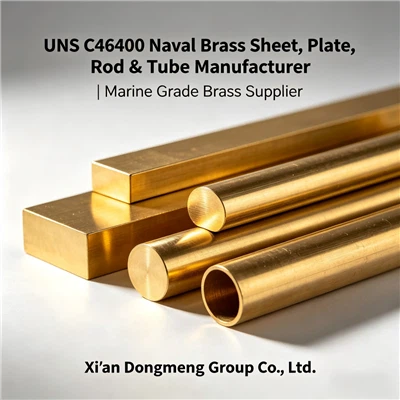

C46400 (UNS C46400) and CW712R are both tin-modified naval brass alloys (Cu-Zn-Sn system) designed for seawater corrosion resistance and marine engineering applications.
However, they belong to two different international standard systems:
C46400 → ASTM / UNS (North American specification system)
CW712R → EN 12164 / EN 12165 (European specification system)
👉 In engineering practice, they are considered cross-standard naval brass grades, but they are not 100% chemically identical equivalents due to different compositional tolerances and product form control.
Chemical Composition Control Differences
| Element | C46400 (ASTM UNS) | CW712R (EN 12164/165) |
|---|---|---|
| Copper (Cu) | 59.0 – 62.0% | 58.0 – 62.0% |
| Zinc (Zn) | Balance | Balance |
| Tin (Sn) | 0.5 – 1.0% | 0.8 – 1.5% |
| Impurities (Pb/Fe) | Strictly limited (ASTM control) | Controlled but slightly more flexible depending on product form |
Metallurgical Interpretation
🔹 C46400 (ASTM)
Narrower composition window
Designed for predictable marine performance across supply chain
Strong emphasis on standard reproducibility
🔹 CW712R (EN)
Slightly higher tin allowance in some product forms
Optimized for European machining bar production (EN 12164 focus)
More flexible industrial manufacturing tolerance
Microstructure & Corrosion Mechanism
Both alloys share a similar α + β duplex brass structure, but performance differences arise from tin distribution and phase stability:
Key mechanism:
Tin (Sn) stabilizes α-phase Cu-rich matrix
Reduces electrochemical potential difference between phases
Suppresses selective zinc dissolution (dezincification)
Critical Engineering Difference
| Behavior | C46400 | CW712R |
|---|---|---|
| Dezincification resistance | Very high (stable ASTM control) | Very high (may vary slightly by producer) |
| Long-term seawater stability | Highly consistent | Slightly dependent on EN manufacturer control |
| Stress corrosion sensitivity | Low–moderate | Low–moderate |
Mechanical Property Behavior (Typical Range)
| Property | C46400 | CW712R |
|---|---|---|
| Tensile Strength | 380–550 MPa | 350–520 MPa |
| Yield Strength | 125–350 MPa | 120–320 MPa |
| Elongation | 15–50% | 20–45% |
| Hardness | 55–85 HB | 50–80 HB |
Engineering Insight
C46400 tends to have slightly more standardized mechanical repeatability
CW712R may show slightly wider property dispersion depending on EN product form (rod/bar vs forged)
Application Standardization Differences
🚢 C46400 (ASTM Ecosystem)
Used primarily in:
US Navy specifications
Offshore oil & gas systems
ASTM-based global EPC projects
Heat exchangers & seawater systems
👉 Strong advantage: engineering specification stability
⚙️ CW712R (EN Ecosystem)
Used primarily in:
European shipbuilding industry
EN 12164 precision bar machining
Mechanical engineering components
Industrial valve & pump systems
👉 Strong advantage: machinability-oriented supply chain
Can C46400 and CW712R be substituted?
👉 Yes, but not automatically.
Substitution depends on:
Engineering code (ASTM vs EN project requirement)
Certification requirement (3.1 / ABS / DNV / Lloyd's)
Product form (bar, plate, forging)
Safety factor of application (marine vs industrial)
Selection Engineering Logic
Choose C46400 when:
ASTM / ASME / US specification required
Offshore oil & gas systems
High corrosion consistency requirement
Strict QA / traceability needed
Choose CW712R when:
EN / DIN / European standard required
Machined brass components (bars/rods)
Industrial valve & mechanical systems
EU supply chain procurement
Conclusion
C46400 and CW712R are both tin-bearing naval brass alloys designed for seawater service, sharing similar corrosion mechanisms and mechanical behavior.
However, the key engineering differences are:
📘 Standard system (ASTM vs EN)
🧪 Composition tolerance control
🏭 Product form optimization (casting vs machining focus)
📦 Certification ecosystem
👉 In professional engineering terms:
CW712R is the EN-standard counterpart family of naval brass, while C46400 is the ASTM-controlled reference grade with tighter specification consistency.