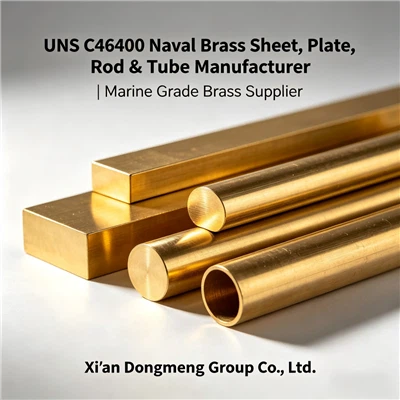

Brass and naval brass are both copper-based alloys widely used in industrial manufacturing. However, they are designed for very different service environments. While standard brass is commonly used for general engineering and decorative applications, naval brass (such as C46400) is specifically engineered for marine and seawater environments where corrosion resistance is critical.
Understanding the difference is essential for engineers, buyers, and procurement teams when selecting materials for long-term performance and cost efficiency.
What is Brass?
Brass is a copper-zinc alloy (Cu-Zn) with varying zinc content, typically ranging from 5% to 40%.
Key characteristics of brass:
Good machinability
Attractive appearance (gold-like color)
Moderate corrosion resistance
Low to medium strength
Common grades:
C26000 (Cartridge Brass)
C36000 (Free-cutting Brass)
Typical applications:
Electrical components
Plumbing fittings
Decorative hardware
Fasteners and connectors
👉 Standard brass is mainly used in non-marine and low-corrosion environments.
What is Naval Brass?
Naval brass is a modified brass alloy that contains approximately 1% tin (Sn) in addition to copper and zinc. A common grade is C46400 (CuZn39Sn1).
Key characteristics:
Excellent seawater corrosion resistance
High resistance to dezincification
Good strength and toughness
Stable long-term marine performance
Common grades:
C46400 (UNS C46400)
CuZn39Sn1 (EN equivalent)
Typical applications:
Shipbuilding components
Marine hardware and fasteners
Seawater piping systems
Heat exchangers and condensers
Offshore engineering equipment
👉 Naval brass is designed specifically for marine and chloride-rich environments.
Brass vs Naval Brass
| Property | Brass (e.g., C36000) | Naval Brass (C46400) |
|---|---|---|
| Base Composition | Cu + Zn | Cu + Zn + Sn (~1%) |
| Corrosion Resistance | Moderate | Excellent (marine grade) |
| Dezincification Resistance | Poor | High |
| Strength | Medium | Medium-High |
| Machinability | Excellent | Good |
| Seawater Performance | Not suitable | Highly suitable |
| Cost | Lower | Slightly higher |
Why Naval Brass Performs Better in Marine Environments
The key difference is tin (Sn) addition.
🧠 Metallurgical mechanism:
Tin stabilizes the α-phase structure
Reduces electrochemical potential difference
Forms a protective corrosion-resistant surface layer
👉 This significantly reduces dezincification corrosion, which is the main failure mode of standard brass in seawater.
Application-Based Selection Guide (Engineering Insight)
Choose Brass (C36000 / C26000) when:
Dry or indoor environments
Electrical or decorative components
Low corrosion exposure
Cost-sensitive applications
Choose Naval Brass (C46400) when:
Seawater exposure is involved
Marine or offshore systems
Long-term corrosion resistance is required
Mechanical reliability is critical
Cost vs Performance Consideration
Brass = lower cost, general-purpose material
Naval brass = higher cost but significantly longer service life in marine conditions
👉 In engineering practice, naval brass often reduces lifecycle cost due to fewer replacements and failures.
Conclusion
The main difference between brass and naval brass lies in composition and corrosion resistance performance.
Brass is a general-purpose copper-zinc alloy
Naval brass (C46400) is a marine-grade alloy enhanced with tin for seawater resistance
👉 For marine, offshore, and seawater applications, naval brass is the technically and economically superior choice over time.