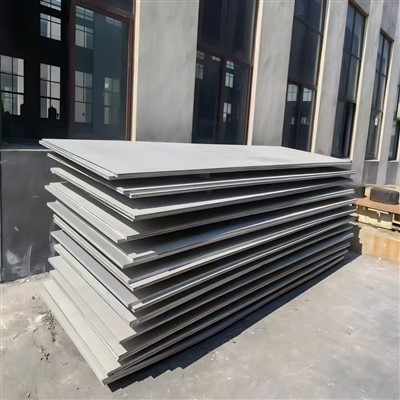

18-10 Stainless Steel (often referred to as Type 304)
Composition: Approximately 18% chromium and 10% nickel.
Strengths:
Good formability - easy to bend and shape.
Excellent weldability.
Good general corrosion resistance - suitable for most everyday applications.
Affordable compared to 316 stainless steel.
Weaknesses:
Less resistant to pitting corrosion compared to 316, especially in environments with high chloride content (salt water, some chemicals).
Composition: Approximately 16-18% chromium, 10-14% nickel, and 2-3% molybdenum.
Strengths:
Superior corrosion resistance, particularly to chlorides and other harsh chemicals.
Excellent for marine environments and applications exposed to salt water.
Good formability and weldability (although slightly less than 18-10).
Weaknesses:
More expensive than 18-10 stainless steel.

DONGMENG STEEL CO., LTD
Xi'an Dongmengsteel - Your Preferred Steel Stockist Xi'an Dongmengsteel is the largest steel stockist in western China, committed to providing high-quality Steel plate, steel coil, steel strip, steel pipe, steel rod, steel wire products to global customers.
high quality
Advanced Equipment
Professional Team
One-Stop Solution
high quality
advanced equipment
professional team
global shipping
We are committed to providing our customers with an exceptional buying experience. Our knowledgeable and friendly sales team is always available to assist you in selecting the right hookah foil for your needs. We offer prompt shipping and secure payment options to ensure a smooth and hassle-free purchase.
Our address
7th Floor, Fortune Building, Sanqiao Street, Weiyang District, Xi'an City, Shaanxi Province
Phone Number
+86 17782538807
office@dongmjd.com

Martensitic Stainless Steels: These steels, like Type 410 and 17-4 PH, are known for their high tensile strength and hardness. They achieve this strength through heat treatment processes. However, they are generally less corrosion resistant than austenitic steels like 304 and 316. They are often used in applications requiring high strength and wear resistance, such as cutlery, gears, and shafts.
Precipitation-hardening Stainless Steels: These steels, like 17-4 PH (mentioned earlier), gain their strength through a process called precipitation hardening. This allows them to be strong while still being relatively corrosion resistant. They are used in high-performance applications like aerospace components, fasteners, and golf clubs.
High-Nitrogen Stainless Steels: These steels, like Type 201 and UNS S32300, achieve high strength through the addition of nitrogen. They offer a good balance of strength, corrosion resistance, and affordability compared to some other high-strength options. They are used in applications like automotive parts and construction materials.
Here are some factors to consider when choosing a high-strength stainless steel:
- Type of strength needed: Is tensile strength, yield strength, or hardness most important?
- Corrosion resistance requirements: How important is it for the steel to resist corrosion?
- Formability and weldability: Will the steel need to be shaped or welded? (Martensitic steels can be more challenging to form and weld.)
- Cost: High-strength stainless steels can be more expensive than some other types.
By considering these factors, you can select the best grade of stainless steel for the specific strength requirements of your application.
316 stainless steel is more expensive than some other types, like 304 stainless steel, due to several factors:
Higher Alloy Content: 316 stainless steel contains additional elements compared to 304. Most notably, it has 2-3% molybdenum, which is more expensive than the chromium and nickel found in both grades. Molybdenum enhances the material's resistance to pitting corrosion, especially from chlorides (like salt water).
More Complex Manufacturing Process: The presence of molybdenum in 316 stainless steel requires adjustments during the steelmaking process to ensure proper distribution of the element and achieve the desired properties. This can add complexity and potentially increase production costs.
Higher Demand: 316 stainless steel is widely used in applications demanding superior corrosion resistance, such as marine environments, chemical processing, and food processing. This higher demand can contribute to a slightly higher price point compared to more general-purpose steels like 304.
| Feature | 304 Stainless Steel (UNS S30400) | 316 Stainless Steel (UNS S31600) |
| Typical Composition | 18% Chromium, 8-10% Nickel | 16-18% Chromium, 10-14% Nickel, 2-3% Molybdenum |
| Corrosion Resistance | Good general resistance | Superior resistance, especially to chlorides |
| Applications | Kitchenware, appliances, architectural panels | Marine environments, chemical processing, food processing |
| Cost | Lower | Higher |
18-8 and 316 are both common designations for types of stainless steel, but there are some key differences between them. Here's a breakdown:
Composition:
18-8: This is a general term referring to stainless steel with roughly 18% chromium and 8% nickel content. It's most commonly synonymous with Type 304 stainless steel (UNS S30400) according to the American Iron and Steel Institute (AISI) standard designation system.
316: This refers to a specific type of stainless steel with a slightly different composition than 18-8. It typically contains 16-18% chromium, 10-14% nickel, and additionally, 2-3% molybdenum.
Key Difference:
The main difference lies in the presence of molybdenum (Mo) in 316 stainless steel. This element significantly enhances its corrosion resistance, particularly against pitting corrosion caused by chlorides (like salt water).
Corrosion Resistance:
18-8 (Type 304): Offers good general corrosion resistance but is more susceptible to pitting corrosion in environments with high chloride content.
316: Provides superior corrosion resistance, especially to chlorides and other harsh chemicals. It's the preferred choice for marine environments and applications exposed to salt water.
Applications:
18-8 (Type 304): Due to its good formability, weldability, and affordability, it's widely used in various applications where general corrosion resistance is sufficient. Examples include kitchenware, appliances, architectural panels, and automotive trim.
316: With its superior corrosion resistance, 316 is ideal for applications like marine equipment, chemical processing equipment, food processing equipment, and other environments with high salt or harsh chemicals.
Cost:
18-8 (Type 304): Generally less expensive due to its simpler composition and wider production.
316: Slightly more expensive due to the additional molybdenum content and potentially more complex manufacturing process.
In summary:
If you need good general corrosion resistance, affordability, and good formability, 18-8 (Type 304) is a suitable choice.
If superior corrosion resistance, especially to chlorides, is crucial, 316 stainless steel is the better option, despite the slightly higher cost.
420 Stainless Steel:
Strengths:
High Strength and Hardness: 420 stainless steel is a martensitic stainless steel, known for its exceptional strength and hardness after heat treatment. This makes it suitable for wear-resistant applications like cutlery, blades, and gears.
Good Corrosion Resistance: While not as corrosion resistant as 316, 420 offers decent resistance in mild environments.
Affordability: 420 is generally less expensive than 316 due to its simpler composition.
Weaknesses:
Lower Corrosion Resistance: Compared to 316, 420 is more susceptible to corrosion, especially in harsh environments with chlorides or strong chemicals.
Limited Formability: Due to its high hardness, 420 is more challenging to form or bend compared to 316.
Lower Weldability: Welding 420 requires special techniques to avoid cracking.
316 Stainless Steel:
Strengths:
Superior Corrosion Resistance: 316 stainless steel offers excellent corrosion resistance, especially to chlorides and other harsh chemicals. This makes it ideal for marine environments and applications exposed to salt water.
Good Formability and Weldability: 316 is relatively easy to form and weld compared to 420.
Good Strength: While not as strong as 420 in its base form, 316 can be work-hardened to achieve good strength levels.
Weaknesses:
Lower Strength (compared to hardened 420): In its base form, 316 is not as strong or hard as heat-treated 420 stainless steel.
Higher Cost: Due to the additional molybdenum content and potentially more complex manufacturing process, 316 is generally more expensive than 420.
| Feature | 420 Stainless Steel | 316 Stainless Steel |
| Composition | Primarily chromium (12-14%) | Chromium (16-18%), Nickel (10-14%), Molybdenum (2-3%) |
| Strength | High (after heat treatment) | Good (can be work-hardened) |
| Hardness | High | Moderate |
| Corrosion Resistance | Good (mild environments) | Excellent |
| Formability | Limited | Good |
| Weldability | More challenging | Good |
| Cost | Lower | Higher |
| Applications | Cutlery, blades, gears | Marine equipment, chemical processing, food processing |
Yes, 304 stainless steel is generally considered better for machining compared to 316 stainless steel. Here's why:
Machinability:
304: Due to its lower chromium and nickel content compared to 316, 304 has better machinability. It offers several advantages:
Easier chip formation: 304 produces shorter, more manageable chips during machining, leading to smoother cuts and less tool wear.
Lower work hardening: 304 work hardens less during machining, meaning it requires less force to cut through the material, reducing energy consumption and extending tool life.
Overall faster machining: The combination of easier chip formation and lower work hardening allows for faster machining speeds and improved efficiency.
Application requirements: If the machined part needs superior corrosion resistance (especially to chlorides), then 316 might be necessary despite the machining challenges.
Machinist experience: Experienced machinists can often work with 316 effectively using proper techniques and tooling.
| Feature | 304 Stainless Steel | 316 Stainless Steel |
| Machinability | Better | More challenging |
| Chip formation | Shorter, manageable | Longer, stringier |
| Work hardening | Lower | Higher |
| Machining speed | Faster | Slower |
| Corrosion resistance | Good | Excellent |
| Cost | Lower | Higher |