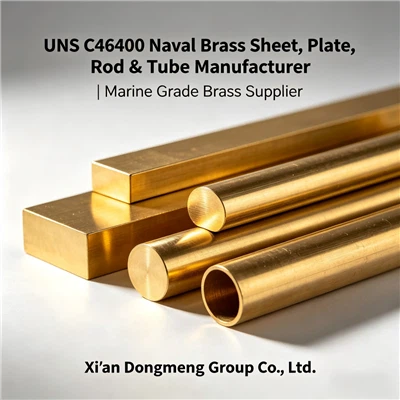

When selecting marine-grade copper alloys, C46700 Naval Brass and C46400 Naval Brass are two commonly compared materials. While both are designed for seawater environments, their chemical composition, corrosion behavior, and application focus differ significantly.
This guide provides a professional, engineering-level comparison to help buyers, engineers, and distributors choose the right alloy for marine, offshore, and industrial use.

What is C46400 Naval Brass?
C46400 is the most widely used traditional naval brass, classified as a copper–zinc–tin alloy (CuZnSn).
Key Characteristics:
~60% Copper, ~39% Zinc, ~1% Tin
Duplex (α + β) structure → high strength
Excellent resistance to:
Seawater corrosion
Dezincification
Stress corrosion cracking
Why Tin Matters:
The ~1% tin addition is critical-it significantly improves resistance to saltwater corrosion and prevents zinc loss.
👉 In short:
C46400 = Classic marine brass (cost-effective, reliable, widely standardized)
What is C46700 Naval Brass?
C46700 is a more advanced marine brass, typically categorized as a copper–zinc–aluminum alloy (CuZnAl).
Key Characteristics:
Contains aluminum instead of tin
Often designated as:
CuZn23Al3
Admiralty / Aluminum naval brass
Designed for:
Higher strength
Enhanced erosion resistance
Severe seawater conditions
Key Advantages of Aluminum Addition:
Better erosion-corrosion resistance
Improved strength at high flow rates
Enhanced performance in:
Desalination plants
Heat exchangers
Pump systems
👉 In short:
C46700 = Upgraded naval brass (higher performance, more aggressive environments)
C46700 vs C46400 – Chemical Composition
| Element | C46400 Naval Brass | C46700 Naval Brass |
|---|---|---|
| Copper (Cu) | 59–62% | ~70–75% (typical range) |
| Zinc (Zn) | Balance (~37–40%) | Lower than C46400 |
| Tin (Sn) | 0.5–1.0% | ❌ Not present |
| Aluminum (Al) | ❌ | ~2–3% |
| Alloy Type | CuZnSn | CuZnAl |
Key Insight:
C46400 → Tin-based corrosion protection
C46700 → Aluminum-based corrosion + erosion resistance
Mechanical Properties Comparison
| Property | C46400 | C46700 |
|---|---|---|
| Strength | High | Higher |
| Hardness | Moderate | Higher |
| Wear Resistance | Good | Excellent |
| Machinability | Fair (~30%) | Lower (harder alloy) |
| Formability | Good (hot working) | More difficult |
👉 Conclusion:
C46700 is stronger and more wear-resistant, but C46400 is easier to machine and fabricate.
Corrosion Resistance Comparison
| Environment | C46400 | C46700 |
|---|---|---|
| Seawater | Excellent | Excellent+ |
| Dezincification | Very good | Excellent |
| Erosion (high flow) | Moderate | Superior |
| Biofouling resistance | Good | Better |
| SCC resistance | Good | Excellent |
Key Difference:
C46400 excels in general marine conditions
C46700 performs better in high-velocity / aggressive seawater systems
Applications Comparison
C46400 Typical Uses:
Marine fasteners
Valve stems & pump parts
Heat exchanger plates
Ship hardware
C46700 Typical Uses:
Condenser tubes
Desalination systems
Pump shafts & impellers
Offshore heat exchangers
Key Differences Summary
| Factor | C46400 | C46700 |
|---|---|---|
| Alloy System | Cu-Zn-Sn | Cu-Zn-Al |
| Cost | Lower | Higher |
| Strength | High | Higher |
| Corrosion Resistance | Excellent | Superior |
| Erosion Resistance | Moderate | Excellent |
| Machinability | Better | Worse |
| Typical Use | General marine | High-performance marine |
Which One Should You Choose?
Choose C46400 if:
You need cost-effective marine brass
Applications include:
Fasteners
Valves
General seawater exposure
You require good machinability
Choose C46700 if:
You are dealing with:
High flow seawater
Erosion / cavitation conditions
Applications include:
Heat exchangers
Condensers
Desalination systems
You need longer service life under harsh conditions
Expert Insight
In real-world marine engineering:
C46400 remains the industry standard naval brass due to its balance of cost, availability, and corrosion resistance.
C46700, however, is increasingly preferred in modern offshore and desalination projects, where erosion-corrosion is the dominant failure mode rather than simple corrosion.
👉 This shift reflects a broader material trend:
From tin-based brasses → aluminum-enhanced high-performance alloys
FAQ – C46700 Naval Brass vs C46400
1. What is the main difference between C46700 and C46400?
The core difference lies in alloying elements:
C46400 is a tin-containing naval brass (Cu-Zn-Sn)
C46700 is an aluminum-containing naval brass (Cu-Zn-Al)
👉 This leads to better erosion resistance and higher strength in C46700, while C46400 offers better machinability and lower cost.
2. Which alloy has better corrosion resistance in seawater?
Both alloys perform well in seawater, but:
C46400 → excellent for general marine environments
C46700 → superior in high-velocity or turbulent seawater systems
👉 If erosion-corrosion is a concern, C46700 is the better choice.
3. Is C46700 stronger than C46400?
Yes.
C46700 generally has higher strength and hardness due to aluminum addition, making it more suitable for:
Pump shafts
Condensers
High-load marine components
4. Which alloy is easier to machine?
C46400 is easier to machine.
C46400 → better machinability, easier for mass production
C46700 → harder, more wear on tools
👉 For CNC machining and fastener production, C46400 is preferred.
5. Which material is more cost-effective?
C46400 is more cost-effective due to:
Wider availability
Easier processing
Lower alloying cost
👉 C46700 is more expensive, but offers longer service life in harsh environments.
6. Can C46700 replace C46400?
Yes, in many cases-but not always necessary.
Replace with C46700 when:
High flow rate seawater
Erosion or cavitation risk
Keep C46400 when:
Standard marine hardware
Budget-sensitive projects
7. Which alloy is better for heat exchangers?
C46700 → better for high-performance heat exchangers and condensers
C46400 → suitable for general-purpose heat exchange systems
8. What industries use C46400 vs C46700?
C46400 Applications:
Marine hardware
Valves & fasteners
Shipbuilding components
C46700 Applications:
Desalination plants
Offshore platforms
Power plant condensers
9. Does aluminum make C46700 better than tin-based brass?
Not universally-but in high-flow and erosion-prone systems, yes.
Tin (C46400) → protects against dezincification
Aluminum (C46700) → improves erosion + mechanical strength
👉 Different mechanisms, different advantages.
10. Which alloy should I choose?
Quick selection guide:
Choose C46400 👉 cost-effective, standard marine use
Choose C46700 👉 high-performance, aggressive seawater systems