

Xi'an Dongmeng Group Co., Ltd. is one of the most reliable manufacturers and suppliers of deformed rebar in China, also supports customized service. With abundant experience, we warmly welcome you to wholesale cheap products in stock here and get free sample from our factory. For price consultation, contact us.
What are the points that B-side buyers of steel bars for construction usually pay attention to?
Construction rebar steel is a popular product among B2B buyers engaged in building, infrastructure, and construction projects. Some key features that B2B buyers may focus on when considering this product could include the durability, strength, and flexibility of the steel, its ability to resist corrosion and weathering, and its compliance with industry standards and regulations. Quality assurance, logistics, and pricing may also be important factors for B2B buyers to consider when sourcing construction rebar steel.
High durability and corrosion resistance
Construction rebar steel is known for its high durability and corrosion resistance. It is designed to withstand the long-term effects of exposure to harsh outdoor conditions, including moisture, sunlight, and chemicals. Rebar steel is commonly used in construction projects because it has a long lifespan and can maintain its strength and integrity for decades even with heavy loads and exposure to the elements. In addition, it is resistant to rust and other forms of corrosion, which makes it an ideal choice for structures that need to withstand heavy rain, saltwater, or other harsh environments.
There are many models of Construction rebar steel, the following are some of them:
Standard models: HRB335, HRB400, HRB500, etc. Longitudinal thread type: HRB400E, HRB500E, etc. Steel mesh model: D6, D8, D10, D12, D14, D16, D18, D20, etc. U-shaped model: 8U, 10U, 12U, 14U, 16U, 18U, etc. Round steel model: Ф6, Ф8, Ф10, Ф12, Ф14, Ф16, Ф18, Ф20, etc. These models are mainly distinguished by different steel grades, steel components and physical and mechanical performance indicators.
China's domestic Construction Rebar Steel
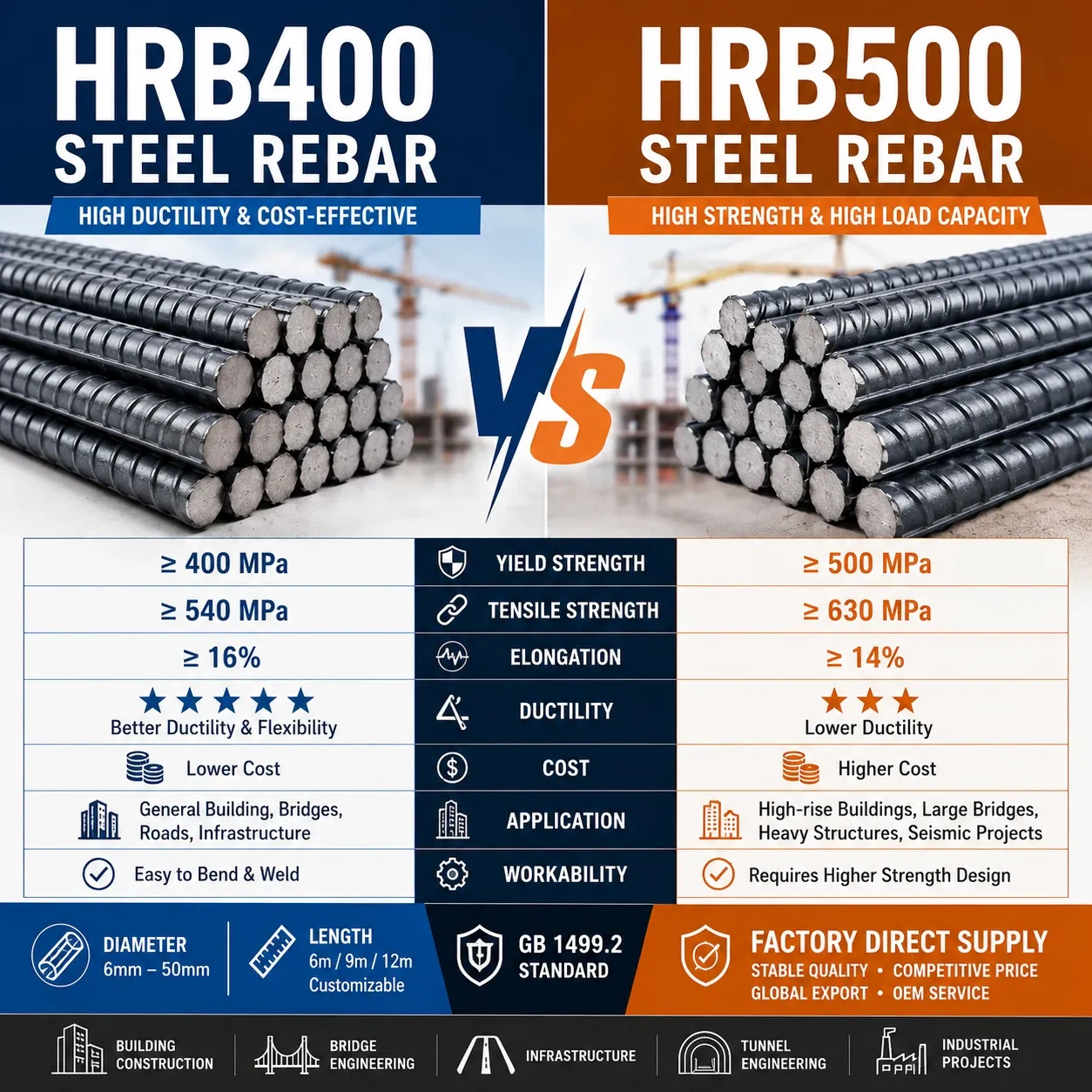
China's domestic Construction Rebar Steel (construction steel bar) is mainly distinguished according to different standards. The following are some common steel bar models and standards: HRB335: Ordinary hot-rolled steel bars specified in the national standard GB1499.2-2018, with a tensile strength of 335MPa. HRB400: Ordinary hot-rolled steel bars specified in the national standard GB1499.2-2018, with a tensile strength of 400MPa. HRB500: Ordinary hot-rolled steel bars specified in the national standard GB1499.2-2018, with a tensile strength of 500MPa. HPB235: cold-drawn steel bar specified in the national standard GB1499.2-2007, with a tensile strength of 235MPa. HPB300: cold-drawn steel bar specified in the national standard GB1499.2-2007, with a tensile strength of 300MPa. HPB335: cold-drawn steel bar specified in the national standard GB1499.2-2007, with a tensile strength of 335MPa. It should be noted that there may be differences in the types and standards of steel bars in different countries.
In the U.S. construction industry, common concrete rebar types include:
ASTM A615 Grade 40 ASTM A615 Grade 60 ASTM A706 Grade 60 ASTM A767 Grade 60
The following are some common steel bar types and their corresponding international standards:
HRB335/400/500: Chinese standard steel bar, also known as hot-rolled ribbed steel bar. ASTM A615 Gr. 40/60/75: American Standard Steel Bar, also known as Plain Hot Rolled Ribbed Bar. BS4449 Grade 250/460: British Standard Steel Bar, also known as Hot Rolled Ribbed Steel Bar. DIN 488 B500B: German standard steel bar, also known as hot-rolled ribbed steel bar. JIS G3112 SD345/490: Japanese standard steel bar, also known as hot-rolled ribbed steel bar. The specific chemical composition, mechanical properties and size requirements of these steel bar types are different, so in the specific construction project, the appropriate steel bar material should be selected according to the design requirements.
"Please provide us with the steel grade, desired thickness, dimensions, quantity, and any specific requirements you have in mind, so we can offer you an accurate and tailored quote for your review."
| Product name | HPB300 HRB400 HRB500 China Manufacturers Iron Steel Rebar |
| Diameter | φ6,φ8,φ10,φ12,φ14,φ16,φ18,φ20,φ22,φ25,φ32,φ36,φ38φ40,φ50 |
| Length | 6M, 9M, 12M and support cutting(accroding to the buyer's request) |
| Surface coating | Black steel and carbon steel |
| Packing | Standard packing for sea freight or air freight |
| Payment terms | T/T or L/C |
| Application | Construction, Bridge building, civil house building, etc. |
Different steel grades
There are quite a few grades of steel bars available for different purposes. These steel grades vary in composition and purpose.
GB1499.2-2007
GB1499.2-2007 is the European standard steel bar. There are different grades of reinforcement in this standard. Some of them are HRB400, HRB400E, HRB500 and HRB500E grade threaded steel bars. Generally, the threaded steel bars in the GB1499.2-2007 standard are made by hot rolling method, which means these are the most common type of threaded steel bars. They come in different lengths and sizes, ranging from 6 mm in diameter to 50 mm in diameter. In terms of length, 9 meters and 12 meters are common sizes.
BS4449
BS4449 is another standard for deformed steel bars. It is also differentiated according to European standards. In terms of manufacturing, the steel bars in this standard are also hot rolled, which means that they are also used for general purposes, i.e. common construction projects. These deformed bars are also available in diameters ranging from 12mm to 30mm. Their common lengths are 9 meters and 12 meters. However, there can be significant differences.
ASTM A615
Different from the first two, ASTM A615 is a deformed steel standard classified according to American standards. The diameter of these steel bars is usually between 9.5mm and 43mm, and the length is between 6m and 12m. Typically, steel bars complying with this standard are low-deformation or plain carbon steel. The grades within this standard are Grade 40, Grade 60, Grade 75 and Grade 80.
Product type

Deformed Bar
Rebar or rebar is vital in construction projects, especially when these projects use concrete to build structures. Concrete structures are strong, but their tensile strength is not very high. Due to this property, they break easily under pressure. To provide the missing tensile strength to the concrete structure, steel bars or rebar are used. Among the different types of steel bars, deformed steel bars are considered to be the best one. They have ribs, lugs or indentations on their surface, which allows them to better support the concrete, ultimately increasing the strength of the structure.
Plain Bar
Plain round steel bars (steel bars) supplied by Dongmeng Steel are commonly used to separate grids in concrete slabs and are used in a range of commercial and infrastructure applications. Plain round bars are used in a wide range of applications, from reinforced concrete piers, bored piles and footings to walls, beams, columns, slabs and precast products. InfraBuild rebar's round bars are Class N (normal ductility) bars and are available in 250 MPa diameters from 10–36mm.

Various Packaging
1, Bundle packaging
Bundling packaging is one of the most common forms of steel bar packaging, which bundles steel bars of the same specifications together at a certain length to form a compact bundle. This packaging form is suitable for situations that require large-scale storage and transportation, and has the advantages of good stability and high storage density. However, when used on construction sites, the bundling and packaging are not flexible enough, and mechanical equipment such as forklifts are needed to assist in handling.
2, Binding packaging
Binding packaging is the process of separately tying each steel bar with binding materials such as iron wire, avoiding the imbalance caused by tying steel bars of different lengths together. Binding packaging is more flexible than bundling packaging, and can be transported in batches as needed during use on construction sites. However, compared to bundled packaging, bundled packaging has a lower storage density and is not suitable for situations that require large-scale storage.
3, Plastic bag packaging
Putting steel bars into plastic bags for packaging is a relatively simple way to avoid surface oxidation and moisture issues, as well as issues such as misalignment and friction. At the same time, this packaging method is more convenient for handling and use, and is suitable for the construction needs of small-scale projects. However, plastic bag packaging cannot fix the steel bars well, resulting in common displacement of the steel bars during the packaging process.


Get A Quick Quote
1. Why is rebar used in concrete?
Concrete is strong in compression but weak in tension. Rebar is added to concrete structures to enhance their tensile strength, prevent cracking, and increase their overall durability and lifespan.
2. What are the different types of rebar?
Rebar comes in various shapes and sizes, including round, square, and deformed bars. Deformed bars have ribs or indentations on their surface to improve the bond between the steel and concrete.
3. How is rebar installed?
Rebar is typically installed in a grid pattern within concrete forms before the concrete is poured. The bars are tied together at intersections using wire or metal ties to create a sturdy reinforcement network.
4.How deep should rebar be in concrete?
The depth of rebar in concrete depends on factors such as the size and type of rebar, as well as the specific requirements of the project. In general, rebar should be positioned in the center of the concrete slab or structure to provide optimal reinforcement.
5. Can rebar rust?
Yes, rebar can rust if it's exposed to moisture and oxygen over time. Rust can weaken the steel and compromise the integrity of the concrete structure. To prevent rusting, rebar is often coated with epoxy or other corrosion-resistant materials, especially in environments with high humidity or salt exposure.
6.How do you calculate the amount of rebar needed for a project?
The amount of rebar required for a project depends on factors such as the size and design of the concrete structure, as well as the engineering specifications. Rebar is typically measured by weight or by the number of bars needed per unit length or area of concrete.
7. Is rebar recyclable?
Yes, rebar is made from recycled steel and can be recycled again at the end of its lifespan. Recycling rebar helps reduce the demand for virgin steel production and minimizes environmental impact.
8. What are common mistakes when installing rebar?
Common mistakes when installing rebar include improper placement or spacing, inadequate anchoring, insufficient cover (distance between the surface of the concrete and the outer surface of the rebar), and failure to properly tie or secure the bars together.
9. How long does rebar last in concrete?
The lifespan of rebar in concrete depends on factors such as the quality of the steel, the environmental conditions, and the level of corrosion protection. With proper installation and maintenance, rebar can last for decades or even the entire lifespan of the concrete structure.
Hot Tags: deformed rebar, China deformed rebar manufacturers, suppliers, factory, Grade 60 Steel Reinforcement Bars, 12mm Steel Rebar Supplier, Steel Rebar in Coil, Construction Rebar Suppliers, ASTM A615 Rebar, Deformed Steel Bar