


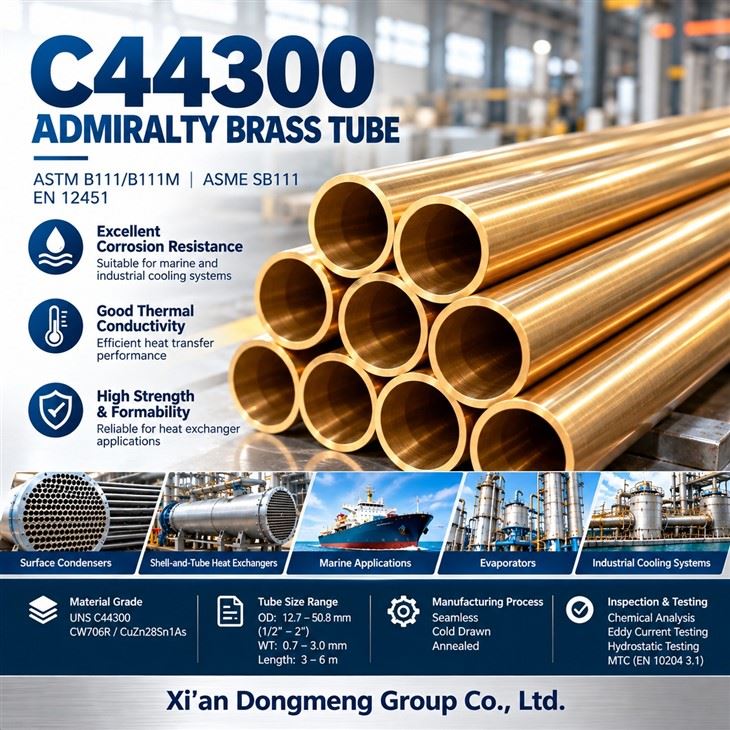
Xi'an Dongmeng Group Co., Ltd. is one of the most reliable manufacturers and suppliers of c44300 admiralty brass | uns c44300 tin brass for heat exchanger tubes in China, also supports customized service. With abundant experience, we warmly welcome you to wholesale cheap products in stock here and get free sample from our factory. For price consultation, contact us.
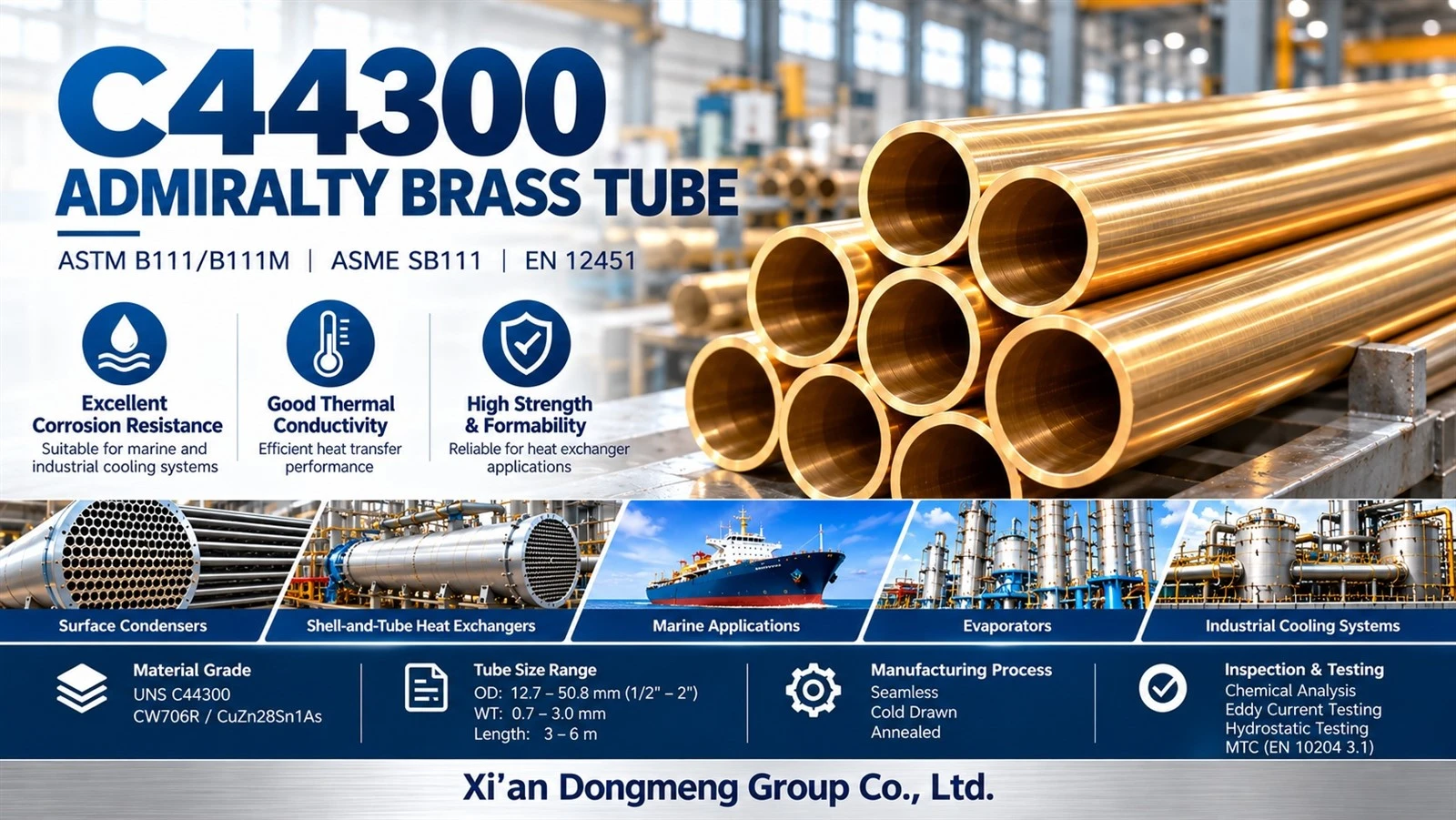
ASTM B111 C44300 Admiralty Brass Tubes | Condenser Tube Supplier
Xi'an Dongmeng Group Co., Ltd. supplies ASTM B111 C44300 Admiralty Brass seamless tubes for industrial condensers, shell-and-tube heat exchangers, evaporators, and cooling-water equipment.
UNS C44300, also known as Arsenical Admiralty Brass, is a copper-zinc-tin alloy containing a controlled arsenic addition to inhibit dezincification. The alloy combines useful thermal conductivity, good cold formability, and established performance in appropriately designed industrial cooling systems.
We support international distributors, heat exchanger manufacturers, engineering contractors, OEMs, and EPC procurement teams with project-specific tube dimensions, material specifications, inspection requirements, and export documentation.
Available supply options include straight seamless condenser tubes, cut-to-length tubing, and custom tube-processing arrangements, subject to technical review and manufacturing availability.
What Is C44300 Admiralty Brass?
C44300 Admiralty Brass is a wrought copper alloy consisting primarily of copper, zinc, and tin, with a small addition of arsenic.
It belongs to the family of inhibited Admiralty Brasses traditionally used in condenser and heat exchanger equipment.
The alloy typically contains approximately 71% copper, 28% zinc, and 1% tin.
Arsenic is deliberately added to inhibit dezincification, a corrosion mechanism that selectively removes zinc from brass and can progressively weaken the material.
Compared with ordinary uninhibited brass, C44300 provides improved resistance to this form of corrosion under suitable operating conditions.
The alloy is particularly relevant where equipment designers require:
Good thermal conductivity for industrial heat-transfer equipment.
Established condenser and evaporator tube applications.
Resistance to dezincification in compatible cooling-water environments.
Excellent cold-forming characteristics.
Compatibility with mechanical tube-expansion processes when the appropriate temper is selected.
A copper-alloy alternative for equipment originally designed around Admiralty Brass tubing.
Material suitability must always be evaluated against actual water chemistry, operating temperature, pressure, and flow conditions.
C44300 Admiralty Brass Tube Specifications
C44300 seamless condenser tubes are commonly manufactured to ASTM B111/B111M, which establishes requirements for copper and copper-alloy seamless condenser tubes and ferrule stock.
For condenser and heat exchanger projects, dimensional accuracy is important because tube outside diameter, wall thickness, straightness, and length affect equipment assembly and service reliability.
Available Tube Dimensions
| Parameter | Metric | Imperial |
|---|---|---|
| Common Outside Diameter | 12.7–50.8 mm | 1/2–2 in. |
| Extended OD Options | Subject to Specification | Subject to Specification |
| Common Wall Thickness | 0.7–3.0 mm | 0.028–0.118 in. |
| Common Straight Length | 3,000–6,000 mm | Approximately 10–20 ft |
| Custom Length | As Required | As Required |
| Tube Configuration | Straight Seamless Tube | Straight Seamless Tube |
| End Condition | Plain, Square-Cut, Deburred | Plain, Square-Cut, Deburred |
| Surface Condition | Clean Mill Finish / Specified Finish | As Ordered |
| Tube Temper | Annealed / Drawn Conditions | As Ordered |
ASTM B111/B111M covers seamless condenser tubes up to 80 mm (3-1/8 in.) in outside diameter.
Actual availability depends on the selected alloy, temper, dimensional combination, quantity, and applicable standard.
Common C44300 Condenser Tube Sizes
| Outside Diameter | OD (mm) | Example Wall Thickness Options | Typical Application |
|---|---|---|---|
| 1/2 in. | 12.70 | 0.7 / 0.9 / 1.0 mm | Compact Heat Exchangers |
| 5/8 in. | 15.88 | 0.9 / 1.0 / 1.2 mm | Industrial Cooling Equipment |
| 3/4 in. | 19.05 | 0.9 / 1.2 / 1.65 mm | Surface Condensers |
| 7/8 in. | 22.23 | 1.0 / 1.2 / 1.5 mm | Process Heat Exchangers |
| 1 in. | 25.40 | 1.0 / 1.5 / 2.0 mm | Power Plant Condensers |
| 1-1/4 in. | 31.75 | 1.2 / 1.5 / 2.0 mm | Industrial Heat Exchangers |
| 1-1/2 in. | 38.10 | 1.5 / 2.0 / 2.5 mm | Large Cooling Equipment |
| 2 in. | 50.80 | 1.5 / 2.0 / 3.0 mm | Process Condensers |
The dimensions above are illustrative procurement sizes, not a stock list or an indication that every diameter and wall-thickness combination is commercially available.
Dimensional Tolerances
For precision condenser applications, tolerances should be specified for the following characteristics:
Outside diameter.
Nominal or minimum wall thickness.
Wall-thickness variation.
Tube length.
Straightness.
Roundness where required.
Surface condition and tube-end preparation.
Acceptance tolerances must follow the applicable product standard and approved purchase specification.
Custom tolerance requirements can be evaluated against manufacturing and inspection capabilities.
Chemical Composition of C44300 Admiralty Brass
C44300 belongs to the copper-zinc-tin alloy family.
Its corrosion behavior is influenced by the combination of tin and the controlled arsenic addition.
C44300 Chemical Composition - Weight %
| Element | Symbol | Typical Specification Limits |
|---|---|---|
| Copper | Cu | 70.0–73.0% |
| Tin | Sn | 0.9–1.2% for the specified condenser tube reference |
| Arsenic | As | 0.02–0.06% |
| Lead | Pb | 0.07% Max. |
| Iron | Fe | 0.06% Max. |
| Zinc | Zn | Remainder |
Important: General C44300 alloy references may specify a tin minimum of 0.8%, while tubular-product requirements can differ. The governing material specification and edition must be confirmed before production and inspection.
Functions of the Main Alloying Elements
Copper (Cu)
Forms the base of the alloy and contributes to thermal conductivity, formability, and general corrosion behavior.
Zinc (Zn)
Contributes to the mechanical characteristics of brass and supports the production of economical engineering materials.
Tin (Sn)
Improves corrosion resistance in certain water environments and contributes to the performance of Admiralty Brass in heat-transfer applications.
Arsenic (As)
Acts as a dezincification inhibitor, reducing the tendency toward selective zinc removal.
For critical applications, the material's chemical composition should be verified through traceable chemical analysis and the applicable material certificate.
Mechanical Properties of C44300 Admiralty Brass
The mechanical properties of C44300 depend on the tube temper, manufacturing process, dimensions, and testing requirements.
Annealed tubing is commonly considered for applications requiring good ductility and subsequent fabrication.
Reference Mechanical Properties - Annealed C44300 Tubing
| Property | Reference Value |
|---|---|
| Material | UNS C44300 |
| Product Form | Seamless Condenser Tube |
| Temper | O61 - Annealed |
| Minimum Tensile Strength | 310 MPa (45 ksi) |
| Minimum Yield Strength | 105 MPa (15 ksi) |
| Cold Formability | Excellent |
| Relative Machinability | Approximately 30% of Free-Machining Brass |
Mechanical values are reference requirements associated with specified annealed tubing, not guaranteed properties for all product forms or tempers.
Effect of Material Temper
Annealed Condition
Provides good ductility and is commonly specified where tube expansion, forming, or other deformation operations are required.
Light-Drawn Condition
Provides a different balance of mechanical strength and formability for applications requiring moderate cold-working capability.
Hard-Drawn Condition
Provides increased strength and hardness but reduces the material's ability to undergo additional deformation.
The appropriate temper should be selected according to the heat exchanger design, tube expansion requirements, and governing material specification.
Physical Properties of C44300 Admiralty Brass
| Property | Typical Value |
|---|---|
| Density | 8.53 g/cm³ |
| Thermal Conductivity | Approximately 110 W/(m·K) |
| Electrical Conductivity | Approximately 25% IACS |
| Modulus of Elasticity | Approximately 110 GPa |
| Specific Heat Capacity | Approximately 0.38 kJ/(kg·K) |
| Thermal Expansion Coefficient | Approximately 20.2 × 10⁻⁶/K over 20–300°C |
| Solidus Temperature | Approximately 900°C |
| Liquidus Temperature | Approximately 935°C |
These values are general engineering reference data. They are not design allowable stresses, certified batch results, or guarantees of performance at elevated operating temperatures.
Thermal Conductivity and Heat Transfer
Thermal conductivity is an important characteristic when selecting tube materials for condensers and heat exchangers.
C44300 Admiralty Brass provides substantially higher thermal conductivity than many common stainless steel grades.
However, actual heat exchanger performance also depends on:
Tube wall thickness.
Heat-transfer surface area.
Cooling-water velocity.
Internal and external fouling resistance.
Operating temperature.
Fluid properties.
Equipment configuration.
A higher material thermal conductivity does not automatically guarantee higher total heat exchanger efficiency.
Corrosion Resistance of C44300 Admiralty Brass
C44300 was developed for applications requiring improved resistance to dezincification compared with uninhibited brasses.
Its corrosion resistance is useful in selected industrial cooling-water systems, but it must not be treated as universally resistant to seawater or aggressive chemical environments.
Dezincification Resistance
Dezincification occurs when zinc is selectively removed from brass under certain corrosive conditions.
This can leave behind a porous, copper-rich structure and reduce the remaining material's strength.
The controlled addition of arsenic in C44300 inhibits this mechanism.
This is one of the principal reasons Admiralty Brass is used in heat-transfer equipment.
Freshwater Cooling Systems
C44300 may be suitable for selected freshwater and treated cooling-water applications.
Operating conditions should be evaluated for dissolved oxygen, pH, dissolved salts, contamination, and the potential for deposit formation.
Brackish Water and Seawater
Admiralty Brass has a history of use in seawater-cooled condensers.
However, severe seawater conditions may require a more corrosion-resistant alloy.
Particular attention should be given to:
Water velocity and local turbulence.
Suspended solids and erosion-corrosion.
Ammonia contamination.
Sulfides and polluted seawater.
Stagnant or intermittently operated systems.
Deposit accumulation.
Galvanic interaction with other materials.
Ammonia and Stress-Corrosion Cracking
Copper-zinc alloys can be vulnerable to stress-corrosion cracking in certain ammonia-containing environments.
Residual stresses, chemical contamination, and exposure conditions can influence this risk.
For critical equipment, material selection and any necessary stress-relief requirements should be reviewed by the equipment designer.
Recommended Material Selection
For moderately demanding cooling-water applications, C44300 may provide an appropriate combination of thermal properties, established service experience, and material cost.
For aggressive marine environments, higher water velocities, or difficult water chemistry, C68700 Aluminum Brass or C70600 Copper-Nickel should be evaluated.
Final material selection should be based on operating data and applicable engineering requirements.
C44300 Admiralty Brass vs C44400, C68700 and C70600
Selecting the correct copper alloy can influence condenser reliability, maintenance requirements, and long-term operating costs.
| Property | C44300 | C44400 | C68700 | C70600 |
|---|---|---|---|---|
| Alloy Family | Admiralty Brass | Admiralty Brass | Aluminum Brass | Copper-Nickel |
| Main Additions | Tin + Arsenic | Tin + Antimony | Aluminum + Arsenic | Nickel + Iron |
| Dezincification Inhibition | Arsenic | Antimony | Arsenic | Different Alloy System |
| Thermal Conductivity | Relatively High | Relatively High | Relatively High | Lower |
| Typical Application | Condensers | Condensers | Marine Heat Exchangers | Seawater Cooling Systems |
| Main Selection Factor | Established Service Requirements | Material Specification | Flow and Corrosion Conditions | Demanding Marine Service |
C44300 vs C44400
Both alloys belong to the Admiralty Brass family.
C44300 contains arsenic as a dezincification inhibitor, whereas C44400 uses antimony.
Their applications may overlap, but their chemical requirements and material certifications are different.
They should not be substituted without engineering approval.
C44300 vs C68700 Aluminum Brass
C68700 contains aluminum and is commonly considered for marine condensers and cooling-water applications requiring improved resistance to certain erosion-corrosion conditions.
The appropriate alloy depends on the cooling-water chemistry, operating velocity, equipment design, and applicable material requirements.
C44300 vs C70600 Copper-Nickel
C70600 is a copper-nickel alloy containing approximately 90% copper and 10% nickel, together with controlled iron and manganese additions.
It is widely used in marine cooling and seawater systems.
Compared with C44300, C70600 is often selected for more demanding seawater conditions.
However, a change in material can affect heat-transfer calculations, mechanical design, cost, and compatibility with other equipment components.
Engineering Recommendation: Do not select condenser tube material based on corrosion resistance or initial price alone. Evaluate the full operating environment and relevant design requirements.
Applicable Standards and Material Designations
C44300 Admiralty Brass may be supplied or specified under different standards depending on product form and intended application.
Manufacturing Standards
| Standard | Description | Application |
|---|---|---|
| ASTM B111/B111M | Seamless Copper and Copper-Alloy Condenser Tubes | Straight Condenser Tubes |
| ASME SB111 | ASME Material Specification | Applicable Code-Related Equipment |
| ASTM B395/B395M | U-Bend Seamless Copper Alloy Heat Exchanger and Condenser Tubes | U-Bend Tubing |
| ASTM B135/B135M | Seamless Brass Tube | General Engineering Tube Applications |
| ASTM B359/B359M | Seamless Condenser and Heat Exchanger Tubes With Integral Fins | Finned Tubing |
| ASTM B171/B171M | Copper-Alloy Plate and Sheet | Applicable Plate and Tubesheet Materials |
| EN 12451 | Seamless Round Copper Alloy Tubes for Heat Exchangers | European Heat Exchanger Tubing |
| JIS H3300 | Copper and Copper Alloy Seamless Pipes and Tubes | Japanese-Specification Tubing |
Not every listed standard applies to every C44300 product form or order. Grade eligibility, dimensions, manufacturing method, and certification must be verified against the applicable standard edition.
International Material Designations
| Designation System | Material Designation |
|---|---|
| UNS | C44300 |
| CDA | Alloy 443 |
| Common Name | Admiralty Brass |
| Alternative Name | Arsenical Admiralty Brass |
| EN Number | CW706R |
| EN Symbol | CuZn28Sn1As |
| Traditional British Designation | CZ111 |
| JIS Corresponding Grade | C4430 |
International designations provide useful purchasing references, but they do not establish automatic equivalence of every composition limit, mechanical property, or inspection requirement.
Manufacturing and Processing
C44300 seamless condenser tubes are generally produced through controlled alloy preparation, seamless tube manufacturing, cold drawing, annealing, straightening, and inspection.
Typical Manufacturing Process
1. Raw Material Preparation
Copper and other alloying elements are prepared according to the selected chemical specification.
2. Tube Production
Seamless tube stock is produced using an appropriate manufacturing route.
3. Cold Drawing
The tube is processed toward the required outside diameter, wall thickness, and dimensional condition.
4. Heat Treatment
Annealing or other specified processing is performed to achieve the required material condition.
5. Straightening and Cutting
Tubes are straightened and cut according to the approved order dimensions.
6. Inspection and Testing
Chemical, dimensional, mechanical, and applicable nondestructive examinations are completed according to the agreed specification.
7. Identification and Packaging
Finished tubes are identified and protected for transportation.
The manufacturing route and associated tests depend on the product form, dimensions, temper, and governing specification.
Custom Processing Options
Project-specific processing may include:
Precision tube cutting.
Deburring and end preparation.
Special-length tubing.
Tube bending.
U-bend fabrication review.
Dimensional inspection to customer drawings.
Custom marking and packaging.
The feasibility of individual services is subject to technical confirmation.
Straight Tubes vs U-Bend C44300 Tubes
C44300 tubing can be considered for different heat exchanger configurations.
| Parameter | Straight Tubes | U-Bend Tubes |
|---|---|---|
| Configuration | Straight Length | Curved Return Bend |
| Typical Application | Surface Condensers | U-Tube Heat Exchangers |
| Common Material Standard | ASTM B111 | ASTM B111 Base Tube |
| Additional Specification | As Ordered | ASTM B395/B395M Where Applicable |
| Key Dimensions | OD, Wall, Length | OD, Wall, Bend Radius, Leg Length |
| Inspection Focus | Dimensions and Tube Integrity | Dimensions, Bend Quality and Tube Integrity |
| Customization | Cutting and End Preparation | Bend Geometry and Special Processing |
For U-bend applications, the purchaser should provide the required bend radius, leg lengths, tube dimensions, minimum wall requirements, and inspection criteria.
Bend thinning, ovality, residual stress, and heat treatment requirements should be evaluated as part of the tube fabrication specification.
Industrial Applications of C44300 Admiralty Brass Tubes
Power Plant Surface Condensers
C44300 tubing is used in selected surface condenser systems where cooling water removes heat from turbine exhaust steam.
Material selection should consider cooling-water quality, equipment operating conditions, and tube maintenance procedures.
Shell-and-Tube Heat Exchangers
Admiralty Brass tubes are used in heat-transfer equipment serving various industrial processes.
Tube dimensions, material condition, and expansion characteristics should be selected to match the heat exchanger design.
Industrial Evaporators
C44300 can be considered for evaporator applications requiring copper-alloy heat-transfer tubing.
Suitability depends on the composition and operating conditions of the process fluids.
Industrial Cooling Equipment
The alloy is used in selected industrial coolers and water-cooled process equipment.
Corrosion resistance, fouling behavior, and water-treatment conditions should be considered during material selection.
Marine Cooling and Condenser Equipment
Admiralty Brass has historical applications in marine heat-transfer equipment.
However, the alloy should only be specified for seawater service after reviewing the actual corrosion and erosion risks.
Replacement Condenser Tube Projects
C44300 tubing may also be supplied for maintenance and retubing projects where an existing condenser was designed for Admiralty Brass.
Replacement orders should identify the original material specification, tube dimensions, temper, tube-to-tubesheet connection method, and inspection requirements.
Inspection & Quality Assurance
Quality verification is important for condenser tubing because material defects, dimensional deviations, and tube leakage can affect equipment reliability.
Xi'an Dongmeng Group Co., Ltd. can coordinate material inspection and documentation requirements according to the approved purchase specification.
Inspection and Testing Options
| Inspection Item | Inspection Purpose |
|---|---|
| Chemical Composition Analysis | Verify Alloy Chemistry |
| Material Identification | Confirm Grade and Traceability |
| Tensile Testing | Verify Specified Mechanical Properties |
| Dimensional Inspection | Check OD, Wall Thickness and Length |
| Visual Surface Inspection | Examine Surface Condition |
| Eddy Current Testing | Detect Applicable Tube Discontinuities |
| Hydrostatic Testing | Verify Leak Integrity Where Specified |
| Pneumatic Testing | Alternative Testing Where Permitted |
| Expansion Testing | Evaluate Applicable Forming Requirements |
| Flattening Testing | Evaluate Applicable Tube Requirements |
| Residual Stress Evaluation | Assess Specified Material Requirements |
| Third-Party Inspection | Independent Verification |
| Material Test Certificate | Document Material and Test Results |
All testing methods, frequencies, acceptance limits, and certification requirements must follow the applicable product standard and agreed inspection plan.
Not every test is mandatory for every product condition.
Material Certification
Available documentation arrangements may include:
Material Test Certificate.
Chemical composition report.
Mechanical test results.
Dimensional inspection report.
Applicable nondestructive test records.
Heat or batch identification.
Packing list.
Third-party inspection records.
EN 10204 Type 3.1 documentation can be discussed where it is required by the purchase order.
Buyers should specify mandatory documentation before order confirmation.
Product Delivery Standards
To support international procurement, the following delivery requirements can be defined during the quotation and order-review process.
| Delivery Item | Specification or Arrangement |
|---|---|
| Material | UNS C44300 Admiralty Brass |
| Main Standard | ASTM B111/B111M |
| Tube Condition | As Specified in Purchase Order |
| Tube Dimensions | According to Approved Size Schedule |
| Dimensional Tolerance | Governing Standard or Approved Drawing |
| Tube Length | Standard or Custom |
| End Condition | Plain / Square-Cut / Deburred |
| Surface Condition | Clean and Protected |
| Material Identification | Grade, Dimensions and Traceability |
| Quality Inspection | Approved Inspection Requirements |
| Certification | MTC and Agreed Inspection Documents |
| Packaging | Protected Bundles or Export Wooden Cases |
| MOQ | Confirmed by Dimensions and Quantity |
| Lead Time | Confirmed After Technical and Commercial Review |
| Delivery Terms | EXW / FOB / CIF or Other Agreed Terms |
Export Packaging
Admiralty Brass tubes require suitable protection during storage, handling, and international transportation.
Packaging options may include:
Protective tube-end caps.
Bundling and separation materials.
Moisture-resistant wrapping.
Wooden export cases.
Reinforced packaging for long-length tubes.
Custom labels and traceability markings.
Packaging should be selected according to tube length, quantity, transportation method, and project requirements.
Why Choose Xi'an Dongmeng Group Co., Ltd.?
Industrial Copper Alloy Supply
We support customers sourcing copper alloys for condensers, heat exchangers, industrial cooling equipment, and engineering projects.
Technical Specification Review
Our team can review material grades, product dimensions, tube schedules, project drawings, and quality requirements before quotation.
Multiple Material Options
Buyers can inquire about Admiralty Brass, Aluminum Brass, and Copper-Nickel materials for different heat-transfer environments.
Custom Processing Coordination
Project-specific dimensions, cutting, bending, tube-end preparation, and packaging requirements can be reviewed according to manufacturing availability.
Inspection and Documentation Support
Material certification and applicable third-party inspection requirements can be coordinated during order confirmation.
International B2B Procurement
We work with distributors, OEM equipment manufacturers, engineering contractors, and industrial buyers requiring documented material supply and international shipping arrangements.
Frequently Asked Questions
1. What is C44300 Admiralty Brass?
C44300 is a copper-zinc-tin alloy containing a controlled arsenic addition to inhibit dezincification. It is commonly associated with condenser, evaporator, and heat exchanger tubing.
2. What is ASTM B111 C44300 tube?
ASTM B111 C44300 tube is seamless Admiralty Brass tubing manufactured according to the applicable ASTM B111/B111M requirements for condenser and heat exchanger applications.
3. Is C44300 Admiralty Brass suitable for seawater?
C44300 has historically been used in seawater-cooled equipment, but it is not suitable for every seawater environment. Water chemistry, flow velocity, contamination, temperature, and equipment design must be evaluated before selection.
4. What is the chemical composition of C44300?
C44300 typically contains 70–73% copper, approximately 1% tin, 0.02–0.06% arsenic, and zinc as the remainder. The exact limits depend on the governing product specification.
5. What is the difference between C44300 and C44400?
C44300 uses arsenic as a dezincification inhibitor, whereas C44400 uses antimony. Both are Admiralty Brass alloys, but their chemical specifications are different.
6. What is the European equivalent of C44300?
CW706R, commonly designated CuZn28Sn1As, is a corresponding European Admiralty Brass designation. The applicable EN standard must be reviewed before material substitution.
7. What sizes are available for C44300 condenser tubes?
Common condenser tube outside diameters include 12.7, 15.88, 19.05, 22.23, 25.4, 31.75, 38.1, and 50.8 mm. Wall thickness and length are selected according to project requirements.
8. Can C44300 tubes be supplied in U-bend configurations?
U-bend tube requirements can be reviewed according to the applicable product specification. Buyers should provide the bend radius, leg lengths, wall thickness, material condition, and inspection requirements.
9. What is the tensile strength of C44300?
For specified annealed C44300 condenser tubing, a commonly referenced minimum tensile strength is 310 MPa. Requirements for other tempers must be verified against the relevant standard.
10. How does C44300 compare with C70600 Copper-Nickel?
C44300 offers relatively high thermal conductivity and established condenser applications. C70600 is generally considered for more demanding marine cooling environments. Material selection must account for corrosion resistance, operating conditions, equipment design, and cost.
11. What inspection documents can be supplied?
Material Test Certificates, chemical analysis, mechanical test results, dimensional inspection reports, and applicable nondestructive testing records can be arranged according to the confirmed order. Third-party inspection requirements should be specified in advance.
12. What information is required to obtain a quotation?
Please provide the material grade, manufacturing standard, outside diameter, wall thickness, tube length, required temper, quantity, testing requirements, and destination. Drawings or technical specifications are recommended for custom condenser tube projects.
Request a Quote for C44300 Admiralty Brass Tubes
Looking for a reliable supplier of ASTM B111 C44300 Admiralty Brass seamless condenser tubes?
Xi'an Dongmeng Group Co., Ltd. supports industrial buyers requiring material specification review, custom tube dimensions, inspection documentation, and export delivery arrangements.
To receive a technical and commercial quotation, please send:
Material grade and applicable standard.
Outside diameter and wall thickness.
Straight length or U-bend drawing.
Required temper.
Order quantity.
Inspection and certification requirements.
Delivery destination.
Our team will review the specifications and provide a quotation based on the confirmed technical requirements.
Contact Us
Company: Xi'an Dongmeng Group Co., Ltd.
Email: office@dongmjd.com
Phone / WhatsApp: +86 15769214734
Address: Room 4107, Runfeng Building, Sanqiao New Street, Weiyang District, Xi'an City, Shaanxi Province, China
Send your C44300 condenser tube specifications, technical drawings, or material requirements to request a quotation.
Hot Tags: C44300 Admiralty Brass, ASTM B111 C44300 Tube, Admiralty Brass Tube Supplier, C44300 Condenser Tube, UNS C44300, Admiralty Brass Heat Exchanger Tube, ASME SB111 C44300, CuZn28Sn1As, CW706R, Seamless Brass Tubing, C44300 Copper Alloy, Admiralty Brass Manufacturer, UNS C70600 Copper Nickel Alloy, UNS C68700, UNS C44500 Copper Zinc Tin Alloys, ASTM B43 Seamless Red Brass Pipe, UNS C26800 Yellow Brass Copper Alloy, ASTM B88 Seamless Copper Water Tube


