
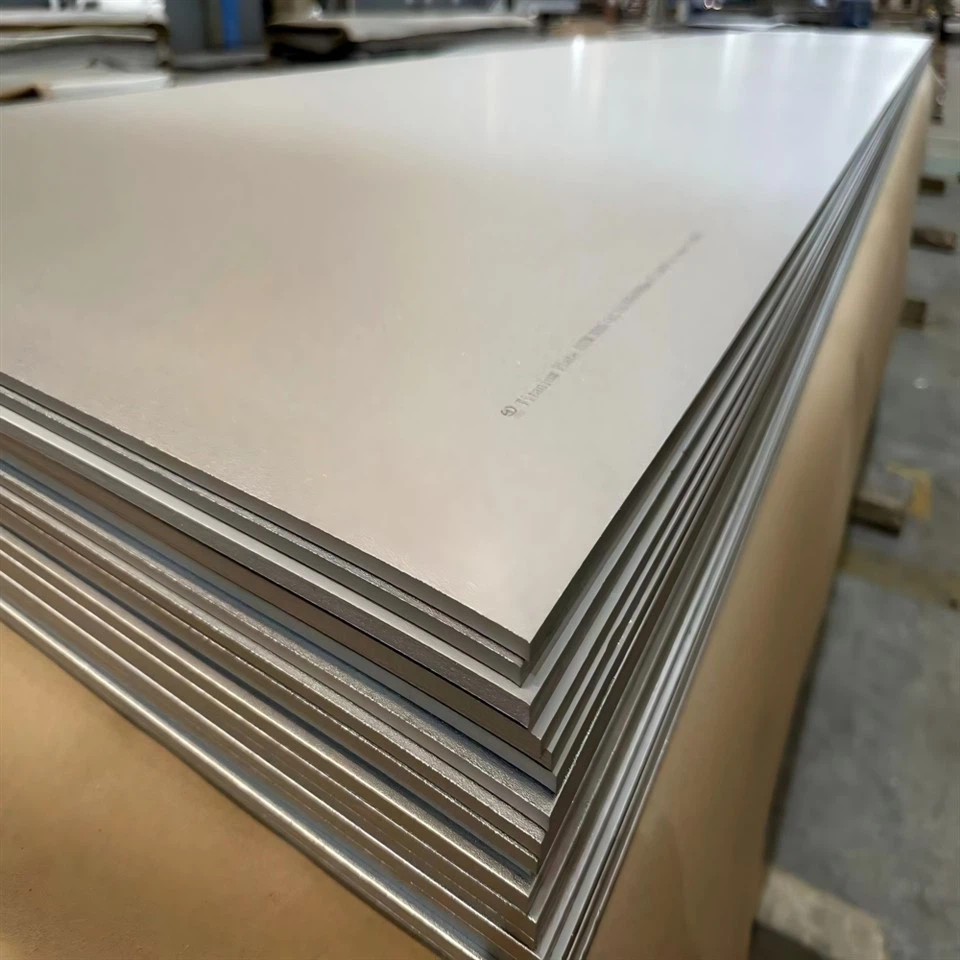
Xi'an Dongmeng Group Co., Ltd. is one of the most reliable manufacturers and suppliers of grade 2 titanium plate / sheet | high quality gr2 titanium sheet – astm b265 in China, also supports customized service. With abundant experience, we warmly welcome you to wholesale cheap products in stock here and get free sample from our factory. For price consultation, contact us.
Commercially Pure Titanium Plate and Sheet for Chemical Processing, Heat Exchangers, Marine Engineering and Industrial Fabrication
Xi'an Dongmeng Group Co., Ltd. supplies Grade 2 titanium plate and sheet (UNS R50400) for industrial manufacturers, equipment fabricators, engineering contractors and international distributors. Our titanium flat products are available to ASTM B265 and, where specified, ASME SB-265 requirements, with options for custom dimensions, surface finishing, cutting and material inspection.
Grade 2 titanium is a commercially pure titanium material recognized for its excellent resistance to seawater and many oxidizing chemical environments, combined with moderate strength, good ductility and weldability. These properties make it an established material for heat exchanger components, chemical processing equipment, desalination systems and corrosion-resistant fabricated assemblies.
We support project-based procurement with material grade verification, dimensional requirements, heat-number traceability, mill test certificates and export packaging.

What Is Grade 2 Titanium Plate?
Grade 2 titanium plate is a commercially pure titanium flat product manufactured primarily for applications requiring corrosion resistance, moderate mechanical strength and fabrication flexibility.
Unlike titanium alloys such as Grade 5 (Ti-6Al-4V), Grade 2 does not rely on intentional additions of aluminum and vanadium for strengthening. Its mechanical properties are influenced by controlled interstitial elements, particularly oxygen, as well as processing and annealing conditions.
Grade 2 occupies an intermediate position within the commercially pure titanium family. It offers higher strength than Grade 1 while retaining good formability and weldability.
Its protective titanium oxide film provides excellent corrosion resistance in many natural waters, chloride-containing solutions and oxidizing environments.
Why Is Grade 2 Titanium Widely Used?
Corrosion Resistance
Grade 2 titanium forms a stable, adherent oxide layer that provides protection in many aggressive service environments, including natural seawater and numerous chloride-containing solutions.
Strength-to-Weight Performance
With a density of approximately 4.51 g/cm³, titanium is substantially lighter than conventional stainless steel while providing useful mechanical strength.
Formability and Weldability
Annealed Grade 2 titanium can be formed, bent and welded using appropriate procedures and equipment.
Industrial Fabrication
Titanium Grade 2 plate can be processed into equipment shells, fabricated panels, corrosion-resistant components and heat exchanger assemblies.
Long-Term Material Performance
In suitable corrosive environments, the combination of corrosion resistance and mechanical performance can reduce material deterioration and maintenance requirements.
Material suitability must always be evaluated against actual operating conditions, including temperature, chemical concentration, pressure and fabrication requirements.
ASTM B265 Grade 2 Titanium Plate & Sheet Specifications
Grade 2 titanium plate and sheet are supplied in different thicknesses, widths and lengths to meet industrial fabrication requirements.
General Product Specifications
| Parameter | Specification |
| Material | Commercially Pure Titanium |
| Grade | Grade 2 |
| UNS | R50400 |
| ASTM Standard | ASTM B265 |
| ASME Standard | ASME SB-265, when specified |
| Product Forms | Sheet, Plate, Cut Plate |
| Nominal Thickness | 0.5–50 mm |
| Special Thickness | Above 50 mm, subject to technical confirmation |
| Standard Width Options | 1000 / 1219 / 1500 mm |
| Special Width | Up to 2000 mm, subject to availability |
| Standard Length Options | 2000 / 2438 / 3000 mm |
| Custom Length | Cut-to-length; longer plates subject to availability |
| Delivery Condition | Annealed |
| Surface | Pickled / Cold Rolled / Polished |
| Cutting | Waterjet / Mechanical Cutting / CNC |
| Inspection Documents | MTC and additional reports as agreed |
The ranges shown are indicative supply options rather than a guarantee of stock availability. Not all thickness, width, length and finish combinations are available.
Grade 2 Titanium Sheet Thickness Chart
| Nominal Thickness | Approx. Imperial Thickness | Typical Application |
|---|---|---|
| 0.5 mm | 0.0197 in | Thin fabricated panels |
| 0.8 mm | 0.0315 in | Formed sheet components |
| 1.0 mm | 0.0394 in | Equipment covers and panels |
| 1.5 mm | 0.0591 in | Chemical equipment components |
| 2.0 mm | 0.0787 in | Heat exchanger fabrication |
| 3.0 mm | 0.1181 in | Fabricated equipment components |
| 5.0 mm | 0.1969 in | Industrial plate components |
| 6.0 mm | 0.2362 in | Welded equipment fabrication |
| 10.0 mm | 0.3937 in | Heavy fabricated components |
| 12.0 mm | 0.4724 in | Industrial equipment |
| 20.0 mm | 0.7874 in | Heavy equipment components |
| 25.0 mm | 0.9843 in | Thick plate fabrication |
| 30.0 mm | 1.1811 in | Custom machined components |
| 50.0 mm | 1.9685 in | Heavy plate applications |
Important: Thickness alone does not determine whether a titanium flat product is suitable for pressure equipment. Engineering calculations, applicable design codes, joint efficiency, corrosion conditions and required inspections must also be considered.
Standard Sheet and Plate Dimensions
Commonly requested dimensional formats include:
| Width × Length | Approximate Imperial Size |
|---|---|
| 1000 × 2000 mm | 39.37 × 78.74 in |
| 1219 × 2438 mm | 48 × 96 in |
| 1500 × 3000 mm | 59.06 × 118.11 in |
| 2000 × 6000 mm | 78.74 × 236.22 in |
These are example ordering dimensions. Availability must be verified for the selected thickness and processing condition.
Thickness and Dimensional Tolerances
Dimensional tolerances should be specified according to the applicable edition of ASTM B265 or the agreed purchase specification.
Relevant acceptance parameters include:
Thickness tolerance
Width and length tolerance
Flatness
Squareness
Edge condition
Surface imperfections
Cut-edge quality
ASTM B265 dimensional requirements vary with product form and dimensions. A single universal tolerance should not be applied to every thickness and width.
For precision equipment fabrication, buyers should provide any additional tolerances required on the engineering drawing.
Grade 2 Titanium Chemical Composition
Grade 2 titanium is classified as commercially pure, unalloyed titanium.
Its chemical composition is controlled to achieve the required combination of mechanical strength, ductility and corrosion resistance.
ASTM B265 Grade 2 Chemical Composition
| Element | Symbol | Maximum Content (wt. %) |
|---|---|---|
| Carbon | C | 0.08 |
| Oxygen | O | 0.25 |
| Nitrogen | N | 0.03 |
| Hydrogen | H | 0.015 |
| Iron | Fe | 0.30 |
| Titanium | Ti | Balance |
The composition limits above are representative of ASTM Grade 2 titanium. Applicable residual-element limits and product-analysis requirements must also be satisfied.
Why Does Chemical Composition Matter?
Oxygen
Oxygen contributes significantly to the strength of commercially pure titanium. Higher oxygen content generally increases strength but can reduce ductility.
Iron
Iron is a controlled residual element that can influence mechanical behavior and microstructure.
Hydrogen
Excessive hydrogen can contribute to hydride formation and embrittlement. Hydrogen content must therefore be controlled during manufacturing, surface treatment and welding.
Carbon and Nitrogen
Carbon and nitrogen are controlled interstitial elements that can affect strength, ductility and overall material performance.
For critical industrial applications, actual chemical composition should be verified through the supplied heat-specific mill test certificate.
Mechanical Properties of Grade 2 Titanium
Annealed Grade 2 titanium offers moderate tensile strength and good ductility.
ASTM B265 Grade 2 Mechanical Properties
| Property | Value | Imperial |
|---|---|---|
| Ultimate Tensile Strength, Minimum | 345 MPa | 50 ksi |
| 0.2% Offset Yield Strength, Minimum | 275 MPa | 40 ksi |
| 0.2% Offset Yield Strength, Maximum | 450 MPa | 65 ksi |
| Elongation, Minimum | 20% | 20% |
Technical Notes
The values above are the commonly specified room-temperature requirements for annealed ASTM B265 Grade 2 sheet and plate within the applicable standard thickness range.
For plate thicknesses exceeding 25 mm (1 in.), mechanical properties may require agreement between the manufacturer and purchaser.
Actual test results depend on the production heat, processing conditions and product dimensions.
Mechanical properties for elevated-temperature pressure equipment must be evaluated under the applicable design code rather than inferred from room-temperature tensile values.
Mechanical Performance Considerations
Grade 2 titanium provides a practical combination of:
Moderate strength
Good ductility
Cold-forming capability
Weldability
Corrosion resistance
For applications involving significant structural loading, engineers should evaluate allowable design stresses, fatigue behavior, joint details and operating temperatures.
Where substantially higher mechanical strength is required, Grade 5 titanium may be considered, subject to fabrication and corrosion requirements.
Physical Properties of Grade 2 Titanium
| Property | Typical Value |
|---|---|
| Density | 4.51 g/cm³ |
| Elastic Modulus | Approximately 105 GPa |
| Thermal Conductivity | Approximately 16.4 W/m·K |
| Coefficient of Thermal Expansion | Approximately 8.6 × 10⁻⁶ /K |
| Specific Heat Capacity | Approximately 523 J/kg·K |
| Melting Temperature | Approximately 1665–1670°C |
These values are representative material properties, not guaranteed acceptance limits under ASTM B265.
Weight Calculation for Titanium Plate
The theoretical weight of a rectangular titanium plate can be estimated using:
Weight (kg) = Thickness (mm) × Width (mm) × Length (mm) × 0.00000451
Example:
For a Grade 2 titanium sheet measuring:
Thickness: 2 mm
Width: 1000 mm
Length: 2000 mm
The theoretical weight is:
2 × 1000 × 2000 × 0.00000451 = 18.04 kg
Actual shipping weight may differ because of dimensional tolerances, cutting allowances and packaging.
Grade 2 Titanium Plate Manufacturing & Surface Finishes
The manufacturing route influences plate thickness, surface appearance, flatness and subsequent fabrication behavior.
Hot Rolled Titanium Plate
Hot rolling is commonly used for producing medium and heavy titanium plates.
After rolling, plates may undergo annealing, surface conditioning and pickling according to the material specification.
Typical applications include:
Chemical processing equipment
Industrial fabricated assemblies
Machined plate components
Heat exchanger structures
Cold Rolled Titanium Sheet
Cold rolling is commonly used for thinner titanium sheet products requiring tighter dimensional control and relatively uniform surface appearance.
Final annealing is applied where required to achieve the specified material condition.
Typical applications include:
Thin fabricated panels
Precision sheet components
Formed equipment parts
Industrial covers and housings
Available Surface Finishes
| Surface Condition | Description | Typical Use |
|---|---|---|
| Annealed & Pickled | Oxide scale removed by controlled surface treatment | Chemical equipment fabrication |
| Cold Rolled | Relatively smooth cold-processed surface | Thin sheet components |
| Mechanically Polished | Surface mechanically finished to an agreed appearance | Visible equipment components |
| Brushed | Directional mechanical surface finish | Decorative or exposed panels |
| Custom Finish | Agreed surface condition and inspection criteria | Project-specific requirements |
Surface finish requirements should be clearly stated on the purchase order.
For applications requiring controlled roughness, specify the required Ra value, measurement method and acceptance criteria.
Corrosion Resistance of Grade 2 Titanium
The corrosion resistance of Grade 2 titanium is primarily associated with the formation of a thin, adherent titanium oxide film.
When the oxide film is stable, it protects the underlying metal from further corrosion.
Seawater and Chloride Environments
Grade 2 titanium provides excellent resistance to general corrosion in natural seawater and many chloride-containing environments.
For this reason, it is widely considered for marine equipment, seawater cooling systems and desalination plant components.
Its performance can be advantageous where conventional stainless steels are vulnerable to chloride-induced localized corrosion.
However, resistance depends on the complete operating environment, including temperature, deposits, crevice geometry, water chemistry and the presence of other chemical species.
Chemical Processing Environments
Grade 2 titanium offers good corrosion resistance in many oxidizing environments and selected aqueous chemical solutions.
It is used in equipment handling suitable solutions containing salts, oxidizing chemicals and certain process media.
Corrosion Limitations
Grade 2 titanium is not universally resistant to all corrosive environments.
Particular attention is required for:
Hydrofluoric Acid and Fluoride-Containing Solutions
Fluoride-containing environments can destabilize the protective oxide film and cause severe corrosion under certain conditions.
Strong Reducing Acids
Hydrochloric and sulfuric acids can cause significant corrosion depending on concentration, temperature and oxidizing conditions.
High-Temperature Crevice Conditions
Localized corrosion risks may increase under certain elevated-temperature and crevice conditions.
Anhydrous Chlorine
Titanium is not suitable for every chlorine environment. Dry chlorine service presents particular hazards requiring specialist materials evaluation.
Material Selection Recommendation
Before selecting Grade 2 titanium for chemical equipment, provide:
Chemical composition of the process fluid
Operating and design temperatures
Pressure conditions
Chloride and fluoride concentrations
pH and oxidizing conditions
Expected service life
Relevant design and corrosion acceptance criteria
A material suitability assessment should be completed before final procurement for critical applications.
Grade 2 Titanium Plate Welding and Fabrication
Grade 2 titanium generally offers good weldability when appropriate welding procedures are followed.
Welding Processes
Commonly used titanium welding methods include:
GTAW / TIG Welding
Gas Tungsten Arc Welding is widely used for titanium fabrication because it provides good weld control and allows effective shielding.
GMAW / MIG Welding
Gas Metal Arc Welding can be used for suitable titanium fabrication applications with correctly designed shielding and qualified procedures.
Laser and Electron Beam Welding
These processes may be selected for specialized fabrication where dimensional precision, penetration control or production requirements justify their use.
Welding Precautions
Titanium reacts readily with atmospheric gases at elevated temperatures.
Inadequate shielding can result in oxygen or nitrogen contamination, embrittlement and reduced weld quality.
Effective welding procedures must address:
Clean joint preparation
Suitable shielding gas
Weld-pool protection
Trailing shielding
Back purging where necessary
Compatible titanium filler material
Controlled heat input
Weld inspection
For Grade 2 titanium, ERTi-2 filler metal is commonly considered where appropriate under the qualified welding procedure.
Can Grade 2 Titanium Be Welded to Stainless Steel?
Direct conventional fusion welding between titanium and stainless steel is generally unsuitable because brittle intermetallic compounds can form.
Where a titanium-to-steel connection is required, engineers may consider qualified transition joints or other specially designed joining methods.
The joining method must be verified against service conditions and the applicable engineering code.
Bending and Forming
Grade 2 titanium offers useful forming capability, particularly in the annealed condition.
Minimum bend radius depends on thickness, grain direction, material condition and the applicable specification.
For tight-radius forming, project-specific trials may be necessary.
Grade 2 Titanium Plate Applications
Grade 2 titanium plate and sheet are used in industrial applications where corrosion resistance, weight reduction or fabrication performance are important.
Chemical Processing Equipment
Titanium plate is used in suitable corrosion-resistant processing equipment, including fabricated vessels, equipment internals and components exposed to aggressive chemicals.
Common applications include:
Chemical processing tanks
Process equipment components
Corrosion-resistant liners
Evaporator components
Fabricated equipment panels
Material selection must be based on actual process chemistry and service conditions.
Heat Exchangers and Condensers
Grade 2 titanium is a recognized material for heat exchanger fabrication, particularly where chloride-containing cooling water is involved.
Flat products may be used for:
Tube sheets
Equipment partitions
Heat exchanger components
Fabricated housings
Plate-type heat transfer components
Heat exchanger tubes require separate product specifications and should not be ordered under ASTM B265.
Seawater Desalination
The excellent seawater corrosion resistance of Grade 2 titanium makes it suitable for consideration in desalination equipment.
Applications include:
Seawater cooling systems
Evaporator components
Condenser equipment
Corrosion-resistant fabricated parts
Marine and Offshore Equipment
Titanium sheet and plate are used in selected marine and offshore components requiring resistance to seawater exposure.
Applications include marine cooling equipment, corrosion-resistant panels and specialized mechanical components.
Power Generation
Grade 2 titanium can be used in suitable power-generation equipment where corrosion-resistant materials are required.
Potential applications include cooling system components, condenser-related equipment and fabricated parts.
Industrial Fabrication
Titanium plate is also processed into customized components for equipment manufacturers.
Typical processing includes cutting, bending, machining and welding according to approved drawings.
Grade 1 vs Grade 2 vs Grade 5 vs Grade 7 Titanium
Selecting the correct titanium grade is essential for balancing corrosion resistance, mechanical strength, fabrication and total project cost.
Titanium Grade Comparison
| Grade | Material Type | Main Characteristics | Typical Selection Reason |
|---|---|---|---|
| Grade 1 | Commercially Pure Titanium | Excellent ductility and formability | Complex forming requirements |
| Grade 2 | Commercially Pure Titanium | Balanced strength, corrosion resistance and weldability | General chemical and marine fabrication |
| Grade 3 | Commercially Pure Titanium | Higher strength than Grade 2 | Higher-strength CP titanium applications |
| Grade 4 | Commercially Pure Titanium | Higher strength within standard CP grades | More demanding mechanical applications |
| Grade 5 | Ti-6Al-4V Alloy | High strength and lower ductility | High-strength structural components |
| Grade 7 | Titanium-Palladium Grade | Improved corrosion performance in selected aggressive reducing environments | Specialized chemical processing |
| Grade 12 | Titanium-Nickel-Molybdenum Grade | Improved resistance in certain crevice and reducing environments | Specialized process equipment |
When Should You Choose Grade 2 Titanium?
Grade 2 is often an appropriate starting point when the project requires:
Commercially pure titanium
Good weldability
Moderate mechanical strength
Resistance to natural seawater
Good fabrication performance
For highly aggressive chemical environments or more demanding mechanical conditions, alternative titanium grades should be evaluated.
Grade selection should be based on technical specifications rather than price alone.
Grade 2 Titanium Standards and Material Equivalents
Different markets may reference commercially pure Grade 2 titanium using different material designation systems.
International Standards and Designations
| Standard System | Designation | Notes |
|---|---|---|
| ASTM | Grade 2 | Titanium material grade |
| UNS | R50400 | Grade identification |
| ASTM B265 | Grade 2 | Strip, sheet and plate |
| ASME SB-265 | Grade 2 | ASME material specification |
| EN / DIN Reference | 3.7035 | Common European material reference |
| Chinese Grade Reference | TA2 | Approximate corresponding grade |
| JIS Reference | TP340 | Common corresponding grade reference |
| AMS | AMS 4902 | Separate aerospace material specification |
Important: Cross-references do not automatically establish full equivalence or dual certification.
Differences may exist in chemical composition limits, mechanical properties, manufacturing requirements, product forms and test methods.
For projects requiring two or more standards, the purchase order must identify the exact specifications and editions.
Compliance should be confirmed against the actual production heat and certification documents.
Inspection & Quality Assurance
Material verification and traceability are essential for industrial titanium procurement.
Xi'an Dongmeng Group Co., Ltd. supports the coordination of inspection and documentation according to the agreed product specification and purchase order.
Chemical Composition Verification
Chemical analysis is used to verify that the supplied titanium meets the required grade composition.
Particular attention is given to controlled elements such as oxygen, nitrogen, hydrogen, iron and carbon.
Mechanical Testing
Tensile testing verifies the required room-temperature strength and ductility.
Depending on the applicable specification, test results may include:
Ultimate tensile strength
Yield strength
Elongation
Additional mechanical testing may be specified where required by the project.
Dimensional Inspection
Dimensional inspection may cover:
Thickness
Width
Length
Flatness
Squareness
Surface condition
Inspection methods and acceptance tolerances should be established before production.
Ultrasonic Testing
Ultrasonic testing may be arranged for suitable plate thicknesses and project requirements.
The applicable testing procedure, coverage and acceptance criteria must be identified in the purchase specification.
UT should not be assumed to be a mandatory test for every ASTM B265 titanium sheet or plate.
Material Identification and Traceability
Material traceability helps connect the delivered products with their corresponding production heats and inspection records.
Traceability information may include:
Material grade
Heat number
Batch identification
Dimensions
Applicable standard
Inspection status
Mill Test Certificates
Material test certificates can be specified to document chemical composition, mechanical properties and other agreed inspection results.
EN 10204 Type 3.1 documentation may be requested where the applicable supply and inspection arrangements support it.
Type 3.2 documentation or independent inspection requires prior agreement and additional verification arrangements.
Third-Party Inspection
Independent inspection by organizations such as SGS, Bureau Veritas, TÜV or other approved agencies can be arranged subject to project requirements.
The scope and cost of third-party inspection should be confirmed before order placement.
Custom Processing and Fabrication Services
Industrial buyers often require titanium sheets and plates in dimensions that differ from standard mill sizes.
Depending on the material specification and processing requirements, we can coordinate value-added services.
Cut-to-Length
Titanium plates can be prepared according to the required length and width.
Waterjet Cutting
Waterjet processing is suitable for many customized plate shapes and can reduce the thermal effects associated with conventional thermal cutting.
CNC Machining
Machining can be arranged for components requiring specific dimensions, profiles, holes or other features.
Surface Finishing
Mechanical polishing and other surface treatments may be specified to meet project requirements.
Drawing-Based Processing
For components manufactured from engineering drawings, buyers should provide:
Material grade and standard
Required dimensions
Manufacturing drawing
Tolerances
Surface requirements
Inspection criteria
Custom processing feasibility is confirmed after technical review.
Packaging and International Delivery
Titanium products require appropriate handling to prevent mechanical damage, contamination and surface deterioration during storage and transportation.
Packaging Options
Depending on product dimensions and shipment requirements, packaging may include:
Protective interleaving
Moisture-resistant wrapping
Reinforced export pallets
Wooden cases
Edge and corner protection
Identification labels
Export Transportation
Shipment arrangements can be coordinated according to order quantity, package dimensions and destination.
For international projects, buyers can specify their preferred Incoterms, documentation requirements and shipment schedules.
Delivery Documentation
Depending on the order, documents may include:
Commercial invoice
Packing list
Mill test certificate
Certificate of origin, where applicable
Inspection reports, where specified
Shipping documents
Why Choose Xi'an Dongmeng Group Co., Ltd.?
Selecting a titanium supplier requires more than comparing material prices.
Buyers must also consider specification accuracy, traceability, processing requirements and international delivery arrangements.
Material Specification Support
We help industrial buyers define the correct titanium grade, product form, dimensions and material specification for their projects.
Customized Size Requirements
Sheet and plate requirements can be reviewed according to the customer's requested thickness, width, length and processing needs.
Inspection and Documentation
Material certification, dimensional inspection and additional verification requirements can be coordinated according to the purchase order.
Industrial Procurement Support
We work with equipment manufacturers, contractors, fabricators and distributors requiring titanium materials for technical applications.
International Export Service
We support export documentation, protective packaging and international shipping coordination for overseas customers.
Frequently Asked Questions
Q1. What is the difference between Grade 2 titanium plate and Grade 2 titanium sheet?
Both are commercially pure Grade 2 titanium flat products.
The distinction generally relates to thickness, manufacturing route and the product classification used by the applicable material standard.
Buyers should specify the exact thickness, dimensions, condition and standard rather than relying only on the terms "plate" and "sheet."
Q2. Is Grade 2 titanium the same as UNS R50400?
Yes. UNS R50400 is the Unified Numbering System designation associated with titanium Grade 2.
The material's product standard must still be specified separately.
For example, ASTM B265 applies to titanium strip, sheet and plate.
Q3. What is the difference between ASTM B265 and ASME SB-265?
ASTM B265 is a material specification covering titanium and titanium alloy strip, sheet and plate.
ASME SB-265 is the corresponding material specification used within the ASME framework.
For pressure equipment projects, buyers must specify the applicable ASME edition and ensure that the complete equipment design satisfies the relevant construction code.
Q4. Is Grade 2 titanium resistant to seawater?
Grade 2 titanium provides excellent general corrosion resistance in natural seawater and is widely considered for marine cooling and desalination equipment.
However, the complete operating environment should be evaluated, including temperature, deposits, crevice conditions and process contaminants.
Q5. Can Grade 2 titanium be welded?
Yes. Grade 2 titanium generally has good weldability when suitable procedures are used.
The weld and adjacent heated material must be protected from atmospheric contamination.
GTAW/TIG welding is commonly used for titanium equipment fabrication.
Q6. Can Grade 2 titanium be used for pressure vessels?
Grade 2 titanium may be used in pressure equipment where permitted by the applicable construction code.
The material specification, allowable stresses, design temperature, pressure, welding procedures and inspection requirements must satisfy the selected code.
ASTM B265 certification alone does not establish pressure-vessel code compliance.
Q7. What is the difference between Grade 2 and Grade 5 titanium?
Grade 2 is commercially pure titanium, offering good corrosion resistance, weldability and formability.
Grade 5 is a titanium alloy containing aluminum and vanadium. It provides substantially higher strength but has different forming, welding and material selection considerations.
Q8. Is Grade 2 titanium suitable for chemical processing equipment?
Yes, in compatible chemical environments.
Grade 2 titanium is used in chemical processing applications requiring corrosion resistance.
However, strong reducing acids and fluoride-containing environments may cause corrosion. Operating conditions must be reviewed before material selection.
Q9. What surface finishes are available for Grade 2 titanium sheet?
Typical options include annealed and pickled, cold rolled and mechanically polished surfaces.
Surface finish availability depends on thickness, manufacturing route and customer requirements.
Q10. Can you supply custom-sized Grade 2 titanium plates?
Custom dimensions and processing can be reviewed based on the material standard, required thickness, cutting method and available manufacturing resources.
Customers are encouraged to provide complete dimensional drawings for technical evaluation.
Q11. Do you provide mill test certificates?
Mill test certificates can be supplied according to the purchase specification.
Additional inspection reports and third-party verification can be arranged when agreed before order placement.
Q12. How can I request a quotation for Grade 2 titanium plate?
Please provide the required grade, standard, dimensions, quantity, surface condition and any inspection requirements.
For project applications, drawings and operating conditions can help determine whether additional technical clarification is needed.
Request a Quote – ASTM B265 Grade 2 Titanium Plate & Sheet
Looking for a Grade 2 titanium plate supplier for your next industrial project?
Xi'an Dongmeng Group Co., Ltd. supports international buyers with technical specification review, customized material requirements and export coordination.
To receive an accurate quotation, please provide:
Material: Grade 2 Titanium / UNS R50400
Standard: ASTM B265 or ASME SB-265
Thickness: Required thickness in mm or inches
Width × Length: Required plate dimensions
Quantity: Pieces or total weight
Surface: Annealed & Pickled / Cold Rolled / Polished
Processing: Standard Plate / Custom Cutting / Machining
Inspection: MTC / UT / Third-Party Inspection
Destination: Country and delivery terms
Our team will review the specifications and confirm available supply options.
Contact Xi'an Dongmeng Group Co., Ltd.
Company: Xi'an Dongmeng Group Co., Ltd.
Email: office@dongmjd.com
Phone / WhatsApp: +86 15769214734
Address: Room 4107, Runfeng Building, Sanqiao New Street, Weiyang District, Xi'an City, Shaanxi Province, China
Send us your inquiry to discuss Grade 2 titanium plate specifications, material documentation and international delivery requirements.
Hot Tags: ASTM B265 Titanium Sheet, Gr2 Titanium Plate, UNS R50400 Titanium, CP Titanium Sheet, Titanium Grade 2 Plate,Grade 2 Titanium Plate Supplier, ASTM B265 Gr2 Titanium Plate, Titanium Plate for Heat Exchangers, Titanium Sheet for Chemical Processing, Gr2 Titanium Plate Sheet, Gr2 Titanium Plate, Titanium Alloy Wire And Bar