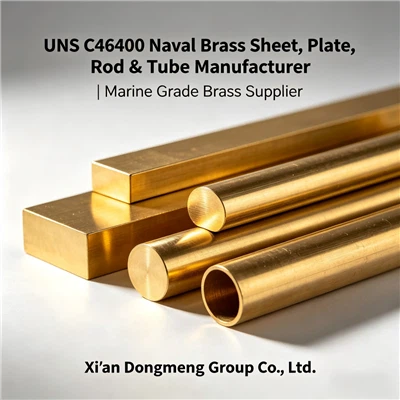

What Is Naval Brass?
Naval Brass is a high-performance copper-based alloy primarily composed of copper (Cu), zinc (Zn), and tin (Sn), designed specifically for marine and seawater applications.
It is known for:
Excellent corrosion resistance in seawater
High mechanical strength
Good wear resistance
Strong machinability (especially leaded grades)
Because of its durability in harsh environments, Naval Brass is widely used in shipbuilding, marine hardware, pumps, valves, and heavy engineering systems.
Chemical Composition of Naval Brass
Typical composition varies by grade:
Copper (Cu): 59% – 62%
Zinc (Zn): 36% – 40%
Tin (Sn): 0.8% – 1.5%
Lead (Pb): Optional (for machining grades like C46500)
Iron (Fe): Trace amount for strength improvement
Naval Brass Grades Overview
1. C46400 Naval Brass (Standard Marine Grade)
C46400 Naval Brass is the most widely used grade in marine applications.
Key Features:
Excellent seawater corrosion resistance
High strength and toughness
Good dezincification resistance
Suitable for structural marine parts
Applications:
Ship propeller shafts
Marine fasteners
Pump components
Valves and fittings
Condenser tubes
2. C46700 Manganese Naval Brass
C46700 is a modified naval brass with manganese addition for improved performance.
Key Features:
Higher corrosion resistance than C46400
Improved fatigue strength
Better performance in polluted seawater
Good wear resistance
Applications:
Marine pumps
Offshore engineering parts
High-stress marine components
Heat exchanger systems
3. C46200 Naval Brass (Low-Zinc Type)
C46200 contains slightly lower zinc content for improved corrosion stability.
Key Features:
Better resistance to dezincification
Stable performance in seawater
Moderate strength but high durability
Applications:
Marine fittings
Valve components
Low-pressure seawater systems
Structural marine hardware
4. C46500 Leaded Naval Brass
C46500 is a machinability-optimized naval brass containing lead.
Key Features:
Excellent machinability
Good corrosion resistance
Ideal for precision machining parts
Slightly lower strength than C46400
Applications:
CNC machined marine components
Precision valve parts
Hydraulic fittings
Electrical marine connectors
Comparison Table: Naval Brass Grades
| Property | C46400 | C46700 | C46200 | C46500 |
|---|---|---|---|---|
| Alloy Type | Standard Naval Brass | Manganese Naval Brass | Low-Zinc Naval Brass | Leaded Naval Brass |
| Copper (Cu) | 59–62% | 59–62% | 60–63% | 59–62% |
| Zinc (Zn) | Balance | Balance | Lower Zn content | Balance |
| Tin (Sn) | 0.5–1.0% | 0.5–1.0% | 0.5–1.0% | 0.5–1.0% |
| Lead (Pb) | ≤0.2% | ≤0.2% | ≤0.2% | 0.5–1.5% |
| Manganese (Mn) | - | Present | - | - |
| Strength | High | Very High | Medium | Medium |
| Corrosion Resistance | Excellent (Seawater) | Superior (Harsh Marine) | High (Dezincification Resistant) | Good |
| Dezincification Resistance | Good | Excellent | Very High | Moderate |
| Machinability | Medium | Medium | Medium | Excellent |
| Wear Resistance | Good | Excellent | Good | Moderate |
| Fabrication | Good | Moderate | Good | Excellent (Machining) |
| Typical Forms | Rod, Plate, Tube | Rod, Forging | Rod, Plate | Rod, Machined Parts |
| Main Advantage | Balanced performance | High strength + corrosion | Stability in seawater | Easy machining |
| Limitations | Moderate machinability | Higher cost | Lower strength | Lower strength vs C46400 |
| Typical Applications | Marine hardware, shafts, valves | Offshore equipment, pumps | Fittings, seawater systems | Precision machined parts |
Choose C46400 → Best general-purpose naval brass for marine use
Choose C46700 → For high-stress + harsh seawater environments
Choose C46200 → When dezincification resistance is critical
Choose C46500 → For CNC machining & precision components
Key Properties of Naval Brass (C46400, C46700, C46200, C46500)
Naval brass is engineered for marine durability, mechanical strength, and long-term corrosion resistance. Below are its most critical technical properties, presented in a high-authority, SEO-friendly format.
1. Excellent Seawater Corrosion Resistance
Naval brass is specifically designed to perform in saltwater and marine atmospheres.
Tin (Sn) addition significantly improves resistance to dezincification
Forms a protective oxide layer that slows corrosion
Performs well in chloride-rich environments
👉 Especially strong in:
C46700 (best in harsh marine conditions)
C46200 (highest dezincification resistance)
2. High Mechanical Strength
Naval brass offers a strong balance between strength and ductility, making it ideal for structural applications.
Higher strength than standard brass alloys
Suitable for load-bearing components
Maintains integrity under pressure and vibration
👉 Strength ranking:
C46700 > C46400 > C46200 ≈ C46500
3. Dezincification Resistance
One of the most important properties in marine alloys.
Prevents selective leaching of zinc in seawater
Extends service life in corrosive environments
Critical for long-term reliability in piping and fittings
👉 Best performers:
C46200 (optimized low-zinc composition)
C46700 (enhanced alloying elements)
4. Good Wear and Fatigue Resistance
Naval brass performs well under mechanical friction and cyclic loads.
Resistant to wear in moving parts
Handles repeated stress cycles
Suitable for rotating and sliding components
👉 Ideal for:
Shafts
Bearings
Pump components
5. Machinability (Grade-Dependent)
Machinability varies significantly depending on composition.
C46500 (Leaded Naval Brass) → Excellent machinability
Other grades → Moderate machinability
👉 Benefits:
Reduced tool wear
Higher production efficiency
Better surface finish
6. Good Fabrication & Formability
Naval brass can be processed using common manufacturing methods:
Hot forging
Rolling
Bending
Extrusion
👉 Notes:
C46400 → Best balance for forming + strength
C46500 → Best for machining, not forming
7. Thermal and Electrical Conductivity
While not as conductive as pure copper, naval brass still provides:
Moderate thermal conductivity
Acceptable electrical conductivity
👉 Suitable for:
Heat exchangers
Condenser systems
8. Resistance to Biofouling
Naval brass exhibits natural resistance to marine organism growth.
Reduces algae and barnacle attachment
Maintains system efficiency in seawater
👉 Important for:
Offshore equipment
Seawater piping systems
9. Long Service Life & Low Maintenance
Due to its corrosion resistance and strength:
Minimal maintenance required
Long operational lifespan
Lower lifecycle cost
Applications of Naval Brass (C46400, C46700, C46200, C46500)
Naval brass is widely used across marine, offshore, and heavy industrial sectors due to its excellent corrosion resistance, strength, and durability in seawater environments. Below is a comprehensive, SEO-optimized breakdown of its key applications.
1. Marine & Shipbuilding Industry
Naval brass is primarily developed for seawater applications, making it a core material in ship construction.
Typical Uses:
Propeller shafts
Marine fasteners (bolts, nuts, screws)
Rudder components
Deck hardware
Ship piping systems
👉 Recommended Grades:
C46400 → Standard marine components
C46700 → High-load and offshore conditions
2. Offshore Oil & Gas Engineering
In offshore platforms, materials must withstand saltwater, pressure, and harsh environments.
Applications:
Pump housings
Valve bodies
Seawater intake systems
Hydraulic fittings
Structural offshore components
👉 Best Choice:
C46700 for superior corrosion and fatigue resistance
3. Pumps, Valves & Fluid Handling Systems
Naval brass is widely used in systems that transport seawater or corrosive fluids.
Components:
Valve stems and bodies
Pump shafts and impellers
Pipe fittings and connectors
Flanges and couplings
👉 Why Naval Brass?
Resistant to dezincification and pitting corrosion
Maintains performance under continuous fluid exposure
4. Heat Exchangers & Condensers
Naval brass offers good thermal conductivity and corrosion resistance, ideal for heat transfer systems.
Applications:
Condenser tubes
Heat exchanger components
Cooling systems using seawater
👉 Recommended Grades:
C46200 → Better long-term corrosion stability
C46400 → General-purpose use
5. Industrial Machinery & Mechanical Parts
Naval brass is used in equipment requiring strength, wear resistance, and reliability.
Applications:
Bushings and bearings
Gears and sleeves
Wear plates
Structural components
👉 Best Grades:
C46400 / C46700 for strength
C46500 for precision-machined parts
6. Precision Machining & CNC Components
For parts requiring tight tolerances and smooth finishes.
Typical Uses:
CNC machined fittings
Threaded connectors
Hydraulic precision parts
Instrument components
👉 Best Choice:
C46500 (Leaded Naval Brass)
✔ Excellent machinability
✔ Reduced tool wear
✔ High production efficiency
7. Seawater Piping & Desalination Systems
Naval brass performs reliably in continuous seawater exposure systems.
Applications:
Seawater pipelines
Desalination plant components
Cooling water systems
Intake and discharge lines
👉 Preferred Grade:
C46200 for superior dezincification resistance
8. Electrical & Marine Hardware
Naval brass is also used where moderate conductivity and corrosion resistance are required.
Applications:
Marine electrical connectors
Terminal components
Cable fittings
Grounding hardware
9. Defense & Heavy Engineering
Due to its durability, naval brass is used in military and heavy-duty systems.
Applications:
Naval defense equipment
Heavy-duty fasteners
Structural components in harsh environments
Application Selection Guide
| Application | Recommended Grade |
|---|---|
| General marine hardware | C46400 |
| Offshore & high-stress systems | C46700 |
| Seawater piping & desalination | C46200 |
| CNC machining & precision parts | C46500 |
Why Choose Naval Brass Instead of Standard Brass?
When selecting copper alloys for demanding environments, Naval Brass (C46400, C46700, C46200, C46500) offers clear advantages over ordinary brass. It is specifically engineered for marine, seawater, and high-corrosion conditions, where standard brass often fails.
1. Superior Corrosion Resistance (Especially in Seawater)
The biggest limitation of standard brass is its vulnerability to dezincification and corrosion in chloride-rich environments.
Naval brass solves this problem:
Tin (Sn) addition improves resistance to saltwater corrosion
Forms a stable protective oxide layer
Performs reliably in marine and offshore environments
👉 Result: Much longer service life than standard brass
2. Strong Resistance to Dezincification
Standard brass can suffer from zinc leaching, leading to:
Structural weakening
Porous material
Premature failure
Naval brass advantages:
Special composition reduces zinc loss
Maintains mechanical integrity over time
👉 Particularly strong in:
C46200 (low-zinc design)
C46700 (enhanced alloying elements)
3. Higher Mechanical Strength
Compared to regular brass, naval brass provides:
Better tensile strength
Improved fatigue resistance
Higher load-bearing capacity
👉 Ideal for:
Marine shafts
Structural components
High-pressure systems
4. Better Performance in Harsh Environments
Standard brass performs well in indoor or mild conditions, but struggles in:
Saltwater exposure
High humidity
Industrial chemical environments
Naval brass is designed for:
Offshore platforms
Seawater pipelines
Marine engineering systems
👉 Result: Reliable long-term performance under extreme conditions
5. Improved Wear & Fatigue Resistance
Naval brass withstands:
Continuous friction
Mechanical wear
Repeated stress cycles
👉 Making it suitable for:
Pumps
Valves
Bearings
Rotating machinery
6. Grade Flexibility for Different Applications
Unlike standard brass, naval brass offers specialized grades for different needs:
| Requirement | Best Naval Brass Grade |
|---|---|
| General marine use | C46400 |
| Heavy-duty / offshore | C46700 |
| Maximum corrosion resistance | C46200 |
| Precision machining | C46500 |
👉 This flexibility allows engineers to optimize performance and cost
7. Lower Maintenance & Lifecycle Cost
Although naval brass may have a higher initial cost:
Requires less maintenance
Has longer service life
Reduces replacement frequency
👉 Total cost of ownership is significantly lower
8. Better Reliability for Critical Systems
In industries like marine and offshore engineering, failure is not an option.
Naval brass provides:
Stable performance under stress
Resistance to environmental degradation
Proven reliability in critical applications
Comparison Summary: Naval Brass vs Standard Brass
| Feature | Naval Brass | Standard Brass |
|---|---|---|
| Seawater Corrosion Resistance | Excellent | Poor–Moderate |
| Dezincification Resistance | High | Low |
| Strength | High | Moderate |
| Marine Suitability | Excellent | Limited |
| Service Life | Long | Shorter |
| Maintenance | Low | Higher |
OEM & Customization
We support full customization based on client requirements:
Custom dimensions
Special mechanical properties
Machining services (CNC turning, milling)
Surface finishing options
Export packaging standards
FAQ – Naval Brass (C46400 / C46700 / C46200 / C46500)
Q1: What is naval brass used for?
Naval brass is mainly used in marine, offshore, and seawater applications due to its corrosion resistance.
Q2: Which is the most common naval brass grade?
C46400 is the most widely used standard naval brass grade.
Q3: Is naval brass better than standard brass?
Yes, it offers significantly better corrosion resistance in seawater environments.
Q4: What is C46500 used for?
C46500 is mainly used for precision machining parts requiring excellent machinability.
Q5: Can naval brass be used in freshwater systems?
Yes, but it is specifically optimized for seawater and marine conditions.
Contact Us
We are a professional manufacturer and exporter of Naval Brass (C46400, C46700, C46200, C46500) products.
📩 For quotations, technical datasheets, or OEM requirements, please contact our engineering team.
+8615769214734
office@dongmjd.com