


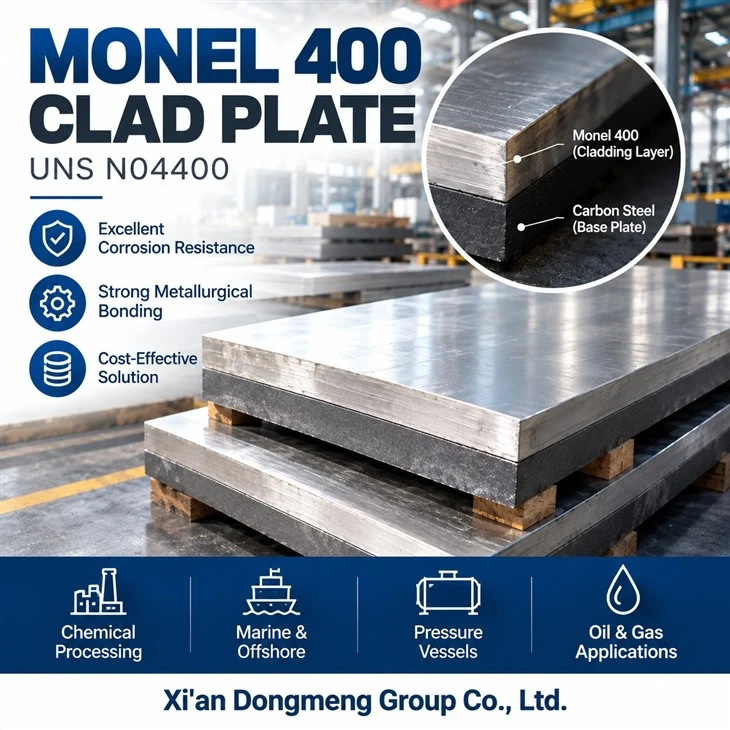
Xi'an Dongmeng Group Co., Ltd. is one of the most reliable manufacturers and suppliers of monel 400 clad plate in China, also supports customized service. With abundant experience, we warmly welcome you to wholesale cheap products in stock here and get free sample from our factory. For price consultation, contact us.
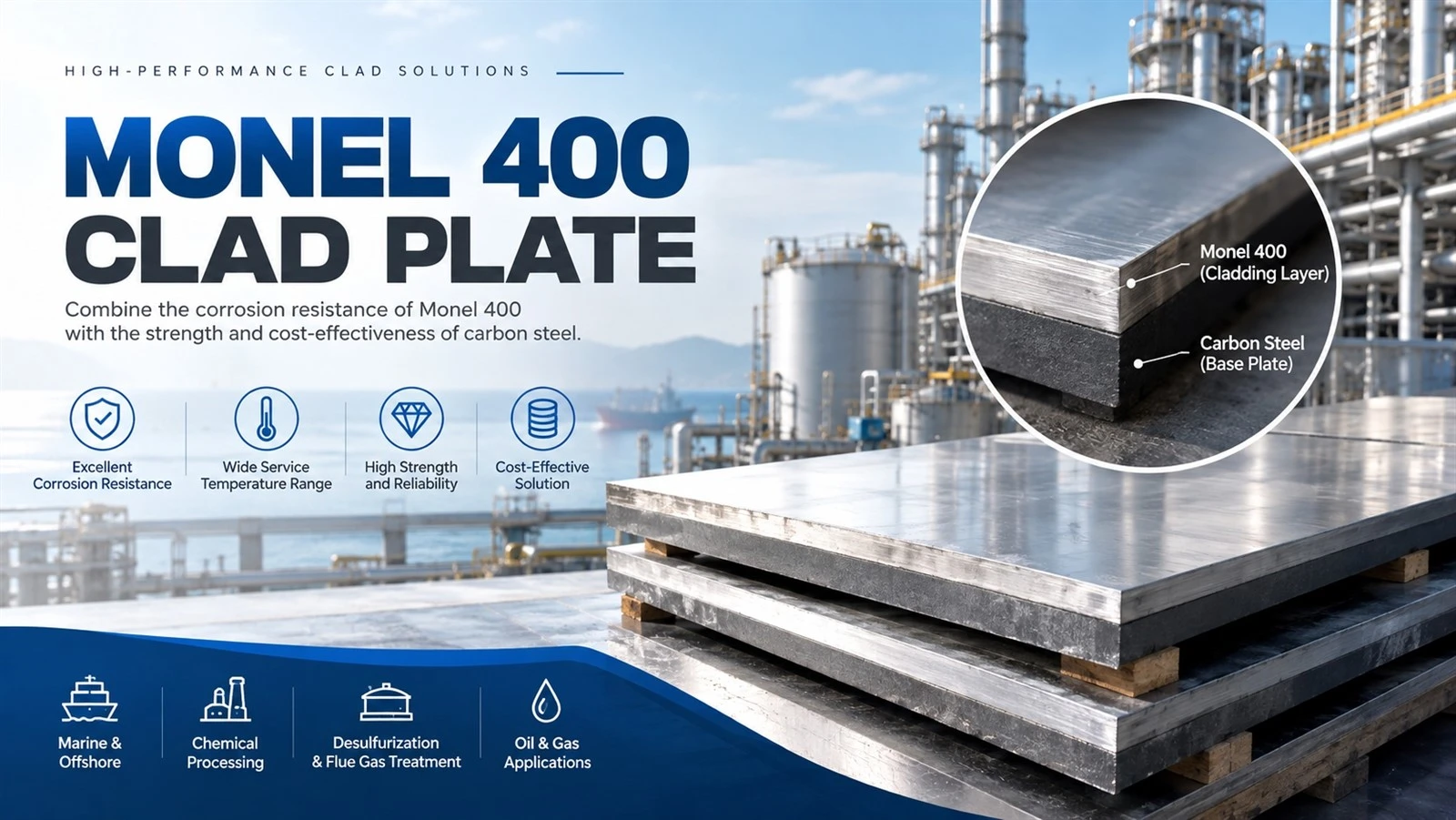
Monel 400 Clad Plate | ASTM A265 UNS N04400 Steel Clad Plate
Xi'an Dongmeng Group Co., Ltd. supplies Monel 400 clad steel plates (UNS N04400) for chemical processing equipment, pressure vessels, marine engineering, offshore facilities, and other corrosion-resistant industrial applications.
Our Monel 400 clad plates combine a nickel-copper alloy corrosion-resistant layer with a carbon steel or low-alloy steel structural backing. The two metals are metallurgically bonded to create a composite plate that provides the corrosion resistance of Alloy 400 on the exposed surface while using steel for most of the structural thickness.
Available with project-specific thickness combinations, bonding processes, and inspection requirements, these plates offer an engineered material solution for pressure vessel manufacturers, equipment fabricators, EPC contractors, and international industrial distributors.
What Is Monel 400 Clad Plate?
Monel 400 clad plate is a metallurgically bonded composite metal plate consisting of two functional layers:
Monel 400 cladding: A corrosion-resistant nickel-copper alloy layer intended to contact the process medium.
Structural steel backing: A carbon steel or low-alloy steel substrate that provides the principal load-bearing thickness.
Monel 400 is a single-phase nickel-copper solid-solution alloy containing a minimum of 63% nickel plus cobalt and approximately 28–34% copper.
It is particularly valued for its corrosion resistance in many reducing chemical environments, selected acid services, alkaline solutions, and marine applications.
In clad construction, the Monel 400 layer is bonded to the backing plate instead of being applied as a loose mechanical lining.
This metallurgical connection allows the composite plate to be fabricated into suitable industrial components when appropriate forming, welding, inspection, and design procedures are followed.
Why Use Monel 400 Clad Steel Instead of Solid Monel 400?
Solid Alloy 400 plate provides corrosion resistance throughout its entire thickness. However, many industrial components require the corrosion-resistant alloy primarily on the process-contact surface.
Using Monel 400 as the cladding layer can reduce nickel-alloy consumption while retaining a structural steel backing.
The resulting material offers several potential advantages:
Reduced consumption of expensive nickel-copper alloy.
Structural support from carbon steel or low-alloy steel.
Corrosion-resistant process-contact surface.
Compatibility with engineered fabrication and welding procedures.
Customized cladding thickness for corrosion allowance.
Potential material-cost savings for large equipment.
The actual economic benefit depends on plate dimensions, required cladding thickness, bonding process, testing requirements, and fabrication costs.
Monel 400 Clad Plate Structure
A typical Monel 400 clad plate consists of three identifiable regions:
| Layer | Material | Main Function |
|---|---|---|
| Corrosion-resistant layer | Monel 400 (UNS N04400) | Protects the process-contact surface |
| Metallurgical bond interface | Bonded Alloy 400 / steel interface | Transfers loads between the bonded layers |
| Structural backing | Carbon steel or low-alloy steel | Provides structural support and principal load-bearing thickness |
Example: Monel 400 + ASTM A516 Grade 70
Typical material configuration:
Monel 400 (3 mm) + ASTM A516 Grade 70 (17 mm)
Total nominal thickness: 20 mm
In this configuration, the Monel 400 layer forms the corrosion-resistant surface while the A516 Grade 70 steel provides the structural backing.
The minimum acceptable remaining cladding thickness after fabrication must be established by the equipment designer.
For pressure-containing equipment, the treatment of cladding in strength calculations depends on the governing design code.
Monel 400 Clad Plate Sizes and Thickness Options
Monel 400 clad steel plates can be specified according to the cladding thickness, backing steel thickness, plate dimensions, and fabrication requirements.
Typical Thickness Combinations
| Monel 400 Cladding | Steel Backing | Total Thickness | Total Thickness (in) |
|---|---|---|---|
| 2 mm | 18 mm | 20 mm | 0.787 |
| 3 mm | 17 mm | 20 mm | 0.787 |
| 3 mm | 22 mm | 25 mm | 0.984 |
| 4 mm | 26 mm | 30 mm | 1.181 |
| 5 mm | 35 mm | 40 mm | 1.575 |
| 6 mm | 44 mm | 50 mm | 1.969 |
These are illustrative engineering configurations rather than confirmed stock sizes. Manufacturing feasibility and applicable thickness tolerances must be reviewed before ordering.
Available Customization
Monel 400 cladding thickness.
Carbon steel backing grade and thickness.
Single-sided or double-sided cladding.
Plate width and length.
Edge preparation and beveling.
Cut-to-size plates and fabricated blanks.
Additional ultrasonic testing.
Special mechanical testing.
Project-specific surface requirements.
The specified minimum cladding thickness should account for anticipated corrosion, forming, grinding, machining, and fabrication requirements.
Material Standards and Specifications
Correct material standards are essential for pressure vessel fabrication, quality assurance, and international project procurement.
| Standard | Description | Application |
|---|---|---|
| ASTM A265 | Nickel and Nickel-Base Alloy-Clad Steel Plate | Composite plate requirements |
| ASME SA-265 | Nickel and Nickel-Base Alloy-Clad Steel Plate | ASME construction, where applicable |
| ASTM B127 | Nickel-Copper Alloy Plate, Sheet, and Strip | Monel 400 cladding material |
| ASME SB-127 | Nickel-Copper Alloy Plate, Sheet, and Strip | Monel 400 material for applicable ASME use |
| ASTM A516/A516M | Carbon Steel Pressure Vessel Plates | Structural backing for pressure equipment |
| ASTM A36/A36M | Carbon Structural Steel | Structural backing for suitable non-pressure applications |
| ASTM A578/A578M | Ultrasonic Examination of Rolled Steel Plates | Supplemental plate UT, when specified |
| EN 10204 | Types of Inspection Documents | Material inspection certificates |
Important Material Standard Notes
ASTM A265 is the principal product specification for nickel and nickel-base alloy clad steel plate.
ASTM B127 specifies Monel 400 plate, sheet, and strip material and does not replace the composite plate specification.
ASTM B164 applies to nickel-copper alloy rod, bar, and wire products and is not the appropriate principal specification for Monel 400 clad plate.
For pressure vessel applications, the purchaser should also identify the applicable ASME construction code, design temperature, required impact testing, and heat-treatment conditions.
Any alternative backing material outside the scope of the specified clad-plate standard requires separate technical approval.
Monel 400 Chemical Composition
Monel 400 is a nickel-copper alloy designated UNS N04400.
The following table summarizes the nominal specification limits commonly associated with Alloy 400.
| Element | Symbol | Composition (wt. %) |
|---|---|---|
| Nickel + Cobalt | Ni + Co | 63.0 min. |
| Copper | Cu | 28.0–34.0 |
| Iron | Fe | 2.50 max. |
| Manganese | Mn | 2.00 max. |
| Carbon | C | 0.30 max. |
| Silicon | Si | 0.50 max. |
| Sulfur | S | 0.024 max. |
Note: These values describe the Monel 400 alloy, not the overall composition of the clad steel plate. Material acceptance must be based on the applicable specification and certified heat analysis.
Role of Nickel and Copper
Nickel: Provides resistance to various corrosive environments and contributes to the alloy's mechanical properties.
Copper: Contributes to corrosion resistance in many reducing chemical environments.
Iron and Manganese: Are controlled alloying constituents within the specified chemical limits.
Unlike chromium-rich stainless steels, Alloy 400 is not primarily dependent on a chromium oxide passive film for corrosion resistance.
Its suitability must be evaluated according to the chemistry, temperature, aeration, contamination, and flow conditions of the intended service environment.
Mechanical Properties of Monel 400
Monel 400 offers a combination of strength, ductility, and toughness.
The following values represent published nominal room-temperature properties of hot-rolled, annealed Monel 400 plate.
| Property | Typical Published Range |
|---|---|
| Tensile Strength | 482–586 MPa |
| Yield Strength (0.2% Offset) | 193–345 MPa |
| Elongation | 35–50% |
| Brinell Hardness | 110–140 HB |
Engineering note: These are representative properties of solid Monel 400 plate, not guaranteed mechanical properties of the completed composite plate.
The composite plate must satisfy the mechanical requirements of its specified base material and applicable clad-plate standard.
Mechanical Performance of the Composite Plate
The completed clad plate should be evaluated for:
Base metal tensile strength.
Base metal yield strength.
Metallurgical bond integrity.
Required shear or bond strength.
Bending and forming performance.
Cladding continuity after fabrication.
Impact toughness, where specified.
Pressure vessel design calculations must follow the governing construction code rather than assuming that the composite plate behaves identically to solid Monel 400.
Physical Properties of Monel 400
The following values are representative of the Monel 400 cladding alloy.
| Property | Typical Value |
|---|---|
| Density | 8.80 g/cm³ |
| Melting Range | 1300–1350°C |
| Elastic Modulus | Approximately 179 GPa |
| Thermal Conductivity at 21°C | Approximately 22 W/m·K |
| Specific Heat at 21°C | Approximately 427 J/kg·K |
| Mean Thermal Expansion, 21–100°C | Approximately 14.2 × 10⁻⁶/K |
These properties apply to the Monel 400 alloy layer.
The overall thermal behavior of the composite plate also depends on the backing steel, layer thicknesses, bonding interface, and operating temperature.
For elevated-temperature applications, both materials and the bond interface must be evaluated against the design requirements.
Manufacturing Process: Explosion Bonding and Roll Bonding
Monel 400 clad plate can be manufactured using different metallurgical bonding technologies.
The preferred process depends on plate dimensions, material combination, required bond quality, and subsequent fabrication conditions.
1. Explosion Bonded Monel 400 Clad Plate
Explosion bonding uses controlled high-velocity impact to create a metallurgical bond between the Monel 400 cladding plate and the steel backing.
The process is performed using specialized equipment and carefully controlled manufacturing conditions.
Typical manufacturing stages include:
Raw material identification and preparation.
Cleaning and preparation of bonding surfaces.
Controlled positioning of the cladding and backing plates.
Metallurgical bonding.
Flattening and dimensional correction.
Required heat treatment, where applicable.
Ultrasonic bond inspection.
Mechanical testing and final inspection.
Advantages of explosion bonding:
Suitable for many dissimilar-metal combinations.
Can produce large-area metallurgical bonding.
Allows project-specific clad layer thicknesses.
Applicable to engineered corrosion-resistant equipment.
2. Roll Bonded Monel 400 Clad Plate
Roll bonding uses high rolling pressure, generally combined with controlled thermal processing, to produce metallurgical bonding between compatible materials.
Process parameters must account for the deformation characteristics and thermal behavior of both alloys.
Potential advantages include:
Controlled plate thickness.
Good dimensional consistency.
Integration with established plate-rolling processes.
Roll bonding is subject to compatibility assessment and should not be assumed suitable for every Monel 400/steel combination.
How to Select the Bonding Process
The bonding route should be selected according to:
Cladding and backing material compatibility.
Required plate thickness.
Plate width and length.
Bond integrity requirements.
Heat-treatment restrictions.
Forming and welding requirements.
Applicable design and procurement specifications.
The selected manufacturing process should be confirmed during technical quotation.
Corrosion Resistance of Monel 400 Clad Plate
Monel 400 is recognized for its resistance to many reducing chemical environments.
However, corrosion resistance depends on the specific operating medium and cannot be determined from alloy grade alone.
Corrosion Performance by Environment
| Service Environment | Alloy 400 Performance Considerations |
|---|---|
| Flowing Seawater | Generally low corrosion rates under suitable conditions |
| Stagnant Seawater | Localized pitting and crevice corrosion may occur |
| Hydrofluoric Acid | Valuable resistance in selected applications; actual process conditions require verification |
| Sulfuric Acid | Suitable for certain reducing conditions, depending on concentration and temperature |
| Hydrochloric Acid | Resistance depends on concentration, temperature, and oxidizing contamination |
| Alkaline Solutions | Good resistance in many alkaline environments |
| Strongly Oxidizing Acids | Generally not the preferred material without detailed corrosion evaluation |
Seawater Applications
Monel 400 performs well in many flowing seawater applications.
However, stagnant seawater, deposits, and restricted-flow regions may create conditions that promote localized corrosion.
Equipment designers should therefore evaluate:
Seawater velocity.
Temperature and salinity.
Dissolved oxygen.
Biofouling and deposits.
Crevice geometry.
Exposure duration.
Chemical Processing Environments
Monel 400 is particularly useful in selected reducing chemical services.
Its resistance to hydrofluoric acid and certain nonoxidizing acid environments has made it an important engineering alloy in chemical processing.
Nevertheless, strongly oxidizing contaminants can significantly affect corrosion performance.
Material selection should always be based on actual process conditions, corrosion data, and the required design life.
Industrial Applications of Monel 400 Clad Steel Plate
1. Chemical Processing Equipment
Monel 400 clad plates can be considered for equipment handling chemical environments where Alloy 400 provides suitable corrosion resistance.
Typical equipment includes:
Chemical reactors.
Process vessels.
Storage tanks.
Chemical processing columns.
Corrosion-resistant internal surfaces.
The cladding protects the exposed process-contact surface while the steel backing provides structural support.
2. Pressure Vessels
Monel 400 clad steel plates may be specified for pressure-containing equipment requiring a nickel-copper alloy corrosion barrier.
Typical applications include:
Process pressure vessels.
Reactor shells.
Separator vessels.
Vessel heads.
Specialized chemical containment equipment.
For ASME pressure vessel projects, plate selection must satisfy the governing design code and approved project specification.
3. Marine and Offshore Engineering
Alloy 400 is used in various marine applications because of its corrosion resistance in seawater environments.
Potential clad-plate applications include:
Seawater-handling equipment.
Marine process vessels.
Offshore chemical processing systems.
Selected seawater containment components.
Crevice conditions, stagnant seawater, and galvanic interactions should be assessed during equipment design.
4. Heat Exchanger and Thermal Processing Equipment
Monel 400 clad plate can be considered for selected heat exchanger components, including:
Tube sheets.
Channel covers.
Heat exchanger end plates.
Process-contact surfaces.
Material selection must account for thermal expansion differences, operating temperatures, corrosion conditions, and the intended fabrication method.
5. Oil and Gas Processing
Potential applications include corrosion-resistant process equipment and chemical handling systems.
For sour service, material acceptability must be verified against the relevant project specification and applicable NACE MR0175/ISO 15156 requirements.
Fabrication, Forming and Welding
Monel 400 clad steel plate can be cut, drilled, formed, and welded using qualified procedures appropriate to both materials.
Special consideration is required because the cladding alloy and steel backing have different metallurgical characteristics.
Cutting and Edge Preparation
Depending on plate thickness and fabrication requirements, cutting methods may include:
Waterjet cutting.
Mechanical cutting.
Plasma cutting with appropriate process control.
Machining and edge preparation.
Thermal cutting may create an affected zone requiring additional inspection, cleaning, or restoration.
Bending and Forming
During forming, the manufacturer should consider:
Minimum forming radius.
Cladding location relative to the bend.
Differences in material deformation.
Potential interface damage.
Forming temperature.
Required post-forming inspection.
Ultrasonic examination may be required following significant forming operations.
Welding Monel 400 Clad Plate
Welding procedures must address both the structural backing and the corrosion-resistant layer.
The backing steel may require a separate welding sequence from the Monel 400 cladding.
For suitable Alloy 400 welding applications, ERNiCu-7 (AWS A5.14) is a commonly used nickel-copper filler metal.
However, filler selection depends on the joint configuration, dilution control, base metal, corrosion requirements, and applicable welding code.
Important welding considerations include:
Use of qualified welding procedures.
Control of iron dilution into the corrosion-resistant weld metal.
Suitable joint preparation.
Restoration of the clad-side corrosion barrier.
Appropriate interpass temperature control.
Verification of corrosion-resistant weld continuity.
Post-weld inspection.
For pressure equipment, WPS/PQR qualification and welder qualifications must meet the applicable construction code.
Any required post-weld heat treatment must be evaluated for its effect on the backing steel, Monel 400 cladding, and metallurgical bond.
Inspection & Quality Assurance
Quality verification is particularly important for Monel 400 clad plates used in pressure-containing and corrosion-resistant equipment.
Inspection requirements should be established before manufacturing.
1. Raw Material Inspection
Incoming materials may be checked for:
Material grade identification.
Heat number and traceability.
Chemical composition.
Mechanical properties.
Surface condition.
Plate dimensions.
2. Positive Material Identification (PMI)
PMI can be used to verify the nickel-copper alloy identification and help prevent material mix-ups.
PMI does not replace laboratory chemical analysis where elements such as carbon or sulfur require verification.
3. Ultrasonic Bond Integrity Testing
Ultrasonic testing is used to examine the metallurgical bond interface and identify unacceptable unbonded areas.
Inspection requirements may include:
Specified scanning coverage.
Bond discontinuity detection.
Defined acceptance criteria.
Edge-zone inspection.
Recorded inspection results.
100% UT scanning coverage can be specified as a project requirement, subject to an approved procedure and acceptance standard.
The purchaser should distinguish bond-interface testing from ultrasonic examination of the backing steel for internal defects.
4. Bond Strength and Mechanical Testing
Depending on the applicable specification, tests may include:
Shear strength testing.
Bond strength testing.
Tensile testing.
Bend testing where specified.
Additional project-specific mechanical tests.
Acceptance values, test orientation, sampling frequency, and test methods must be defined by the governing standard and purchase specification.
5. Surface and Dimensional Inspection
Final inspection may include:
Overall thickness measurement.
Cladding thickness verification.
Width and length measurement.
Flatness examination.
Surface defect inspection.
Edge condition inspection.
6. Material Test Certificates
Depending on contractual requirements, the documentation package may include:
EN 10204 Type 3.1 inspection certificate.
EN 10204 Type 3.2 inspection certificate, where arranged.
Raw material chemical analysis.
Mechanical test results.
Bond integrity UT report.
Cladding thickness inspection report.
Dimensional inspection report.
Third-party inspection report, when required.
Third-party inspection arrangements should be confirmed during the ordering process.
Monel 400 Clad Plate vs Other Nickel Alloy Clad Plates
Different nickel alloy cladding materials offer different corrosion resistance characteristics.
Selecting the correct alloy is more important than choosing solely by nominal nickel content.
| Cladding Alloy | UNS Designation | Main Characteristics | Typical Selection Considerations |
|---|---|---|---|
| Monel 400 | N04400 | Nickel-copper alloy with resistance to many reducing media | Selected chemical and marine environments |
| Alloy 625 | N06625 | Nickel-chromium-molybdenum alloy | Chloride-containing and aggressive mixed environments |
| Alloy C276 | N10276 | Nickel-molybdenum-chromium alloy | Broad range of demanding chemical processing environments |
| Alloy 600 | N06600 | Nickel-chromium-iron alloy | Selected high-temperature and corrosion-resistant services |
When Should You Choose Monel 400?
Monel 400 may be a suitable choice when:
The process medium is compatible with nickel-copper alloys.
The application requires corrosion resistance in selected reducing environments.
Solid nickel-alloy construction would use more alloy than necessary.
A steel-backed structural component is acceptable.
The project requires a metallurgically bonded corrosion-resistant surface.
For strongly oxidizing environments or more demanding chloride conditions, alternative nickel alloys may be more appropriate.
Final alloy selection should follow a corrosion and engineering evaluation.
Manufacturing and Customization Capabilities
Xi'an Dongmeng Group Co., Ltd. supports project-oriented Monel 400 clad plate procurement for industrial equipment manufacturers and international buyers.
Customization requirements can include:
Material Configuration
Monel 400 with ASTM A516 Grade 70.
Monel 400 with other approved carbon steel grades.
Project-specific low-alloy steel backing.
Special material combinations subject to technical evaluation.
Plate Dimensions
Customized cladding thickness.
Customized structural backing thickness.
Specified total thickness.
Customized width and length.
Cut-to-size plates.
Fabrication Requirements
Edge preparation.
Cutting and machining.
Surface preparation.
Plate identification and marking.
Special packaging.
Quality Requirements
Material traceability.
Specified UT coverage.
Mechanical testing.
PMI verification.
Inspection certificates.
Third-party inspection coordination.
Manufacturing feasibility, minimum order quantity, and production lead time are confirmed according to the required material combination, dimensions, quantity, and inspection scope.
Packaging and International Delivery
Monel 400 clad plates require suitable handling and packaging to protect the corrosion-resistant surface and prevent transport damage.
Packaging Options
Depending on the plate size and project requirements:
Protective wrapping for finished surfaces.
Edge and corner protection.
Suitable protection of exposed steel surfaces.
Wooden pallets or engineered transport supports.
Steel frames for heavy plates.
Export packaging with identification labels.
For oversized plates, handling and lifting arrangements should be established according to plate weight and transport dimensions.
Export Documentation
Documentation may include:
Commercial invoice.
Packing list.
Material Test Certificate.
Inspection reports.
Certificate of origin, where required.
Additional contractual documentation.
Shipping arrangements and Incoterms are confirmed during quotation.
Why Choose Xi'an Dongmeng Group Co., Ltd.?
Material Selection Support
We assist industrial buyers in reviewing cladding alloy requirements, backing material specifications, plate thickness combinations, and intended applications.
Customized Clad Plate Solutions
Our product offering supports project-specific plate configurations rather than relying exclusively on standard commercial dimensions.
Technical Documentation
Material traceability, inspection requirements, and applicable certification options can be reviewed before order confirmation.
Industrial Procurement Support
We work with equipment fabricators, engineering contractors, industrial distributors, and international project buyers requiring customized metal products.
International Supply Coordination
Our team supports technical inquiries, quotations, manufacturing coordination, inspection arrangements, and export documentation for international orders.
Frequently Asked Questions
1. What is Monel 400 clad plate?
Monel 400 clad plate is a composite steel plate consisting of a corrosion-resistant Monel 400 nickel-copper alloy layer metallurgically bonded to a carbon steel or low-alloy steel backing.
It combines a corrosion-resistant process surface with a structural steel substrate.
2. What is the difference between Monel 400 clad plate and solid Monel 400 plate?
Solid Monel 400 plate contains Alloy 400 throughout its thickness.
Monel 400 clad plate contains a thinner Alloy 400 layer bonded to structural steel.
Clad construction can reduce nickel-alloy consumption while retaining a corrosion-resistant surface.
3. What ASTM standard applies to Monel 400 clad steel plate?
ASTM A265 is the principal specification for nickel and nickel-base alloy clad steel plate.
ASTM B127 applies to the Monel 400 plate material used as the cladding layer.
The backing steel must meet its own applicable material specification.
4. Can Monel 400 be clad onto ASTM A516 Grade 70 steel?
Yes. Monel 400 can be metallurgically bonded to suitable ASTM A516 Grade 70 carbon steel using an appropriately qualified manufacturing process.
The final plate must satisfy the specified material and bond integrity requirements.
5. Is explosion bonding suitable for Monel 400 clad plate?
Explosion bonding is an established technique for joining suitable dissimilar metals.
Its suitability for a particular Monel 400 and steel configuration depends on plate dimensions, thickness, material condition, and project requirements.
6. Can Monel 400 clad plates be used for pressure vessels?
Yes, when the material combination, manufacturing process, inspections, and fabrication meet the applicable pressure vessel design and construction requirements.
Pressure vessel suitability cannot be established solely from the Monel 400 alloy designation.
7. How thick should the Monel 400 cladding layer be?
The required cladding thickness depends on the corrosion allowance, fabrication process, forming requirements, expected service life, and minimum thickness required after manufacturing.
Typical project configurations may use several millimeters of Monel 400 cladding, but final thickness must be established by engineering design.
8. Can Monel 400 clad plate resist seawater corrosion?
Monel 400 generally performs well in many flowing seawater applications.
However, stagnant seawater and crevice conditions may cause localized corrosion.
The actual service environment must be evaluated before material selection.
9. Can Monel 400 clad steel plates be welded?
Yes, provided that suitable welding procedures are used.
Welding must account for both the structural steel backing and the nickel-copper alloy cladding.
Compatible corrosion-resistant filler metals and dilution control are important.
10. How is the bonding quality inspected?
Ultrasonic testing is commonly used to evaluate bond integrity.
Mechanical testing, including shear or bond strength testing, may also be required according to the applicable specification and project requirements.
11. Can you supply 100% ultrasonic-tested Monel 400 clad plate?
Full scanning coverage may be specified as an additional inspection requirement.
The inspection procedure, test coverage, reporting requirements, and acceptance criteria should be confirmed before production.
12. What information is required for a Monel 400 clad plate quotation?
Buyers should provide the required material combination, cladding thickness, backing thickness, plate dimensions, quantity, application, manufacturing standard, and inspection requirements.
Drawings and project specifications are recommended for pressure equipment and customized components.
Request a Quote for Monel 400 Clad Plate
Looking for Monel 400 clad steel plates for a pressure vessel, chemical processing plant, offshore facility, or customized industrial equipment project?
Xi'an Dongmeng Group Co., Ltd. provides material selection and customized supply support for international industrial buyers.
To receive a technical quotation, please provide:
| RFQ Information | Required Details |
|---|---|
| Cladding Material | Monel 400 / UNS N04400 |
| Base Metal | ASTM A516 Gr 70 or specified grade |
| Cladding Thickness | Required thickness in mm |
| Backing Thickness | Required thickness in mm |
| Plate Dimensions | Width × Length |
| Quantity | Pieces or total weight |
| Bonding Process | Explosion bonded / roll bonded / manufacturer recommendation |
| Applicable Standard | ASTM A265 / ASME SA-265 |
| Inspection Requirements | UT, PMI, mechanical testing, MTC |
| Application | Pressure vessel, chemical equipment, marine system, etc. |
| Delivery Destination | Country or destination port |
Contact Xi'an Dongmeng Group Co., Ltd.
Email: office@dongmjd.com
Phone / WhatsApp: +86 15769214734
Office Address: Room 4107, Runfeng Building, Sanqiao New Street, Weiyang District, Xi'an City, Shaanxi Province, China.
Send your drawings, material specifications, or project RFQ for technical review and quotation.
Hot Tags: Monel 400 clad plate, Monel 400 clad steel plate, UNS N04400 clad plate, ASTM A265 clad plate, nickel copper clad steel plate, Monel 400 explosion bonded plate, Monel 400 A516 Gr 70 clad plate, nickel alloy clad plate manufacturer, corrosion resistant clad steel plate


