


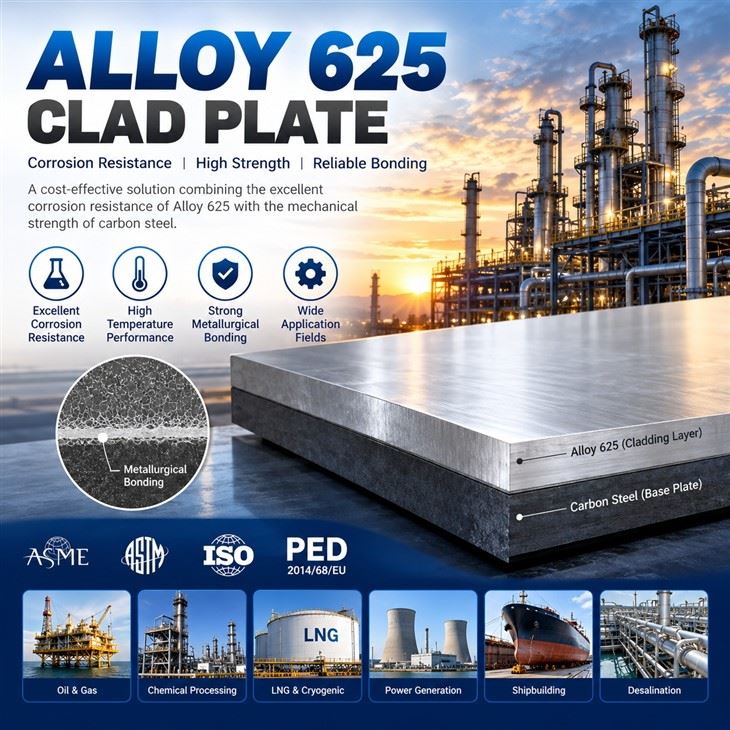
Xi'an Dongmeng Group Co., Ltd. is one of the most reliable manufacturers and suppliers of alloy 625 clad plate in China, also supports customized service. With abundant experience, we warmly welcome you to wholesale cheap products in stock here and get free sample from our factory. For price consultation, contact us.
Alloy 625 Clad Plate | ASTM A265 UNS N06625 Steel Plate Supplier
Xi'an Dongmeng Group Co., Ltd. supplies Alloy 625 clad plate (UNS N06625 / W.Nr. 2.4856) for chemical processing equipment, pressure vessels, offshore engineering, heat exchangers, and other corrosion-intensive industrial applications.
Our Alloy 625 clad steel plates combine a corrosion-resistant nickel-chromium-molybdenum-niobium alloy surface with a structural carbon steel or low-alloy steel substrate. This composite construction provides the corrosion protection of Alloy 625 while reducing the quantity of expensive nickel alloy required compared with solid Alloy 625 plate.
We support project-specific material selection, explosion-bonded and roll-bonded plate procurement, customized dimensions, inspection planning, and export delivery for equipment manufacturers, EPC contractors, fabricators, and industrial material distributors.
What Is Alloy 625 Clad Plate?
Alloy 625 clad plate is a metallurgically bonded composite metal plate consisting of a corrosion-resistant Alloy 625 layer and a structural steel backing plate.
The nickel alloy cladding forms the process-contact surface, while the backing steel provides much of the structural strength and thickness required for the equipment.
Unlike surface coatings or electroplating, metallurgically bonded clad plate incorporates a relatively thick, integral metallic layer designed to remain attached during qualified fabrication and service.
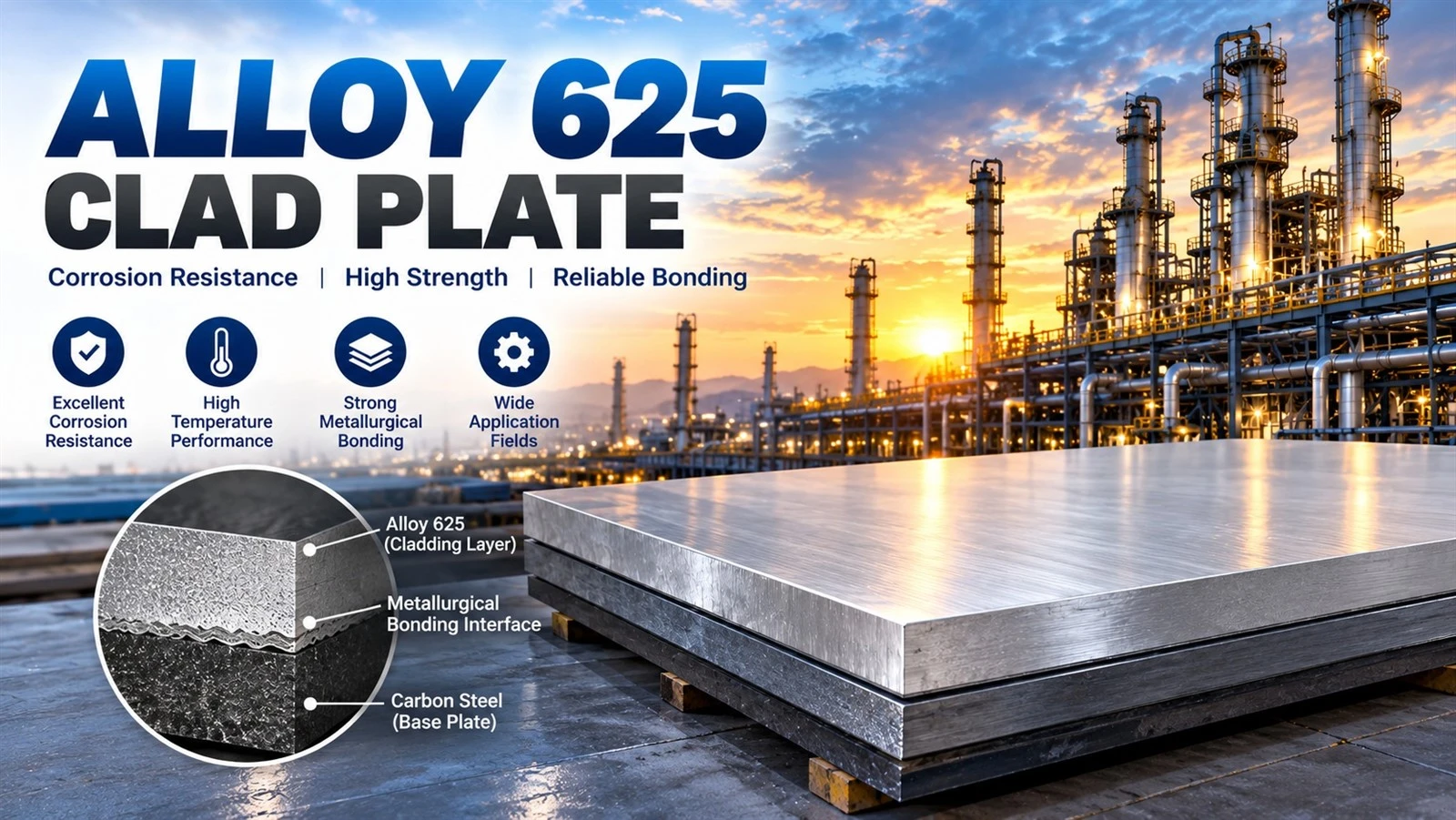
A typical Alloy 625 clad steel plate contains three functional components.
1. Alloy 625 Corrosion-Resistant Layer
The exposed Alloy 625 surface provides resistance to various aggressive environments, including chloride-containing process fluids, seawater, and selected chemical processing media.
Its chromium, molybdenum, and niobium content contributes to corrosion resistance, mechanical strength, and material stability.
2. Metallurgical Bonding Interface
The bonding interface connects the nickel alloy cladding to the structural backing steel.
Bond integrity is particularly important during plate forming, welding, thermal processing, and equipment operation.
Appropriate bond testing and ultrasonic examination help evaluate the integrity of this interface.
3. Structural Steel Base Plate
The carbon steel or low-alloy steel substrate supplies structural thickness and mechanical support.
For pressure-retaining equipment, the contribution of the backing steel and cladding to design strength must be evaluated according to the applicable construction code.
This combination enables equipment designers to use an expensive corrosion-resistant alloy where it is needed while selecting a more economical material for the structural backing.
Alloy 625 Clad Plate Specifications
Alloy 625 clad steel plates are available in project-specific thickness combinations, depending on the selected manufacturing method, base material, plate dimensions, and inspection requirements.
| Parameter | Specification |
|---|---|
| Product Type | Nickel Alloy Clad Steel Plate |
| Cladding Material | Alloy 625 / UNS N06625 |
| European Designation | W.Nr. 2.4856 / NiCr22Mo9Nb |
| Base Metal | Carbon Steel / Low-Alloy Steel |
| Common Base Grades | ASTM A516 Gr.70, ASTM A36, and other approved grades |
| Main Clad Plate Standard | ASTM A265 |
| ASME Clad Plate Specification | ASME SA-265, when specified |
| Cladding Material Standard | ASTM B443 / ASME SB-443 |
| Cladding Thickness | 2–20 mm (0.079–0.787 in) |
| Base Plate Thickness | 3–100 mm (0.118–3.937 in) |
| Reference Total Thickness | 5–120 mm (0.197–4.724 in) |
| Plate Width | 500–2500 mm (19.7–98.4 in) |
| Plate Length | 1000–8000 mm (39.4–315 in) |
| Bonding Methods | Explosion Bonding / Hot Roll Bonding |
| Cladding Configuration | Single-Sided / Custom Double-Sided |
| Surface Condition | As-Rolled / Cleaned / Pickled, as specified |
| Edge Preparation | Mill Edge / Cut Edge / Beveled Edge |
| Testing | Mechanical Tests / UT / PMI / Optional PT |
| Inspection Certificate | EN 10204 Type 3.1 / Optional Type 3.2 |
Technical Note: These ranges represent reference supply parameters rather than guaranteed manufacturing limits for every material combination. Maximum dimensions and achievable cladding thickness depend on the bonding process, plate thickness, material properties, and production route.
Typical Cladding Thickness Combinations
| Alloy 625 Cladding | Steel Base | Total Thickness | Potential Applications |
|---|---|---|---|
| 2 mm | 8 mm | 10 mm | Chemical equipment panels |
| 3 mm | 12 mm | 15 mm | Corrosion-resistant vessel components |
| 3 mm | 17 mm | 20 mm | Process equipment fabrication |
| 5 mm | 20 mm | 25 mm | Pressure vessel shell components |
| 6 mm | 24 mm | 30 mm | Industrial processing equipment |
| 8 mm | 32 mm | 40 mm | Heavy-duty engineered equipment |
The configurations above are illustrative engineering combinations. Actual availability and suitability must be verified against the project specification.
For pressure vessel construction, cladding thickness should be selected according to corrosion allowance, fabrication requirements, welding procedures, and the applicable design code.
Alloy 625 Chemical Composition
Alloy 625 is a nickel-chromium-molybdenum-niobium alloy identified internationally as UNS N06625.
Its combination of chromium, molybdenum, and niobium provides a useful balance of corrosion resistance and strength.
Nominal Specification Limits – Alloy 625 (UNS N06625)
| Element | Symbol | Composition (wt. %) |
|---|---|---|
| Nickel | Ni | 58.0 minimum |
| Chromium | Cr | 20.0–23.0 |
| Molybdenum | Mo | 8.0–10.0 |
| Niobium + Tantalum | Nb + Ta | 3.15–4.15 |
| Iron | Fe | 5.0 maximum |
| Carbon | C | 0.10 maximum |
| Manganese | Mn | 0.50 maximum |
| Silicon | Si | 0.50 maximum |
| Phosphorus | P | 0.015 maximum |
| Sulfur | S | 0.015 maximum |
| Aluminum | Al | 0.40 maximum |
| Titanium | Ti | 0.40 maximum |
| Cobalt | Co | 1.00 maximum, where determined |
The chemical composition of the Alloy 625 cladding material should be verified through the corresponding material test certificate.
The backing steel must independently meet the chemical composition requirements of its specified material grade.
For critical projects, positive material identification may be included in the inspection plan to verify the alloy composition.
Mechanical Properties of Alloy 625 Clad Plate
The mechanical properties of clad plate depend on the backing steel, cladding thickness, bonding process, heat treatment, and finished plate condition.
It is important to distinguish between the properties of solid Alloy 625 and those of the completed composite plate.
Reference Mechanical Properties of Alloy 625 Plate
| Property | Grade 1 – Annealed | Grade 2 – Solution Annealed |
|---|---|---|
| Tensile Strength | 760 MPa minimum | 690 MPa minimum |
| 0.2% Yield Strength | 380 MPa minimum | 275 MPa minimum |
| Elongation | 30% minimum | 30% minimum |
| Material | UNS N06625 | UNS N06625 |
| Reference Product Standard | ASTM B443 | ASTM B443 |
These values are indicative minimum requirements for certain hot-rolled Alloy 625 plate conditions under ASTM B443. Requirements vary with product form, thickness, condition, and the applicable standard edition. They must not be treated as guaranteed properties of the finished clad plate.
Mechanical Performance of the Composite Plate
For Alloy 625 clad steel plate, the following characteristics must be evaluated separately:
Base Metal Strength: Tensile strength, yield strength, and impact toughness according to the specified backing steel grade.
Cladding Properties: Chemical composition, thickness, and material condition according to the applicable Alloy 625 specification.
Bond Integrity: Mechanical bonding performance according to the applicable clad plate specification and purchase requirements.
Composite Plate Properties: Finished plate mechanical properties as required by the relevant product specification and equipment design code.
For pressure vessel applications, the design engineer must determine whether cladding is included in the strength calculation under the governing code.
Physical Properties of Alloy 625
The following values describe Alloy 625 itself rather than the steel-backed composite plate.
| Property | Approximate Value |
|---|---|
| Density | 8.44 g/cm³ |
| Elastic Modulus at Room Temperature | 208 GPa |
| Melting Range | 1290–1350°C |
| Magnetic Behavior | Essentially Nonmagnetic |
| Strengthening Mechanism | Solid-Solution Strengthening |
| Corrosion Resistance | High Resistance to Various Chloride-Containing Environments |
Thermal expansion, thermal conductivity, and other physical properties vary with temperature.
For clad plate fabrication involving elevated temperatures, the different thermal expansion characteristics of Alloy 625 and the backing steel must also be considered.
Manufacturing Methods: Explosion Bonding vs. Roll Bonding
The bonding method is a critical factor in the production of high-quality nickel alloy clad steel plate.
Alloy 625 clad plate may be manufactured using qualified explosion-bonding or hot-roll-bonding processes, depending on the material combination, plate dimensions, and technical requirements.
Explosion Bonded Alloy 625 Clad Plate
Explosion bonding uses controlled high-energy impact to join the cladding metal and backing steel through a solid-state bonding process.
The process creates a metallurgical interface without requiring the bulk materials to melt.
Explosion bonding may be suitable for:
Heavy-gauge composite plates
Selected dissimilar-metal combinations
Custom corrosion-resistant plate structures
Pressure vessel components
Special engineering projects
Engineering Considerations
The bonding interface, residual stresses, plate flatness, and any subsequent heat treatment requirements must be evaluated according to the approved manufacturing procedure.
Ultrasonic examination and mechanical bond testing are important elements of quality verification.
Hot Roll Bonded Alloy 625 Clad Plate
Hot roll bonding joins the cladding and backing materials through controlled high-temperature deformation.
Under suitable processing conditions, the metals develop a metallurgical bond through the rolling process.
Hot roll bonding may be selected for:
Industrial plate production
Repetitive plate specifications
Selected large-format clad plates
Chemical processing equipment
Pressure vessel plate fabrication
Engineering Considerations
Bonding temperature, reduction ratio, surface preparation, and heat treatment must be controlled to achieve the required mechanical properties and bond quality.
Manufacturing Process Comparison
| Parameter | Explosion Bonding | Hot Roll Bonding |
|---|---|---|
| Bonding Principle | High-Energy Impact | High-Temperature Rolling |
| Bonding Type | Metallurgical | Metallurgical |
| Typical Production Approach | Project-Specific | Mill-Based Production |
| Heavy Plate Applications | Often Suitable | Depends on Rolling Capability |
| Material Combination Flexibility | Broad for Qualified Combinations | Process Dependent |
| Bond Interface | Requires Qualification and Inspection | Requires Qualification and Inspection |
| Typical Quality Controls | UT, Mechanical Tests, Dimensional Inspection | UT, Mechanical Tests, Dimensional Inspection |
| Selection Basis | Geometry, Materials, Specification | Geometry, Materials, Specification |
Neither process is universally superior.
The appropriate manufacturing route depends on the required plate geometry, cladding ratio, service conditions, qualification requirements, and project economics.
Important: Weld overlay cladding is another method of applying Alloy 625 to steel, but it is a different manufacturing process from supplying an integrally bonded composite clad plate. The two product types should not be treated as automatically interchangeable.
Corrosion Resistance of Alloy 625 Clad Steel Plate
Alloy 625 is widely used in corrosive industrial environments because of its nickel-chromium-molybdenum-based composition.
The alloy provides a combination of general corrosion resistance, localized corrosion resistance, and mechanical strength.
Chloride-Induced Pitting Resistance
Molybdenum and chromium contribute to Alloy 625's resistance to localized corrosion in many chloride-containing environments.
This characteristic is particularly valuable in seawater processing equipment, offshore systems, and selected chemical manufacturing applications.
Crevice Corrosion Resistance
Alloy 625 offers strong resistance to crevice corrosion compared with many conventional stainless steels.
However, crevice geometry, chloride concentration, temperature, deposits, and oxidizing conditions can significantly influence performance.
Stress Corrosion Cracking Resistance
The nickel-rich composition provides good resistance to chloride-induced stress corrosion cracking in many environments where austenitic stainless steels may be vulnerable.
Material suitability must still be verified for the actual process fluid and operating conditions.
Chemical Processing Resistance
Alloy 625 may be selected for equipment exposed to various acidic, alkaline, and mixed chemical environments.
Corrosion performance depends on the exact chemical concentration, contamination level, temperature, flow conditions, and operating cycle.
Material Selection Note: Alloy 625 should not be described as universally resistant to all acids or chloride solutions. Chemical compatibility must be assessed using relevant corrosion data and project operating conditions.
Alloy 625 Clad Plate Applications
Chemical and Petrochemical Processing
Alloy 625 clad steel plate is suitable for consideration in chemical processing equipment requiring a corrosion-resistant process-contact surface over a structural steel backing.
Potential applications include:
Chemical reactors
Process vessels
Separation equipment
Chemical storage equipment
Process towers
Corrosion-resistant vessel internals
Oil and Gas Processing
Nickel alloy clad plate can be used in selected oil and gas equipment exposed to corrosive process fluids.
Typical equipment includes:
Gas processing vessels
Separation equipment
Offshore process systems
Corrosion-resistant pressure equipment
Selected sour-service components
For sour-service applications, the material system, welding procedures, and relevant requirements of ISO 15156 / NACE MR0175 must be evaluated where applicable.
Marine and Offshore Engineering
Alloy 625 offers corrosion resistance in many seawater and chloride-rich environments.
Potential applications include marine processing equipment, offshore vessels, seawater handling systems, and corrosion-resistant equipment components.
Desalination and Water Treatment
Alloy 625 clad construction may be considered for selected equipment used in desalination and seawater treatment facilities.
Applications include high-corrosion-risk process vessels, specialized seawater equipment, and associated industrial components.
Heat Exchangers and Pressure Vessels
Clad steel plates are particularly useful where equipment requires both corrosion-resistant surfaces and substantial structural wall thickness.
The backing steel provides structural support, while the nickel alloy layer protects the process-contact surface.
Tube sheets, shell sections, vessel heads, and other fabricated components may require additional bonding, machining, welding, or inspection controls.
Flue Gas and Industrial Chemical Treatment
Alloy 625 clad plate may be considered for selected flue gas treatment and chemical processing systems exposed to aggressive condensates or chloride-containing conditions.
Final material selection should be supported by process-specific corrosion evaluation.
How to Select the Correct Alloy 625 Clad Plate
Choosing the correct clad plate requires more than specifying the alloy grade and overall plate thickness.
The following factors should be reviewed before procurement.
1. Select the Base Metal
ASTM A516 Grade 70 is a commonly considered backing material for pressure vessel applications.
Other carbon steel and low-alloy grades may be selected according to the required mechanical strength, operating temperature, impact toughness, and fabrication requirements.
A stainless steel substrate may also be considered for a special engineered composite, but it should not automatically be specified as complying with ASTM A265, which covers carbon steel and low-alloy steel backing materials.
2. Determine the Required Cladding Thickness
The Alloy 625 layer must provide sufficient corrosion-resistant thickness after any required forming, machining, fabrication, and welding operations.
The specified thickness should account for the engineering design, manufacturing tolerances, and any applicable corrosion allowance.
3. Confirm Service Conditions
Important operating parameters include:
Design temperature
Design pressure
Process fluid composition
Chloride concentration
pH and acid concentration
Corrosion allowance
Thermal cycling conditions
Expected service life
4. Select the Bonding Process
Explosion bonding and hot roll bonding offer different manufacturing characteristics.
The selection should consider material compatibility, plate dimensions, mechanical property requirements, and inspection standards.
5. Confirm Inspection and Certification Requirements
For pressure vessel and critical industrial applications, the purchase specification should clearly state the bond inspection method, acceptance criteria, mechanical tests, traceability requirements, and inspection certificate type.
Fabrication, Welding and Heat Treatment
Alloy 625 clad plate can be fabricated into equipment components using qualified cutting, forming, machining, and welding procedures.
However, the dissimilar-metal structure requires additional engineering controls compared with conventional homogeneous steel plate.
Cutting and Edge Preparation
Mechanical cutting, thermal cutting, and other suitable methods may be used depending on plate thickness and fabrication requirements.
Edge preparation should prevent excessive contamination or damage to the Alloy 625 cladding surface.
For welded joints, the required groove geometry and cladding restoration procedure should be established before fabrication.
Forming and Bending
Forming procedures must account for the mechanical characteristics of the backing steel, cladding layer, and metallurgical bonding interface.
Minimum forming radius, forming temperature, and intermediate or final heat treatment requirements should be evaluated according to the material combination.
Additional bond-integrity inspection may be required after severe forming operations.
Welding
Welding must use procedures qualified for the selected backing steel and Alloy 625 cladding system.
Depending on the welding process, suitable Alloy 625 filler metals may include:
AWS A5.14 ERNiCrMo-3
AWS A5.11 ENiCrMo-3
Final filler metal selection depends on the joint design, welding process, corrosion requirements, and applicable fabrication code.
Special attention should be given to:
Welding procedure qualification
Base metal and cladding weld sequence
Dilution control
Cladding restoration at joints
Surface contamination prevention
Weld inspection requirements
Post-Weld Heat Treatment
Any post-weld heat treatment must be evaluated for compatibility with the backing steel, Alloy 625 cladding, and bonding interface.
The heat treatment required for the backing steel may influence the microstructure and corrosion performance of the nickel alloy layer.
Therefore, the complete thermal cycle should be reviewed and approved before fabrication.
Inspection & Quality Assurance
For industrial Alloy 625 clad plate, quality assurance must address both the individual metals and the integrity of the composite structure.
Inspection and testing requirements are determined by the applicable product standard, customer specification, and approved inspection and test plan (ITP).
| Inspection | Purpose |
|---|---|
| Chemical Analysis | Verify Alloy 625 and backing steel composition |
| Positive Material Identification (PMI) | Confirm alloy identification |
| Ultrasonic Testing (UT) | Evaluate the bonded interface for unbonded areas |
| Bond Strength Testing | Evaluate bonding performance |
| Shear Testing | Verify bond shear strength where required |
| Tensile Testing | Evaluate mechanical properties |
| Bend Testing | Evaluate ductility and bond performance where specified |
| Dimensional Inspection | Verify thickness, width, length, and flatness |
| Cladding Thickness Measurement | Confirm specified corrosion-resistant layer thickness |
| Visual Inspection | Check surface condition and visible defects |
| Dye Penetrant Testing (PT) | Detect surface-breaking indications where specified |
| Impact Testing | Verify backing steel toughness when required |
| Corrosion Testing | Verify selected corrosion-performance requirements |
| Third-Party Inspection | Independent verification when contracted |
Ultrasonic Bond Integrity Testing
Ultrasonic examination is important for detecting areas of inadequate bonding or delamination between the Alloy 625 cladding and the steel substrate.
The inspection procedure, scanning coverage, reference blocks, and acceptance criteria should be agreed upon before production.
For critical pressure equipment, customers may request enhanced examination coverage and project-specific acceptance requirements.
Mechanical Bond Testing
Bonding strength may be evaluated through mechanical testing according to ASTM A265 or other applicable project specifications.
The required test methods, sampling locations, and acceptance criteria should be included in the manufacturing quality plan.
Material Traceability
Material identification should be maintained through the production and delivery process.
Traceability records may include:
Cladding material heat number
Base steel heat number
Finished clad plate identification
Manufacturing route
Test results
Inspection records
Material Test Certificates
Inspection documents can be specified according to EN 10204.
Type 3.1: Inspection certificate containing specific inspection results and validated by an authorized manufacturer representative independent of the manufacturing department.
Type 3.2: Inspection certificate involving the manufacturer and the designated independent inspector, as required by the standard.
Independent inspection and additional certification requirements should be agreed before order confirmation.
Applicable Standards and Material Designations
| Standard / Designation | Application |
|---|---|
| ASTM A265 | Nickel and Nickel-Base Alloy-Clad Steel Plate |
| ASME SA-265 | ASME Specification for Nickel and Nickel-Base Alloy-Clad Steel Plate |
| ASTM B443 | Alloy 625 Plate, Sheet and Strip |
| ASME SB-443 | ASME Specification for Alloy 625 Plate, Sheet and Strip |
| ASTM A516 | Carbon Steel Pressure Vessel Plate |
| ASTM A36 | Structural Carbon Steel, where suitable |
| UNS N06625 | Alloy 625 Material Designation |
| W.Nr. 2.4856 | European Material Number for Alloy 625 |
| EN 10204 | Types of Material Inspection Documents |
| ASTM G48 | Optional Localized Corrosion Testing, when specified |
| ASME BPVC Section IX | Welding Procedure and Personnel Qualification |
The applicable standards must be selected according to the actual manufacturing process, backing material, equipment design, and purchase specification.
Alloy 625 Clad Plate vs. Solid Alloy 625 Plate
Both products provide an Alloy 625 surface, but they differ significantly in structural design and material consumption.
| Feature | Alloy 625 Clad Plate | Solid Alloy 625 Plate |
|---|---|---|
| Material Structure | Nickel Alloy + Steel Base | Full-Thickness Alloy 625 |
| Corrosion-Resistant Surface | Alloy 625 | Alloy 625 |
| Structural Material | Primarily Backing Steel | Alloy 625 |
| Nickel Alloy Consumption | Lower | Higher |
| Material Cost | Often Lower for Thick Components | Generally Higher |
| Bonding Interface | Present | Not Applicable |
| Fabrication | Requires Clad-Specific Controls | Conventional Alloy-Specific Fabrication |
| Typical Use | Large Vessels and Process Equipment | Solid Alloy Components and Specialized Equipment |
When Is Clad Plate the Better Choice?
Alloy 625 clad plate is often considered when the equipment requires substantial structural wall thickness but only the process-contact surface needs nickel alloy corrosion resistance.
Solid Alloy 625 plate may be preferred when full-thickness alloy properties are necessary, when extensive machining would remove the cladding, or when clad construction is not permitted by the applicable design requirements.
The correct selection depends on engineering performance, fabrication costs, inspection requirements, and lifecycle economics.
Packaging and International Delivery
Alloy 625 clad steel plates require suitable handling and protection to minimize surface contamination and transportation damage.
Packaging methods depend on the plate dimensions, weight, surface requirements, and shipping route.
Available Packaging Arrangements
Protective wrapping for the Alloy 625 cladding surface
Edge and corner protection
Suitable wooden supports or steel transport frames
Moisture protection for export shipments
Plate identification and traceability markings
Customized handling arrangements for heavy or oversized plates
Export Supply Options
Xi'an Dongmeng Group Co., Ltd. supports international supply arrangements for industrial projects and equipment manufacturers.
Available commercial terms may include EXW, FOB, CFR, and CIF, subject to quotation.
Shipping schedules depend on plate dimensions, manufacturing complexity, inspection requirements, and transportation arrangements.
Why Choose Xi'an Dongmeng Group Co., Ltd.?
Application-Oriented Material Selection
We assist customers in reviewing Alloy 625 cladding grades, backing steel materials, and plate thickness combinations according to project requirements.
Customized Clad Plate Procurement
We support project-specific requests for nickel alloy clad steel plates, including nonstandard dimensions, material combinations, and technical requirements.
Inspection and Documentation Coordination
Inspection requirements can be incorporated into the purchasing and production process, including material traceability, ultrasonic examination, mechanical testing, and inspection documentation.
Fabrication-Oriented Technical Communication
We understand that industrial clad plate procurement requires attention to bonding integrity, forming requirements, welding procedures, and applicable equipment codes.
International B2B Supply
We serve industrial buyers, equipment manufacturers, EPC contractors, distributors, and fabricators requiring project-based material procurement and export coordination.
Frequently Asked Questions
1. What is Alloy 625 clad plate used for?
Alloy 625 clad plate is used in selected chemical processing equipment, pressure vessels, offshore systems, desalination equipment, and other applications requiring a corrosion-resistant nickel alloy surface supported by structural steel.
2. What is the difference between Alloy 625 clad plate and solid Alloy 625 plate?
Alloy 625 clad plate contains a relatively thin nickel alloy layer bonded to a thicker structural metal substrate. Solid Alloy 625 plate consists entirely of the nickel alloy.
Clad plate can reduce nickel alloy consumption in equipment where full-thickness Alloy 625 is not required.
3. What standard applies to Alloy 625 clad steel plate?
ASTM A265 is a key specification for nickel and nickel-base alloy clad plates with carbon steel or low-alloy steel backing.
ASTM B443 applies to Alloy 625 plate, sheet, and strip used as cladding material.
The exact standard must be confirmed according to the product construction and project requirements.
4. Is Alloy 625 the same as UNS N06625?
Yes. UNS N06625 is the Unified Numbering System designation for Alloy 625.
Its European material number is 2.4856, and it is also identified as NiCr22Mo9Nb.
5. What base metal can be used for Alloy 625 clad plate?
Common backing materials include carbon steel and low-alloy pressure vessel steels, such as ASTM A516 Grade 70.
Other materials may be used for specially engineered composites, but the applicable manufacturing specification must be verified.
6. What cladding thickness is available?
Reference cladding thicknesses range from 2 mm to 20 mm.
The actual thickness range depends on plate dimensions, bonding method, backing steel thickness, and manufacturing capability.
7. Can Alloy 625 clad plate be explosion bonded?
Yes. Explosion bonding is one possible manufacturing method for Alloy 625 clad steel plate, subject to material compatibility and an appropriately qualified production process.
8. Can Alloy 625 clad plate be welded?
Yes. Welding is possible using qualified procedures suitable for the backing steel and nickel alloy cladding.
The procedure must address weld dilution, cladding restoration, corrosion resistance, and applicable fabrication code requirements.
9. How is the bonding quality inspected?
Bond integrity may be evaluated using ultrasonic examination and applicable mechanical bond tests.
The testing procedure and acceptance criteria should be specified according to ASTM A265 and the project purchase requirements.
10. Is Alloy 625 clad plate suitable for seawater applications?
Alloy 625 provides good corrosion resistance in many seawater and chloride-containing environments.
However, material suitability must be evaluated according to operating temperature, chloride concentration, crevice conditions, and other process parameters.
11. Can Alloy 625 clad plate be supplied with EN 10204 Type 3.1 certification?
EN 10204 Type 3.1 documentation can be included as a purchase requirement.
Type 3.2 certification and third-party inspection may also be arranged when agreed before manufacturing.
12. What information is required to request a quotation?
For an accurate quotation, please provide:
Required plate quantity
Alloy 625 cladding thickness
Backing steel grade and thickness
Total plate dimensions
Applicable standards
Preferred bonding process, if specified
Mechanical testing requirements
Ultrasonic inspection requirements
Surface and edge preparation requirements
Inspection certificate requirements
Delivery destination
Technical drawings or purchase specifications
Our team will review the technical information and provide a quotation based on the required material configuration and inspection scope.
Contact Us – Request an Alloy 625 Clad Plate Quotation
Xi'an Dongmeng Group Co., Ltd. supplies corrosion-resistant nickel alloy clad steel plates for international industrial projects.
Whether you require Alloy 625 clad pressure vessel plate, explosion-bonded composite plate, or a custom nickel alloy cladding configuration, please contact our team with your technical specifications.
We welcome inquiries from equipment manufacturers, engineering contractors, industrial distributors, and project procurement teams.
Company: Xi'an Dongmeng Group Co., Ltd.
Phone / WhatsApp: +86 15769214734
Email: office@dongmjd.com
Office Address: Room 4107, Runfeng Building, Sanqiao New Street, Weiyang District, Xi'an City, Shaanxi Province, China
Send your plate dimensions, backing steel grade, cladding thickness, inspection requirements, and project drawings to request a technical quotation.
Hot Tags: Alloy 625 Clad Plate, UNS N06625 Clad Steel Plate, ASTM A265 Clad Plate, Inconel 625 Clad Plate, Nickel Alloy Clad Steel Plate, Explosion Bonded Alloy 625 Plate, Roll Bonded Alloy 625 Plate, Alloy 625 Clad Pressure Vessel Plate, 625 Clad Plate Supplier


