


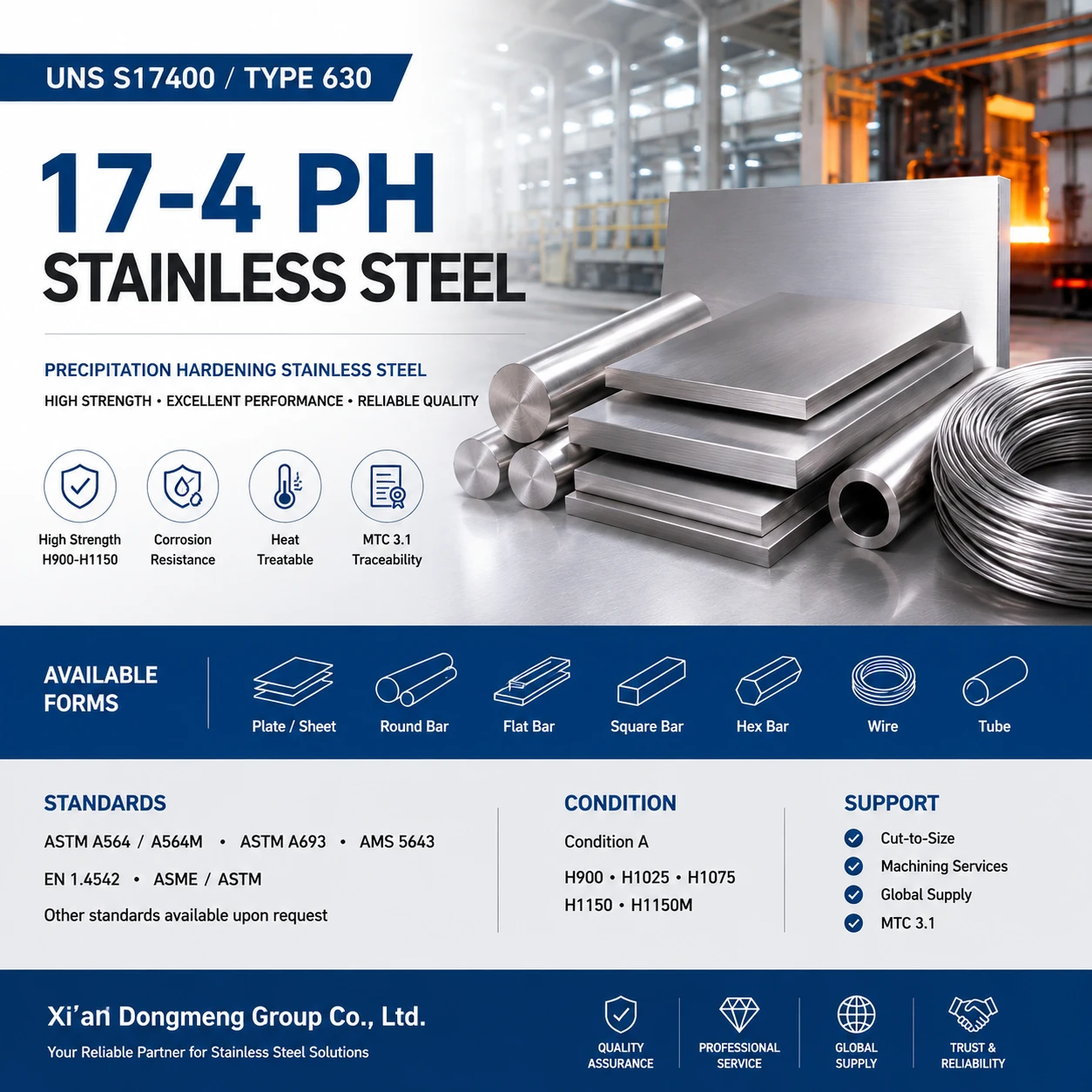
Xi'an Dongmeng Group Co., Ltd. is one of the most reliable manufacturers and suppliers of 17-4 PH Stainless Steel | UNS S17400 H900–H1150 in China, also supports customized service. With abundant experience, we warmly welcome you to wholesale cheap products in stock here and get free sample from our factory. For price consultation, contact us.
Xi'an Dongmeng Group Co., Ltd. supplies 17-4 PH stainless steel, UNS S17400 / Type 630, for aerospace, oil and gas, chemical processing, valve, pump, shaft, fastener and precision-engineering applications.
Unlike conventional austenitic grades such as 304 and 316, 17-4 PH can be strengthened by precipitation aging after solution treatment. By selecting the appropriate aging condition-from H900 for maximum strength to H1150 or H1150M for greater toughness and improved stress-corrosion resistance-engineers can adjust the balance between strength, hardness, ductility and environmental resistance.
Available forms include plate, sheet, strip, round bar, flat bar, square bar, hex bar, wire and mechanical tubing, subject to specification and size requirements.
Cutting, sawing, machining, polishing, heat-treatment coordination, inspection and export packing can be arranged according to project requirements.
Need help selecting H900, H1025 or H1150?
Send us your required product form, dimensions, mechanical properties and service environment for material selection and quotation.
17-4 PH Stainless Steel at a Glance
| Property | Specification |
| Grade | 17-4 PH Stainless Steel |
| UNS | S17400 |
| AISI / Type | Type 630 |
| EN / DIN | 1.4542 / X5CrNiCuNb16-4 |
| Metallurgical Structure | Martensitic precipitation-hardening stainless steel |
| Main Alloying Elements | Cr · Ni · Cu · Nb |
| Supply Condition | Condition A or precipitation hardened |
| Common Aging Conditions | H900 · H925 · H1025 · H1075 · H1100 · H1150 · H1150M |
| Density | Approx. 7.75 g/cm³ in Condition A |
| Magnetic | Yes |
| Typical Service Requirement | High strength + moderate/good corrosion resistance |
| Processing | Approx. 7.75 g/cm³ in Condition A |
| Inspection |
|
| Documentation | MTC 3.1 / Heat number traceability according to order |
| Packing | Export wooden case / pallet / waterproof protection |
17-4 PH Standards by Product Form
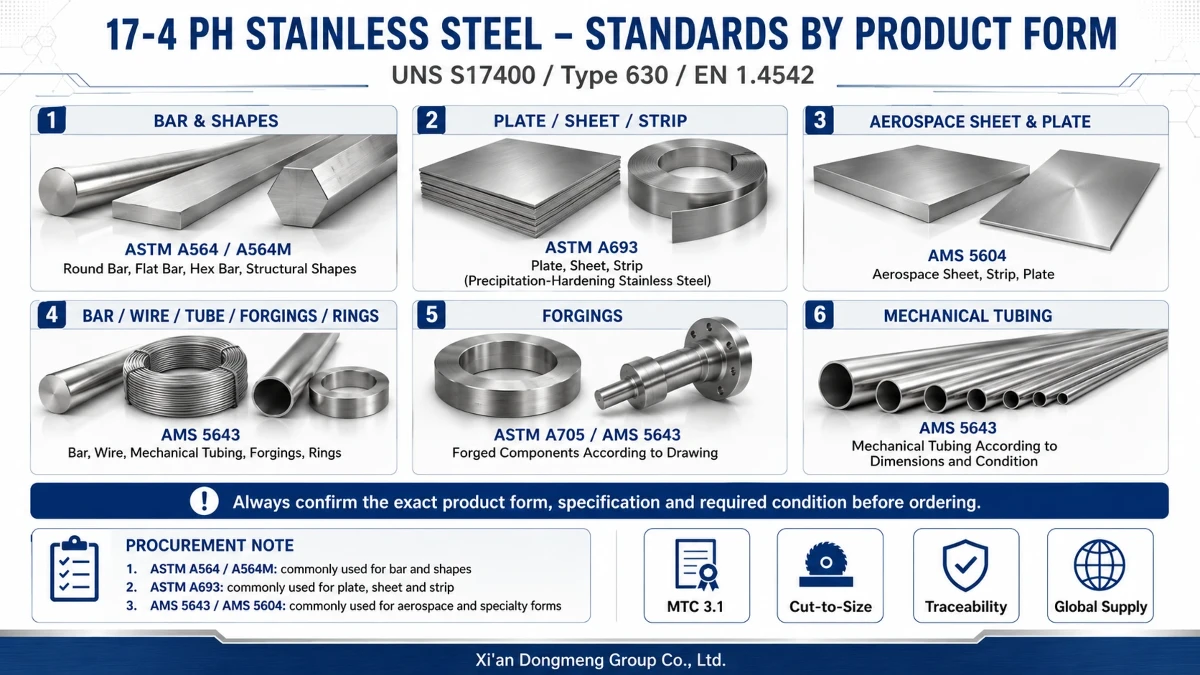
One of the most important purchasing considerations is that the applicable material standard depends on the product form.
Do not specify only "17-4 PH" on a purchase order. The product form, standard and required heat-treatment condition should also be stated.
| Product Form | Common Specification | Typical Supply |
| Round / Square / Hex / Flat Bar | ASTM A564 / A564M | Condition A or aged condition |
| Structural Shapes | ASTM A564 / A564M | According to order |
| Plate / Sheet / Strip | ASTM A693 | Solution treated or precipitation hardened |
| Aerospace Sheet / Strip / Plate | AMS 5604 | According to aerospace specification |
| Bar / Wire | AMS 5643 | Solution treated or specified aged condition |
| Forgings | ASTM A705 / AMS 5643 | According to drawing and heat-treatment requirement |
| Mechanical Tubing | AMS 5643 | According to dimensions and condition |
| Rings / Forging Stock | AMS 5643 | According to purchaser specification |
Procurement Note
ASTM A564 and ASTM A693 are not interchangeable.
For example:
ASTM A564 is commonly specified for 17-4 PH bar and shapes.
ASTM A693 is used for precipitation-hardening stainless steel plate, sheet and strip.
AMS 5643 is widely used for aerospace-grade bar, wire, forgings, mechanical tubing and rings.
Always confirm the exact product form and governing specification before ordering.
17-4 PH Heat Treatment: H900 vs H1025 vs H1075 vs H1150

The H-condition is one of the most important parameters on a 17-4 PH purchase order.
17-4 PH is normally solution treated first and then precipitation aged at a controlled temperature.
Higher aging temperatures generally reduce tensile strength and hardness while improving ductility, impact toughness and resistance to certain forms of stress-corrosion cracking.
Typical Room-Temperature Properties
| Condition | Typical Aging Treatment | 0.2% Yield Strength | Tensile Strength | Elongation | Hardness | Selection Priority |
| H900 | 482°C / 900°F × 1 h | ~1260 MPa | ~1365 MPa | ~15% | ~44 HRC | Maximum strength / hardness |
| H1025 | 552°C / 1025°F × 4 h | ~1115 MPa | ~1160 MPa | ~16% | ~38 HRC | High strength + improved toughness |
| H1075 | 579°C / 1075°F × 4 h | ~1020 MPa | ~1130 MPa | ~17% | ~36 HRC | Balanced strength and toughness |
| H1150 | 621°C / 1150°F × 4 h | ~870 MPa | ~995 MPa | ~20% | ~33 HRC | Higher toughness / SCC resistance |
| H1150M | Double aging | ~600 MPa | ~850 MPa | ~22% | ~29 HRC | Maximum toughness / lower strength |
Important: Values above are typical engineering reference values, not guaranteed purchase minimums. Mechanical-property requirements must be confirmed against the applicable ASTM, AMS, ASME or customer specification, product size and testing direction.
How to Choose the Correct 17-4 PH Condition

Choose H900 When
Maximum tensile strength, yield strength and hardness are the main design requirements.
Typical examples include:
high-strength fasteners, precision components, tooling and selected aerospace fittings.
H900 should be evaluated carefully when impact toughness, chloride exposure or stress-corrosion cracking is a major concern.
Choose H1025 When
You need high strength but require more toughness than H900.
H1025 is widely considered a useful engineering compromise for shafts, fasteners, valves and aerospace components.
Choose H1075 When
Strength, toughness and machinability need to be balanced.
It can be suitable for pumps, shafts, valves and industrial components subjected to cyclic loading.
Choose H1150 When
Toughness and stress-corrosion resistance are more important than maximum hardness.
H1150 is often considered for oilfield, marine-adjacent, pump, valve and heavy-duty components where H900 may be unnecessarily hard or notch sensitive.
Choose H1150M When
Higher ductility and toughness are required and reduced strength is acceptable.
The correct condition must always be selected from actual design stresses, service temperature, corrosion environment and governing specification.
Condition A Is Not the Final Service Condition
17-4 PH is frequently supplied in Condition A, the solution-treated condition, because it is convenient for machining and subsequent heat treatment.
However, Condition A should not automatically be regarded as the preferred final condition for a finished component.
The normal manufacturing route is:
Solution Treatment → Rough Machining → Aging / Precipitation Hardening → Finish Machining → Inspection
This allows the required final mechanical properties to be developed after initial machining while minimizing distortion compared with conventional quench-hardening processes.
When ordering Condition A material, specify who will perform the final aging operation and what final H-condition must be achieved.
Corrosion Resistance of 17-4 PH
17-4 PH offers substantially better corrosion resistance than many conventional hardenable 400-series martensitic stainless steels.
In many environments, its corrosion resistance can approach that of 304 stainless steel, but it should not automatically be treated as a replacement for 316L or duplex stainless steel in aggressive chloride service.
General Selection Guidance
| Environment | Suitability |
| Atmospheric exposure | Generally good |
| Fresh water | Generally good |
| Mild industrial environments | Generally good |
| Oxidizing environments | Application dependent |
| Salt spray | Can perform well with correct condition and surface treatment |
| Seawater immersion | Restricted - evaluate carefully |
| High-chloride solutions | Risk of pitting / crevice corrosion / SCC |
| Sulfuric acid | Generally restricted; concentration and temperature critical |
| Sour oil & gas | Requires specification-specific qualification |
| Chemical processing | Medium, concentration, temperature and H-condition must be reviewed |
For maximum corrosion resistance, finished components should be properly cleaned and, where required, passivated after fabrication.
Important Chloride and SCC Warning
17-4 PH should not be selected for marine or chloride environments based only on the word "stainless."
Stress-corrosion resistance depends strongly on heat-treatment condition.
Higher aging temperatures such as H1025 and above generally provide improved stress-corrosion-cracking resistance compared with the highest-strength H900 condition.
For seawater, concentrated chloride solutions or severe offshore service, compare 17-4 PH with alternatives such as:
316L · Duplex 2205 · Super Duplex 2507 · Nickel Alloys
Material selection should consider chloride concentration, temperature, applied stress, crevices, deposits and required mechanical strength.
17-4 PH vs 304 vs 316L Stainless Steel
| Property | 17-4 PH | 304 | 316L |
| Stainless Type | PH Martensitic | Austenitic | Austenitic |
| Heat Treatable for High Strength | Yes | No | No |
| Maximum Strength | Very High | Moderate | Moderate |
| Hardness | High after aging | Lower | Lower |
| General Corrosion Resistance | Good | Good | Very Good |
| Chloride Resistance | Limited / condition dependent | Limited | Better |
| Magnetic | Yes | Normally low / non-magnetic in annealed condition | Normally low / non-magnetic in annealed condition |
| Machinability | Good with correct condition | Moderate | Moderate |
| Typical Use | Shafts, valves, aerospace, high-strength parts | General fabrication | Chemical / marine / chloride environments |
Selection Rule
Choose 17-4 PH when strength and hardness are major requirements.
Choose 304 when general corrosion resistance, forming and weldability are more important than very high strength.
Choose 316L when chloride resistance is more important and precipitation hardening is not required.
Available 17-4 PH Product Forms
Xi'an Dongmeng Group Co., Ltd. can provide 17-4 PH material according to required product form, dimensional tolerance and heat-treatment condition.
| Product Form | Current Size Range* | Typical Requirement |
| Sheet / Plate | 0.5–50 mm thickness | Cut plate / sheet |
| Round Bar | Ø6–200 mm | Saw cut / machined |
| Flat Bar | 10–100 mm thickness | Custom width / length |
| Mechanical Tube | OD 10–150 mm | Custom wall / length |
| Wire | Ø0.5–10 mm | Coil / straight length |
| Custom Machined Part | Drawing based | CNC / drilling / turning |
*Availability depends on standard, heat-treatment condition, tolerance, quantity and current production or stock status. Confirm dimensions before final specification.
Processing Capabilities
17-4 PH can be supplied with additional processing according to drawing or purchase specification.
Available processing may include:
Cut-to-length
Saw cutting
Plate cutting
CNC turning
Milling
Drilling
Grinding
Polishing
Surface cleaning
Passivation coordination
Heat-treatment coordination
Dimensional inspection
For precision components, send the drawing together with tolerance, surface roughness, H-condition and inspection requirements.
Machining 17-4 PH Stainless Steel
17-4 PH can be machined in both solution-treated and age-hardened conditions.
Condition A is commonly selected when extensive rough machining is required before final aging.
Machining characteristics change significantly with hardness. H900 material requires more conservative cutting parameters than overaged conditions such as H1075 or H1150.
For precision parts, a practical route is often:
Condition A material → Rough machining → Aging → Finish machining → Final dimensional inspection
This approach can reduce machining difficulty while allowing the component to reach its required final strength.
Welding 17-4 PH Stainless Steel
17-4 PH can be welded using suitable fusion and resistance-welding processes.
Welding in the solution-treated condition is commonly used, after which the component can be aged to the required mechanical-property condition.
Where matching weld-metal properties are required, appropriate 630-type filler material may be considered according to the welding procedure.
For critical welded components, the complete sequence of:
welding → solution treatment → aging
may be required to obtain the optimum combination of strength, ductility and corrosion resistance.
Welding procedure, filler selection and post-weld heat treatment should always follow the applicable engineering or fabrication specification.
Typical 17-4 PH Applications
Aerospace
Aircraft fittings
High-strength fasteners
Structural components
Precision shafts
Actuator components
Oil & Gas
Valve stems
Valve components
Pump shafts
High-strength fittings
Wellhead and equipment components
Chemical Processing
Pump components
Valve parts
Shafts
High-strength mechanical components
Power Generation
Turbine-related components
Fasteners
Shafts
Valve parts
Industrial Machinery
Gears
Wear-resistant parts
High-load shafts
Precision mechanical components
Medical & Precision Engineering
Surgical tooling
Instrument components
Precision machined parts
Material condition and corrosion requirements must be confirmed for each application rather than selecting the grade by industry name alone.
Chemical Composition (Typical)
| Element | Content (%) |
|---|---|
| Carbon (C) | 0.07 max |
| Chromium (Cr) | 15.0–17.5 |
| Nickel (Ni) | 3.0–5.0 |
| Copper (Cu) | 3.0–5.0 |
| Manganese (Mn) | 1.0 max |
| Silicon (Si) | 1.0 max |
| Iron (Fe) | Balance |
Mechanical Properties
| Property | Condition | Value |
|---|---|---|
| Tensile Strength | H900 | 1,320–1,440 MPa (191–209 ksi) |
| Yield Strength | H900 | 1,240–1,380 MPa (180–200 ksi) |
| Elongation | H900 | 10–12% |
| Hardness | H900 | 44–50 HRC |
| Density | - | 7.75 g/cm³ |
| Modulus of Elasticity | - | 200 GPa |
Available Forms & Standard Sizes
| Form | Thickness / Diameter | Width / OD | Length |
|---|---|---|---|
| Sheet / Plate | 0.5–50 mm | 1000–2000 mm | 2000–6000 mm |
| Round Bar | 6–200 mm | - | Cut-to-length |
| Flat Bar | 10–100 mm | 20–300 mm | Custom |
| Tube / Pipe | 10–150 mm OD | 1–20 mm wall | Custom |
| Wire | 0.5–10 mm | - | Coil |
Products Features
High strength combined with good corrosion resistance
Excellent fatigue and wear resistance
Precipitation hardenable to tailor mechanical properties
Good machinability and weldability in solution-annealed condition
Suitable for cryogenic to moderately high-temperature applications
Inspection & Quality Documentation

For B2B and engineering orders, material can be supplied with inspection and documentation according to purchase requirements.
| Inspection Item | Available Requirement |
| Chemical Composition | Spectrometer / heat analysis |
| Mechanical Properties | Tensile / hardness according to specification |
| Dimensional Inspection | OD / thickness / width / length / tolerance |
| PMI | On request |
| Surface Inspection | Visual / dimensional |
| Ultrasonic Testing | When specified and applicable |
| Third-Party Inspection | SGS / BV / TÜV or nominated agency on request |
| Material Certificate | EN 10204 3.1 / relevant mill certificate |
| Traceability | Heat number / batch identification |
Please state required inspection standards before quotation because additional testing can affect production time and cost.
What to Include in a 17-4 PH RFQ
For faster and more accurate quotation, provide:
1. Grade
17-4 PH / UNS S17400 / Type 630
2. Product Form
Plate / Sheet / Strip / Round Bar / Flat Bar / Wire / Mechanical Tubing / Forging
3. Standard
ASTM A564 / ASTM A693 / AMS 5643 / AMS 5604 / ASTM A705 or customer specification
4. Heat-Treatment Condition
Condition A / H900 / H1025 / H1075 / H1150 / H1150M
5. Dimensions
Thickness × Width × Length
or
Diameter × Length
or complete drawing
6. Quantity
7. Required Mechanical Properties
8. Surface / Machining Requirement
9. Inspection Documentation
10. Destination and Required Delivery Date
Need Help Choosing 17-4 PH?
The correct 17-4 PH specification is determined by more than the alloy grade.
Tell our engineering team:
application + loading + operating temperature + corrosion medium + dimensions + required strength
and we can help confirm an appropriate product form, material standard and heat-treatment condition before quotation.
Request a Quote
17-4 PH / UNS S17400
ASTM A564 · ASTM A693 · AMS 5643
Condition A · H900 · H1025 · H1075 · H1150 · H1150M
Cut-to-Size · Machining · MTC 3.1 · Third-Party Inspection
FAQ
1. What is 17-4 PH stainless steel?
17-4 PH, also known as Type 630 or UNS S17400, is a martensitic precipitation-hardening stainless steel containing chromium, nickel, copper and niobium. It can achieve very high strength through controlled aging heat treatment.
2. Is UNS S17400 the same as 17-4 PH?
Yes. UNS S17400 is the UNS designation commonly associated with 17-4 PH stainless steel and AISI Type 630.
3. What is EN 1.4542 stainless steel?
EN 1.4542 / X5CrNiCuNb16-4 is the commonly referenced European designation corresponding closely to 17-4 PH / UNS S17400.
4. What is the difference between H900 and H1150?
H900 provides higher strength and hardness. H1150 provides lower strength but greater ductility, impact toughness and generally improved resistance to stress-corrosion cracking.
5. Which 17-4 PH condition is strongest?
H900 is normally selected when maximum strength and hardness are required.
6. Which condition has better toughness?
H1150 and H1150M generally provide considerably greater toughness than H900.
7. Is Condition A suitable for final use?
Condition A is primarily the solution-treated condition and is commonly used for machining before final aging. The required final service condition should be defined by the component design and material specification.
8. Is 17-4 PH more corrosion resistant than 304?
Not generally. Its corrosion resistance in many environments can approach that of 304, while its major advantage is much higher achievable strength. It should not automatically be considered superior to 304 in corrosion resistance.
9. Is 17-4 PH better than 316L in seawater?
Usually not when corrosion resistance alone is considered. 316L has molybdenum and generally provides better chloride resistance, while duplex and super duplex grades may be more appropriate for severe seawater exposure.
10. Can 17-4 PH be used in marine environments?
It can be used in selected marine applications, but seawater immersion and severe chloride exposure require careful evaluation because pitting, crevice corrosion and stress-corrosion cracking may occur.
11. Is 17-4 PH magnetic?
Yes. Because of its predominantly martensitic structure, 17-4 PH is magnetic.
12. Can 17-4 PH be welded?
Yes. It can be welded using suitable procedures. Welding in the solution-treated condition followed by aging is commonly used, although the final procedure depends on the required properties.
13. Can 17-4 PH be machined before heat treatment?
Yes. Condition A is frequently selected for rough machining before precipitation aging and final machining.
14. What standard is used for 17-4 PH bar?
ASTM A564/A564M is one of the principal specifications for age-hardening stainless steel bars and shapes. AMS 5643 is frequently specified for aerospace applications.
15. What standard is used for 17-4 PH plate?
ASTM A693 is commonly used for precipitation-hardening stainless steel plate, sheet and strip. Aerospace flat products may be specified to AMS requirements such as AMS 5604.
16. Can you supply 17-4 PH with MTC 3.1?
Material certificates and heat-number traceability can be supplied according to purchase-order requirements. State the required certificate type when requesting a quotation.
17. Can 17-4 PH be supplied cut to size?
Yes. Plate, bar and other forms can be cut or processed according to required dimensions, tolerance and quantity.
18. What information is needed for a 17-4 PH quotation?
Provide the grade, product form, applicable standard, H-condition, dimensions, quantity, required mechanical properties, inspection documentation and delivery destination.
Are you looking for high-quality 17-4 PH stainless steel for your projects? Our team is ready to provide custom sizes, OEM solutions, and rapid global delivery.
We pride ourselves on ISO-certified quality, strict third-party inspections, and responsive customer support, ensuring that your materials meet the highest standards.
Get in touch today and let us help you find the perfect solution for your engineering, aerospace, chemical, or industrial applications.
Our address
Room 4107, Runfeng Building, Sanqiao New Street, Weiyang District, Xi'an City, Shaanxi Province
Phone Number
+86 15769214734

Hot Tags: 17-4 PH Stainless Steel | UNS S17400 H900–H1150,UNS S17400,Type 630 Stainless Steel,17-4 PH H900,17-4 PH H1150,ASTM A564 17-4 PH,17-4 PH Stainless Steel | UNS S17400 H900–H1150 Bar,17-4 PH Stainless Steel | UNS S17400 H900–H1150 Plate,AMS 5643 Stainless Steel,Precipitation Hardening Stainless Steel China 17-4 PH Stainless Steel | UNS S17400 H900–H1150 manufacturers, suppliers, factory, 440C Stainless Steel


