
1235-O and 8011-O Aluminum Foil for Cigarette Inner Liners
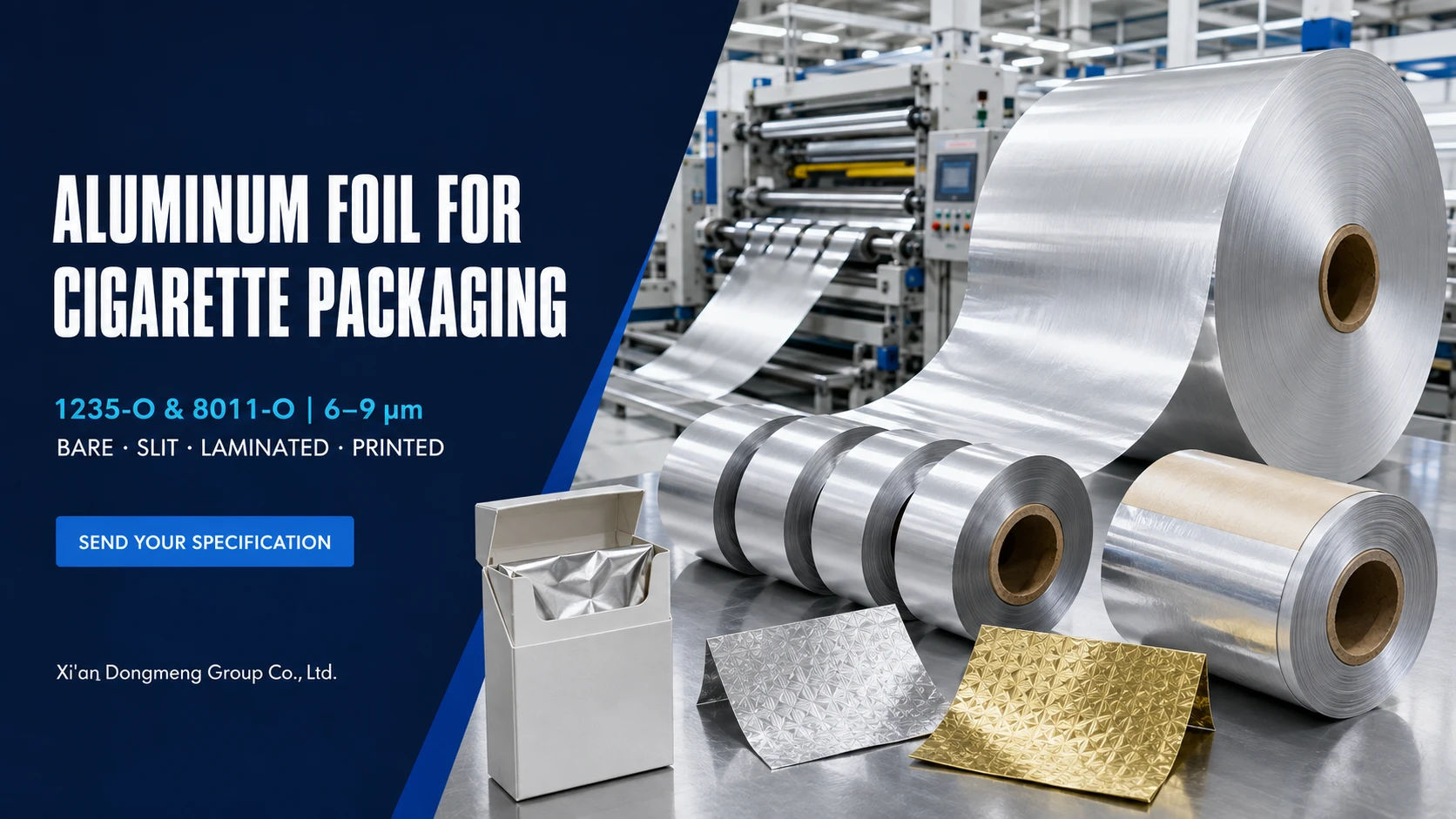
Xi'an Dongmeng Group Co., Ltd. supplies 1235-O and 8011-O aluminum foil for converters producing cigarette inner liners and tobacco packaging materials. The foil can be supplied as bare jumbo or slit rolls and, subject to technical confirmation, as paper-laminated, embossed or printed material.
For each project, we review the foil gauge, finished web width, core ID, roll OD or roll weight, winding direction, splice limit, surface condition and pinhole acceptance against the buyer's converting and packing-line requirements.
Send for quotation:
Foil Structure × Alloy/Temper × Gauge × Width × Core ID × Roll Requirement × Quantity
Send Your Inner Liner Specification
Request Technical Data / Ask About Sample Availability
Aluminum foil for cigarette packaging is a high-barrier material specifically engineered for cigarette inner liner foil and tobacco inner packaging applications. This tobacco aluminum foil provides excellent resistance to moisture, oxygen, and light, making it an essential solution for maintaining cigarette freshness, aroma retention, and product integrity. As a widely used aluminum foil for cigarette inner packaging, it ensures long-term storage stability and premium packaging performance for global tobacco brands.
Produced from high-purity 1235 and 8011 aluminum alloys, aluminum foil for cigarette packaging offers superior flexibility, strong heat sealability, and excellent compatibility with paper lamination and printed foil structures. Compared with other packaging materials, cigarette inner liner foil delivers outstanding barrier properties, lightweight advantages, and cost-effective performance, making it the preferred choice for tobacco foil manufacturers and cigarette packaging suppliers worldwide.
With increasing demand for high-quality tobacco packaging materials, aluminum foil for cigarette packaging continues to play a critical role in cigarette inner liner systems, laminated foil structures, and printed tobacco foil solutions, meeting strict international standards for food-grade safety and packaging reliability.
Types of Cigarette Packaging Foil
1. Plain Aluminum Foil
Used for basic inner wrapping.
2. Laminated Aluminum Foil (Foil + Paper)
Improves strength and printability.
3. Printed Aluminum Foil
Customized branding and decorative packaging.


Cigarette Packaging Foil Procurement Summary
| Item | Available Specification |
|---|---|
| Product | Aluminum Foil for Cigarette Inner Liners |
| Common Alloys | 1235 / 8011 |
| Temper | O, fully annealed |
| Foil Gauge | 6–9 μm / 0.006–0.009 mm |
| Published Width Range | 100–1,200 mm; custom slitting subject to confirmation |
| Core ID | 76 mm / 152 mm; other sizes subject to review |
| Bare Foil Surface | Typically one side bright and one side matte |
| Supply Forms | Bare jumbo roll, slit roll, foil-paper laminate |
| Converted Options | Printing, embossing, coating or colored finish by order |
| Quality Controls | Gauge, width, surface, pinholes, tensile properties, wettability, edges, winding and splices |
| Documents | COA/MTC and agreed inspection records |
| Packing | Moisture-resistant export packing with roll and batch identification |
Availability depends on alloy, gauge, width, converted structure and order volume. Final requirements should be recorded in the approved technical specification and purchase order.
Choose the Correct Cigarette Inner Liner Material
"Cigarette foil" can refer to several different products. Buyers should confirm the required supply stage before requesting a quotation.
| Supply Form | Recommended Buyer | Information Required |
|---|---|---|
| Bare Aluminum Foil | Paper laminators, coating and printing converters | Alloy, gauge, width, core, roll OD, pinholes, wettability and splice limit |
| Custom Slit Foil | Converters requiring production-ready web widths | Finished width, slitting tolerance, winding direction, core ID and roll build |
| Foil-Paper Laminate | Cigarette inner-liner manufacturers and packers | Foil gauge, paper type and grammage, adhesive, total grammage, bond strength, curl and COF |
| Printed or Embossed Liner | Packaging producers requiring decorative finishes | Artwork, color reference, print side, repeat length, embossing pattern and approval sample |
| Coated Foil Structure | Lines requiring slip or heat-seal performance | Coating type, coat weight, sealant substrate, sealing temperature and COF requirement |
Metallized paper is not the same product as aluminum foil laminated paper. Its construction, metal thickness, barrier performance and recycling route are different and should be specified separately.
Why Aluminum Foil Is Used in Cigarette Inner Liners
Soft aluminum foil offers dead-fold behavior, allowing the inner liner to retain a formed fold around the cigarette bundle. It also provides a continuous metal layer that contributes to protection against light, moisture and aroma transfer.
However, the finished package performance is not determined by aluminum alone. At gauges of 6–9 μm, pinholes, paper lamination, adhesive coverage, folds, seams and pack closure can all affect the measured barrier.
For this reason:
Bare foil should be evaluated using agreed foil quality requirements.
Laminated materials should be tested as a complete construction.
Finished-pack shelf-life claims should be based on the buyer's packaging validation.
Bare aluminum foil should not be described as heat-sealable unless a heat-seal coating or sealant layer is applied.
Aluminum foil's dead-fold characteristic is a recognized functional advantage for wrapping applications, but finished-package performance still depends on the complete structure. European Aluminium Foil Association
Chemical Composition
| Element | 1235 (%) | 8011 (%) |
|---|---|---|
| Al | ≥99.35 | Balance |
| Si + Fe | ≤0.65 | 0.6 – 1.0 |
| Cu | ≤0.05 | ≤0.1 |
| Mn | ≤0.05 | ≤0.2 |
| Zn | ≤0.1 | ≤0.1 |
Key Features
1. Excellent Barrier Performance
Prevents moisture, oxygen, and light penetration, ensuring tobacco freshness.
2. Aroma Retention
Maintains the original flavor and fragrance of cigarettes.
3. High Flexibility
Easy to fold and wrap without cracking.
4. Heat Seal Compatibility
Suitable for lamination with paper or plastic films.
5. Food-Grade Safety
Complies with international food packaging standards.
1235-O vs 8011-O for Cigarette Packaging
| Selection Factor | 1235-O Aluminum Foil | 8011-O Aluminum Foil |
|---|---|---|
| Alloy Type | Commercially pure aluminum grade | Al-Fe-Si aluminum foil alloy |
| General Character | Soft and highly flexible | Greater strength and web stability at comparable conditions |
| Folding | Good dead-fold and conformability | Good folding with improved handling strength |
| Typical Selection Priority | Softness, lamination and economical light-gauge conversion | High-speed converting, stronger web handling and tear resistance |
| Recommended Verification | Gauge, tensile strength, elongation, pinholes and wettability | Gauge, tensile strength, elongation, pinholes and winding quality |
Neither alloy should be selected by grade name alone. The buyer should approve the actual tensile properties, elongation, gauge profile, pinhole level and roll performance.
For new packaging structures or high-speed lines, a trial roll is recommended before commercial production.
Foil Thickness and Theoretical Weight
Thinner foil reduces metal consumption but is generally more sensitive to pinholes and web breaks. Increasing gauge can improve handling stability, although it also increases material weight, stiffness and cost.
| Nominal Gauge | Approximate Foil Weight |
|---|---|
| 6.0 μm | 16.2 g/m² |
| 6.4 μm | 17.3 g/m² |
| 6.5 μm | 17.6 g/m² |
| 7.0 μm | 18.9 g/m² |
| 8.0 μm | 21.6 g/m² |
| 9.0 μm | 24.3 g/m² |
Calculation: Foil weight ≈ thickness in μm × 2.70 g/m².
The values are calculated using an assumed aluminum density of 2.70 g/cm³ and exclude paper, adhesive, coating and printing ink.
Important ASTM Thickness Boundary
ASTM B479-19 covers annealed foil beginning at 0.0064 mm or 6.4 μm. A 6.0 μm order therefore requires an EN-based or purchaser-approved specification rather than an unsupported ASTM B479 declaration.
Critical Requirements for High-Speed Converting
A reliable cigarette inner liner roll needs more than the correct alloy and thickness.
| Control Item | Why It Matters | Recommended Order Requirement |
|---|---|---|
| Thickness Profile | Affects roll length, laminate weight and web stability | Nominal gauge plus agreed tolerance and test method |
| Width and Slitting | Poor edges may initiate tears or cause tracking problems | Width tolerance, edge condition and burr limit |
| Pinholes and Roll Holes | Affect the barrier contribution of ultra-thin foil | Test method, sample area, hole-size category and acceptance limit |
| Wettability | Influences adhesive, lacquer and ink anchorage | Required wettability level and test method |
| Tensile Strength and Elongation | Affect web breaks, folding and converting speed | Alloy-, temper- and gauge-specific limits |
| Winding Quality | Poor winding may cause telescoping, wrinkles or tension variation | Roll OD, tension, stagger/telescope limit and orientation |
| Splices | Excess splices reduce converting efficiency | Maximum number, splice construction and identification |
| Laminate Bond | Determines layer integrity during packing | Paper type, adhesive system and minimum peel strength |
| COF and Slip | Affect feeding and folding on the packing line | Test side, method and buyer-approved range |
| Print and Embossing | Affect appearance and registration | Approved artwork, color reference, repeat and inspection sample |
For plain foil, pinhole evaluation can be specified using ASTM B926 or EN 546-4. ASTM B926 provides a method for identifying and counting pinholes and roll holes but does not replace the purchaser's acceptance limit. ASTM B926-09(2025)

Aluminum foil for cigarette packaging foil
Cigarette Packaging Foil is a specialized type of aluminum foil used to package cigarettes, offering a combination of protection and aesthetic appeal.
Material Composition
Aluminum
The primary component, known for being lightweight, durable, and non-toxic. Its reflective properties make it ideal for enhancing product appearance.
Lamination
Often laminated with paper or other materials, adding strength and improving its ability to seal in freshness.

Purpose and Function
Moisture Barrier
Cigarette packaging foil provides an excellent barrier against moisture, preventing the tobacco from drying out.
Oxygen Barrier
Protects against oxidation, which can affect the taste and quality of the tobacco over time.
Aesthetic Appeal
The foil gives a premium, shiny look that enhances the brand image and attractiveness of the packaging.
Light Protection
Keeps the contents safe from light exposure, which can degrade the tobacco.

Common Types
Inner Foil Wrap
A thin layer directly wrapped around the cigarettes inside the carton or box.
Outer Packaging Foil
Often used on the exterior for decorative and protective purposes, combined with other materials.

Applicable Standards
ASTM Route
ASTM B479-19 may be specified for annealed bare aluminum foil within its applicable thickness range. The standard includes packaging alloys such as 1235 and 8011.
EN Route
EN 546-1: Technical conditions for inspection and delivery
EN 546-2: Mechanical properties
EN 546-3: Dimensional tolerances
EN 546-4: Special properties of plain foil, including porosity and wettability
EN 573-3: Chemical composition and alloy designation
EN 515: Temper designation
EN 546-4 does not apply to lacquered, painted, embossed or laminated products. These converted materials require a separate, buyer-approved technical specification covering the complete structure.
Custom Slitting, Lamination, Printing and Embossing

Depending on the confirmed order scope, cigarette packaging foil can be configured with:
Custom master or finished web width
Rewinding to specified core ID, roll OD or roll weight
Paper lamination
Silver, gold or custom-colored finish
Plain, registered or random embossing
Printed patterns or buyer-approved artwork
Slip lacquer or functional coating
Controlled winding direction
Buyer-defined splice marking
Trial rolls for packaging-line validation
For printed material, the buyer should provide the artwork file, color standard, print repeat, printing side, ink requirements and destination-market restrictions.
For foil-paper laminate, also provide the paper type, paper grammage, adhesive system, total grammage, bond-strength requirement, COF, curl direction and any sensory or odor requirements.
Inspection and Traceability
| Inspection Stage | Control Points |
|---|---|
| Material Verification | Alloy, temper and applicable specification |
| Dimensional Inspection | Thickness, width, core ID, roll OD and roll weight |
| Surface Inspection | Cleanliness, scratches, wrinkles, oxidation, holes and foreign material |
| Mechanical Testing | Tensile strength and elongation when specified |
| Converter Tests | Wettability, pinholes, stickiness and roll build |
| Laminate Tests | Total grammage, bond strength, curl, COF and coating condition |
| Printed Material Tests | Color, registration, adhesion and rub resistance |
| Final Release | Label, roll identification, quantity, packing and documents |
Available documents should be stated in the quotation and may include:
Certificate of Analysis or Material Test Certificate
Dimensional inspection record
Surface and pinhole inspection record
Mechanical property report
Converted-material inspection report
Packing list and roll identification list
Buyer-nominated third-party inspection by agreement
Compliance claims should only be made when the relevant certificate, regulation, material structure and destination market have been confirmed.
Applications and Selection Boundaries

This product is intended for:
Base foil for cigarette inner-liner converters
Foil-paper inner liners for hard cigarette packs
Inner wrapping for soft-pack structures
Printed or embossed decorative inner liners
Custom slit rolls for roll-fed packaging equipment
It should not automatically be treated as:
Metallized paper
Heat-seal lidding foil
Pharmaceutical blister foil
Certified food-contact foil
A complete hermetic package
A guaranteed replacement for an existing inner liner without line testing
Packaging-machine compatibility and finished-pack performance should be verified using the customer's actual material structure and production conditions.
Export Packing and Roll Identification
Foil rolls can be protected using moisture-resistant wrapping, edge protection and export pallets or cases selected according to roll size and handling method.
Each roll label should identify, where applicable:
Product and alloy
Temper
Foil gauge and width
Core ID and roll OD
Net and gross weight
Roll number and batch number
Winding direction
Splice quantity
Production or inspection reference
Roll orientation, pallet arrangement and container-loading method should be agreed before shipment, particularly for large or ultra-thin foil rolls.
Why Work With Xi'an Dongmeng Group Co., Ltd.?
Xi'an Dongmeng Group Co., Ltd. supports specification-based procurement of aluminum foil and converted packaging materials.
For cigarette inner-liner projects, our service focuses on:
Reviewing base foil and converted-structure requirements
Coordinating custom width, core and roll-build specifications
Evaluating lamination, printing, coating and embossing options
Establishing inspection requirements before production
Preparing agreed quality and export documents
Protecting rolls for international transportation
We quote the material against a defined technical specification instead of treating every cigarette packaging foil roll as an interchangeable commodity.
Inspection & Quality Assurance
We implement a strict quality control system to ensure every batch meets international standards:
Thickness and width inspection
Surface quality inspection (pinholes, scratches)
Mechanical performance testing
Adhesion testing for laminated foil
Third-party inspection available (SGS / BV)
Product Delivery Standards
Standard seaworthy export packaging
Wooden pallet or fumigation-free packaging
Moisture-proof wrapping
Clear labeling with heat number & batch traceability
FAQ
What thickness of aluminum foil is used for cigarette inner liners?
The current supply range is 6–9 μm. The final gauge should be selected according to the laminate structure, target grammage, packing-line speed, pinhole requirement and required handling strength.
Should I choose 1235-O or 8011-O?
1235-O is often selected when softness and dead-fold are the main priorities. 8011-O is generally considered when stronger web handling and converting stability are required. Final selection should be confirmed by the actual technical data and a production-line trial.
What is the difference between bare foil and cigarette foil paper?
Bare foil is the aluminum layer supplied to a converter. Cigarette foil paper is a finished or semi-finished laminate containing aluminum foil, paper, adhesive and sometimes coating, ink or embossing.
Is bare cigarette packaging foil heat-sealable?
Not by itself. Heat-seal performance requires a suitable lacquer, adhesive or sealant layer matched to the sealing substrate and operating temperature.
Can 6 μm foil comply with ASTM B479?
ASTM B479-19 begins at 6.4 μm. A nominal 6.0 μm foil should be ordered against another applicable standard or a purchaser-approved specification.
How should pinholes be specified?
State the test method, inspected area, hole-size categories and maximum acceptable count. The acceptance limit should reflect foil gauge and final package requirements rather than using one universal value.
Can you supply printed, colored or embossed inner liners?
These options can be evaluated according to the required structure, artwork, color reference, printing side, repeat length, embossing pattern and order volume. Approval samples should be confirmed before commercial production.
What documents can be supplied?
COA/MTC, dimensional reports, surface or pinhole records and converted-material inspection reports can be supplied according to the agreed order. Regulatory or third-party documents must be confirmed before quotation.
What affects the price?
Pricing depends on the aluminum basis, alloy, gauge, width, tolerance, order quantity, roll build, paper grammage, adhesive, coating, printing colors, embossing tooling, inspection requirements, packing and destination.
What information is required for a quotation?
Please provide the supply form, alloy and temper, foil gauge, finished width, paper structure if applicable, core ID, maximum roll OD or weight, winding direction, splice limit, quantity, destination and required delivery date.
Please include:
Bare foil or finished foil-paper laminate
1235-O or 8011-O
Foil thickness and tolerance
Finished web width
Paper type and grammage
Printing, coating or embossing requirements
Core ID and maximum roll OD or roll weight
Winding direction and splice limit
Pinhole, wettability, bond-strength or COF requirements
Packaging-machine model or operating speed
Trial quantity and commercial quantity
Destination port and required date
Our address
Room 4107, Runfeng Building, Sanqiao New Street, Weiyang District, Xi'an City, Shaanxi Province
Phone Number
+86 15769214734
office@dongmjd.com