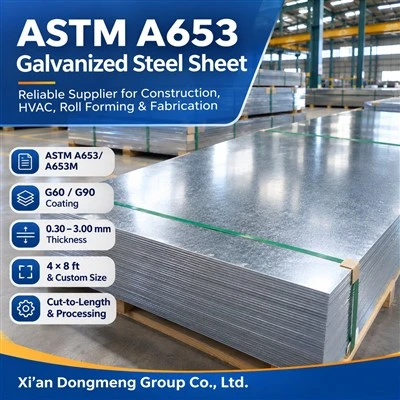

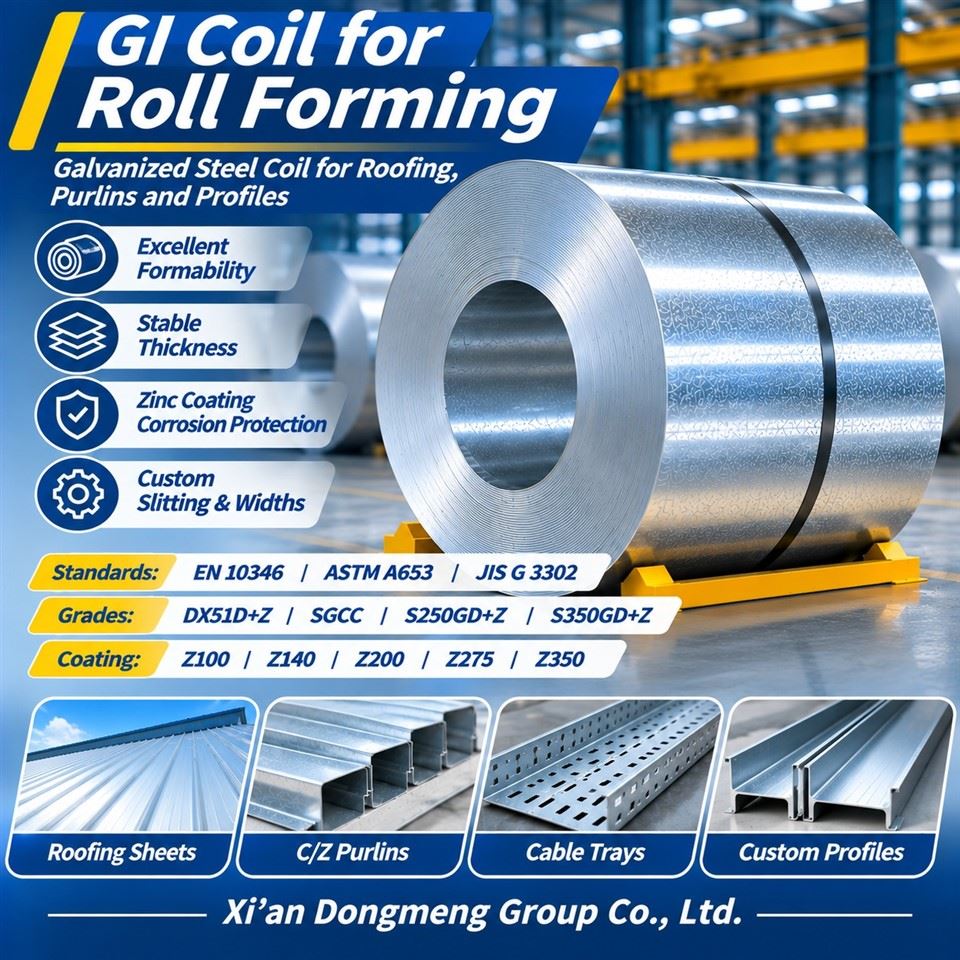
Xi'an Dongmeng Group Co., Ltd. is one of the most reliable manufacturers and suppliers of gi coil for roll forming in China, also supports customized service. With abundant experience, we warmly welcome you to wholesale cheap products in stock here and get free sample from our factory. For price consultation, contact us.
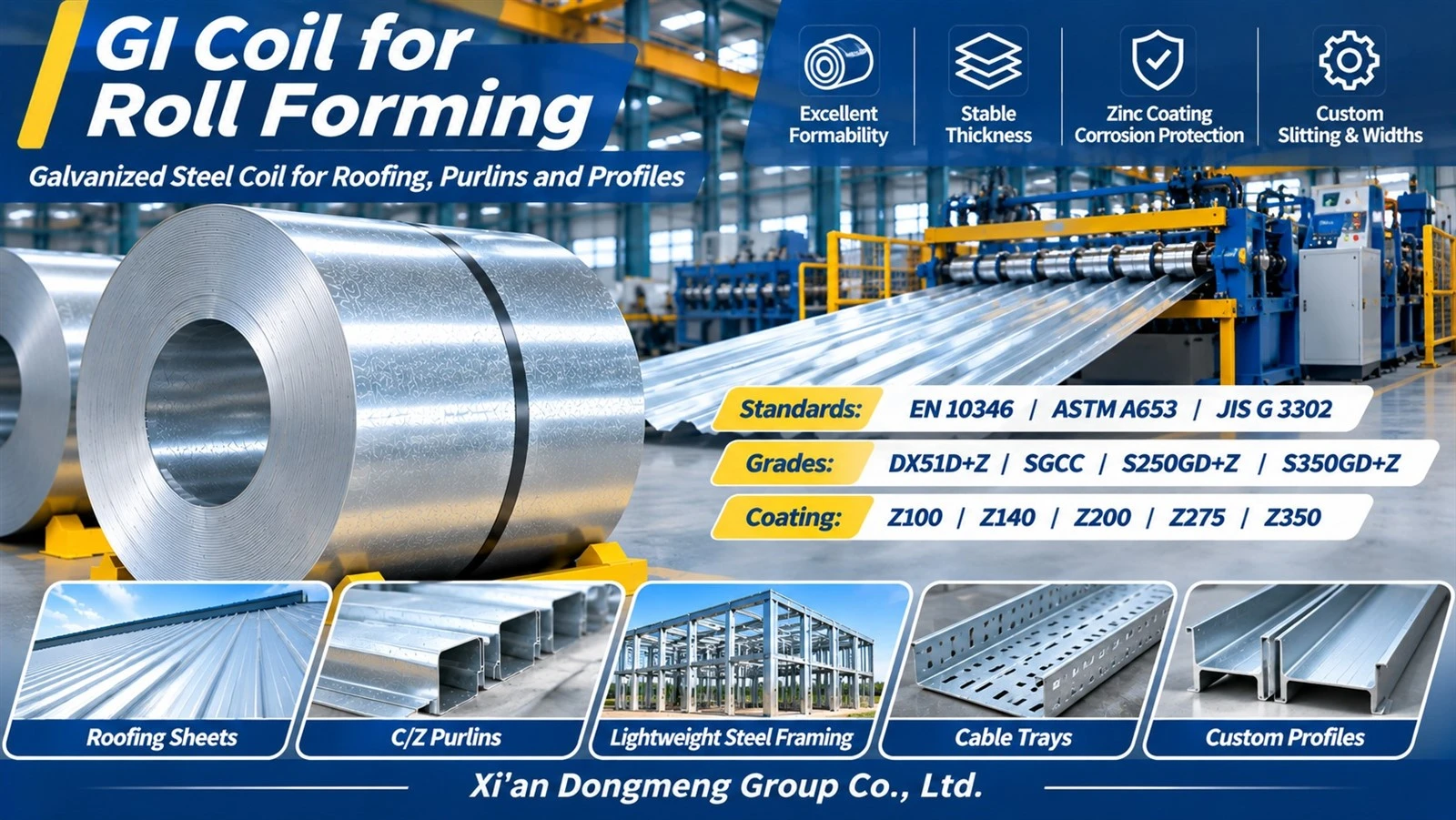
GI Coil for Roll Forming
Hot-Dip Galvanized Steel Coil Supplier for Roofing Sheets, C/Z Purlins, Steel Profiles and Industrial Roll Forming
Xi'an Dongmeng Group Co., Ltd. supplies GI Coil for Roll Forming, designed for manufacturers requiring reliable cold-forming performance, consistent strip dimensions and zinc-coated corrosion protection.
Our galvanized steel coil supply supports continuous roll-forming production of roofing sheets, wall panels, C and Z purlins, light-gauge steel framing, cable trays, steel channels and other custom metal profiles.
Available in selected commercial, forming and structural steel grades under EN 10346, ASTM A653/A653M and JIS G 3302, GI coils can be specified with different zinc coating weights, surface finishes, thicknesses and widths according to the finished product and processing requirements.
We support steel distributors, roll-forming manufacturers, construction material producers and OEM fabricators with grade selection, custom slitting, coil configuration, inspection documentation and international export supply.
Request a Quote | Custom Slit Coils | Bulk Supply | Roll-Forming Material Support
What Is GI Coil for Roll Forming?
GI coil for roll forming is hot-dip galvanized steel strip selected for continuous cold-forming operations.
Unlike conventional press forming, roll forming gradually transforms flat steel strip into a predetermined cross-section using a series of rotating rolls.
As the steel passes through multiple forming stations, it is progressively bent into the required profile without substantial changes to its original thickness.
The process is widely used for manufacturing long, uniform metal components such as roofing panels, galvanized channels, framing members and structural purlins.
For roll-forming applications, the quality of the incoming steel coil is especially important.
Successful production requires the correct combination of:
Suitable steel grade and mechanical properties
Consistent thickness and width
Controlled strip camber and flatness
Adequate zinc coating adhesion
Appropriate surface finish and lubrication
Controlled slit-edge condition
Stable coil winding and feeding performance
Selecting the correct GI coil can help manufacturers reduce production interruptions, dimensional variation, surface damage and unnecessary material waste.
GI Coil for Roll Forming Specifications
| Parameter | Specification / Supply Options |
|---|---|
| Product | Hot-Dip Galvanized Steel Coil |
| European Standard | EN 10346 |
| American Standard | ASTM A653/A653M |
| Japanese Standard | JIS G 3302 |
| Dimensional Standard | EN 10143 / ASTM A924/A924M, as applicable |
| Steel Substrate | Commercial / Forming / Structural Steel |
| Coating Type | Hot-Dip Zinc (+Z) |
| Reference Thickness | 0.40–3.00 mm (0.0157–0.1181 in) |
| Common Coil Width | 600–1500 mm (23.62–59.06 in) |
| Custom Strip Width | Based on Profile Drawing |
| Coating Weight | According to Specified Standard |
| Surface Finish | Regular / Minimized Spangle / Skin-Passed |
| Surface Protection | Passivated / Oiled / Unoiled |
| Edge | Mill Edge / Slit Edge |
| Coil ID | 508 / 610 mm (20 / 24 in approximately) |
| Coil Weight | According to Mill and Order Requirements |
| Processing | Slitting / Shearing / Cut-to-Length |
| Documentation | Mill Test Certificate / Inspection Report |
| Packaging | Export Coil Packaging |
Steel Grades Available for Roll Forming
The most important factor when selecting galvanized steel coil for roll forming is choosing a substrate grade compatible with the final profile geometry and mechanical requirements.
Not every galvanized steel grade is suitable for every forming application.
DX51D+Z – General Roll Forming and Profiling
DX51D+Z is a commonly specified cold-forming galvanized steel grade under EN 10346.
It is particularly suitable for general bending and profiling operations.
Typical applications include:
Roofing and wall sheets
Corrugated panels
Metal channels
General building profiles
Light-duty fabricated sections
DX51D+Z is a practical starting point when the finished component does not require a specified structural yield strength.
DX52D+Z – More Demanding Forming
DX52D+Z is a drawing-quality galvanized steel grade.
It can be considered for profiles requiring greater forming capability than general bending-quality material.
Applications may include more complex profile geometries and sheet-metal components involving increased deformation.
SGCC – Commercial-Quality Galvanized Steel
SGCC is a commercial-quality galvanized steel grade specified under JIS G 3302.
It is used for general forming and profiling operations, including building products, sheet-metal components and light industrial profiles.
SGCC and DX51D+Z serve similar application markets but should not be treated as automatically equivalent specifications.
S250GD+Z – Structural Roll-Formed Components
S250GD+Z provides a specified minimum yield strength of 250 MPa under EN 10346.
It can be selected for structural profiles requiring defined mechanical properties.
S350GD+Z – Structural Purlins and Framing
S350GD+Z provides a specified minimum yield strength of 350 MPa.
It is suitable for consideration in engineered roll-formed products such as C/Z purlins, framing members and structural channels.
S550GD+Z – High-Strength Roll Forming
S550GD+Z provides a minimum yield strength of 550 MPa.
It may be used for specialized lightweight and high-strength structural components.
However, this grade requires careful evaluation of bending radii, springback, forming forces, edge condition and ductility.
Steel Grade Comparison
| Grade | Standard | Main Selection Priority | Typical Applications |
|---|---|---|---|
| DX51D+Z | EN 10346 | General Bending and Profiling | Roofing, Cladding, Channels |
| DX52D+Z | EN 10346 | Improved Forming Capability | Complex Formed Profiles |
| SGCC | JIS G 3302 | General Commercial Forming | Panels, Light Profiles |
| S250GD+Z | EN 10346 | 250 MPa Structural Yield Strength | Structural Sections |
| S350GD+Z | EN 10346 | 350 MPa Structural Yield Strength | Purlins, Structural Framing |
| S550GD+Z | EN 10346 | 550 MPa High Yield Strength | Engineered High-Strength Profiles |
Material Selection Tip: For roofing profiles, DX51D+Z may be suitable when the required strength criteria are met. For load-bearing purlins or structural framing, select a certified structural grade according to the engineering design.
Chemical and Mechanical Properties
GI Coil for Roll Forming is an application-based product category rather than a single steel grade.
Therefore, there is no universal chemical composition or mechanical property table that applies to every roll-forming GI coil.
The correct chemical and mechanical requirements depend on the selected substrate specification.
Representative Mechanical Requirements for Structural Grades
| Grade | Minimum Yield Strength | Minimum Tensile Strength |
|---|---|---|
| S250GD+Z | 250 MPa | 330 MPa |
| S280GD+Z | 280 MPa | 360 MPa |
| S320GD+Z | 320 MPa | 390 MPa |
| S350GD+Z | 350 MPa | 420 MPa |
| S550GD+Z | 550 MPa | 560 MPa |
Forming grades such as DX51D+Z and DX52D+Z have their own applicable mechanical property requirements and should not be assigned structural strength guarantees without the corresponding specification.
Actual chemical analysis and mechanical performance should be verified using mill test results.
Zinc Coating Options for Roll Forming
The zinc coating protects the steel substrate against atmospheric corrosion and influences the finished profile's durability.
For roll-forming applications, coating mass must be balanced with forming severity, coating adhesion and service conditions.
EN Zinc Coating Weight Chart
| Coating Designation | Minimum Total Coating Mass, Both Sides | Approximate Coating Thickness Per Side |
|---|---|---|
| Z100 | 100 g/m² | 7 μm |
| Z140 | 140 g/m² | 10 μm |
| Z200 | 200 g/m² | 14 μm |
| Z275 | 275 g/m² | 20 μm |
| Z350 | 350 g/m² | 25 μm |
The figures represent minimum three-spot average coating masses across both surfaces. Coating thicknesses are theoretical guidance values, not guaranteed thicknesses at every point.
Z100–Z140 Galvanized Coil
These coating classes may be selected for protected indoor profiles or components that receive additional finishing.
Z200 Galvanized Coil
Z200 can be considered for building products and industrial profiles requiring an intermediate zinc coating mass.
Z275 Galvanized Coil
Z275 is frequently specified for construction-related galvanized sheet and roll-formed components.
It provides a minimum three-spot average total coating mass of 275 g/m².
Z350 Galvanized Coil
Z350 offers a higher coating mass and may be considered for products requiring additional zinc protection, subject to mill availability and forming compatibility.
Important: A heavier zinc coating does not automatically guarantee better roll-forming performance. Tight bends, unsuitable tooling or excessive friction may damage the coating. Select the coating according to both the forming process and service environment.
Surface Finish and Treatment Options
Regular Spangle
A visible zinc crystallization pattern typically used for general industrial and building products where surface appearance is not critical.
Minimized Spangle
A more uniform zinc surface with reduced visible crystallization.
It is often preferred for visible panels, appliance components and products requiring a more consistent appearance.
Skin-Passed Finish
Skin passing can help improve surface characteristics and certain shape-related properties.
It may be specified when surface uniformity and consistent downstream fabrication are important.
Chromate-Free Passivation
A temporary surface treatment that can help reduce the risk of wet-storage staining during transport and storage.
Oiled Surface
An oil film may provide temporary handling and storage protection and can affect forming friction.
Oil type and application should be compatible with downstream operations, including painting or adhesive bonding.
Key Requirements for GI Coil Used in Roll Forming
1. Consistent Strip Thickness
Steel thickness directly influences the final profile dimensions, bending force, product strength and roll-tool clearances.
Excessive thickness variation can cause:
Incorrect final dimensions
Inconsistent profile angles
Unstable roll-forming pressure
Increased tooling wear
Out-of-tolerance products
For precision roll-forming applications, thickness tolerance requirements should be confirmed before purchasing.
2. Accurate Strip Width
Roll-forming equipment typically requires a specific strip width based on the developed geometry of the finished profile.
The required width depends on:
Profile cross-section
Bend allowances
Material thickness
Inside bending radii
Forming process
Edge geometry
Recommendation: Provide the approved cross-sectional drawing or developed strip-width specification when requesting slit coils.
3. Controlled Flatness and Camber
Flatness and strip camber influence tracking through the roll-forming line.
Excessive camber or uneven strip shape may cause twisting, bowing or dimensional instability in finished profiles.
4. Good Zinc Coating Adhesion
During roll forming, the coated steel undergoes repeated localized bending.
The zinc coating must withstand the required deformation without unacceptable cracking, peeling or flaking.
Coating performance depends on the steel grade, coating mass, bend severity and processing conditions.
5. Suitable Mechanical Properties
The substrate must provide sufficient formability for the profile and appropriate strength for the final application.
Higher strength is not always better for roll forming.
Excessive strength can increase springback and forming loads, while insufficient strength may make the final product unsuitable for structural use.
6. Stable Coil Feeding
Coil winding quality, inner diameter, coil weight, edge condition and tension consistency can affect decoiling and line stability.
These parameters should match the roll-forming equipment.
Common Roll Forming Problems and Material Selection
| Production Problem | Possible Material-Related Causes | Recommended Checks |
|---|---|---|
| Profile Twisting | Strip Camber, Uneven Forming | Flatness, Camber, Roll Alignment |
| Edge Cracking | Severe Deformation, Insufficient Ductility | Grade, Edge Quality, Bend Radius |
| Zinc Coating Cracking | Excessive Bend Severity | Coating Class, Bend Radius, Forming Process |
| Surface Scratches | Tool Friction, Poor Handling | Roll Surface, Lubrication, Coil Protection |
| Excessive Springback | Higher Yield Strength | Steel Grade, Tooling Geometry |
| Inconsistent Width | Strip Width Variation | Slitting Tolerances |
| Unstable Feeding | Coil Set, Poor Winding, Camber | Coil Geometry and Feeding Setup |
| Fluting or Coil Breaks | Material Ageing and Yield Behavior | Storage Conditions and Steel Selection |
These are potential causes rather than definitive diagnoses. Tooling condition, forming sequence, line alignment and process settings must also be investigated.
GI Coil for Roll Forming Applications
Roofing Sheets and Corrugated Panels
Galvanized steel coils are widely used to manufacture roll-formed roof and wall products.
Common final profiles include:
Corrugated roofing sheets
Trapezoidal roofing panels
Metal wall cladding
Building flashing
Roof accessories
For these applications, material selection should consider forming performance, sheet thickness, coating weight, profile geometry and any required structural capacity.
C and Z Steel Purlins
Structural galvanized steel coils can be processed into C and Z purlins for industrial buildings, warehouses and roofing support systems.
Typical procurement considerations include:
Structural yield strength
Nominal steel thickness
Developed strip width
Forming radius
Profile geometry
Zinc coating designation
Structural design requirements
S250GD+Z, S350GD+Z and other approved structural grades may be considered according to the project specification.
Light-Gauge Steel Framing
Galvanized coils can be roll-formed into light-gauge structural and non-structural components such as:
Steel studs
Steel tracks
Framing channels
Partition profiles
Building support members
The applicable steel grade and coating must meet the relevant framing requirements.
Cable Trays and Electrical Support Profiles
GI coils can be processed into cable trays, cable ladders, electrical support channels and associated accessories.
Manufacturers should consider punching requirements, edge condition, corrosion exposure and final loading requirements.
Steel Channels and Industrial Profiles
The material is suitable for selected cold-formed channels, U profiles, hat sections, angles and custom industrial components.
Agricultural and Greenhouse Profiles
GI coils can be used for suitable greenhouse channels, agricultural building components, equipment profiles and supporting sections.
Environmental corrosion requirements should be evaluated according to the actual application.
GI Coil for Roll Forming vs General Galvanized Coil
Although many conventional galvanized coils can be roll-formed, a coil selected specifically for a roll-forming line should be evaluated against additional processing requirements.
| Requirement | General GI Coil | GI Coil Specified for Roll Forming |
|---|---|---|
| Base Grade | General Product Specification | Selected for Final Profile |
| Thickness | Standard Supply Tolerance | Matched to Forming Line |
| Strip Width | Mill Width or Standard Slit | Developed Width Specification |
| Flatness and Camber | Standard Acceptance | Profile-Specific Requirements |
| Mechanical Properties | Grade Requirements | Grade + Forming Feasibility |
| Zinc Coating | Corrosion Requirement | Corrosion + Coating Formability |
| Edge Condition | Standard Coil Requirement | Matched to Feeding and Processing |
| Coil Configuration | General Supply | Matched to Decoiler and Line |
| Inspection | Standard Material Checks | Additional Checks When Specified |
The distinction is in the procurement specification and application verification, not necessarily a different galvanizing manufacturing process.
Custom GI Coil Supply for Roll Forming Lines
Xi'an Dongmeng Group Co., Ltd. supports buyers requiring galvanized coils configured for different processing equipment and finished products.
1. Customized Steel Grades
We can assist with grade selection according to:
Profile geometry
Required yield strength
Forming severity
Finished-product application
Applicable material standard
2. Custom Slitting
Slit-coil supply can be arranged based on the required strip width and edge condition.
Please provide the developed strip width, tolerance, burr requirements and any special handling instructions.
3. Zinc Coating Selection
Select the coating class based on the intended service environment and forming conditions.
4. Coil Configuration
Coil ID, maximum coil weight, strip winding direction and packaging can be reviewed against the customer's equipment requirements.
5. Surface and Edge Requirements
Buyers may specify surface appearance, oiling, passivation and edge-quality requirements according to downstream processing needs.
Quality Inspection for Roll Forming GI Coils
Quality inspection should evaluate both compliance with the applicable steel standard and the suitability of material characteristics for the agreed processing application.
Thickness and Width Inspection
Verify coil thickness and strip width against contractual tolerances.
Mechanical Testing
Review yield strength, tensile strength and elongation where required for the specified grade.
Zinc Coating Mass Testing
Confirm the coating mass against the selected zinc coating class.
Coating Integrity
Where required, perform agreed bend tests or coating adhesion evaluations appropriate to the intended forming process.
Flatness and Camber Inspection
Check the incoming coil or slit strip for shape deviations that may affect roll-forming line tracking.
Edge Quality Inspection
Verify slit-edge condition and burr requirements where agreed.
Surface Inspection
Inspect for scratches, dents, unacceptable coating defects and handling damage.
Material Traceability
Review coil identification, heat information and mill test documentation.
EN 10204 Type 3.1 inspection certificates and independent third-party inspection can be arranged according to the agreed order requirements.
Export Packaging for Galvanized Roll Forming Coils
Export packaging is especially important for buyers using galvanized coils on continuous production lines.
Typical packing arrangements may include:
Moisture-resistant wrapping
Inner and outer protective covers
Edge protectors
Steel strapping
Slit-coil separators where required
Coil identification labels
Suitable coil cradles or pallets
Container loading and securing arrangements
Proper handling and packaging can help reduce edge damage, coil distortion and moisture-related surface defects.
Why Choose Xi'an Dongmeng Group Co., Ltd.?
Application-Oriented Steel Selection
We help international buyers select galvanized steel grades based on finished profile requirements rather than relying only on thickness and zinc coating weight.
Custom Coil Specifications
Coil dimensions, slit widths, coating classes and surface requirements can be coordinated according to confirmed mill and processing capabilities.
Support for Industrial Buyers
We work with steel distributors, roofing sheet manufacturers, roll-forming factories, structural component producers and OEM businesses.
Material Quality Documentation
Inspection certificates, traceability information and additional quality checks can be specified in the purchase contract.
International Supply Coordination
We support quotation preparation, export packaging, commercial documentation and shipment coordination for overseas buyers.
Frequently Asked Questions About GI Coil for Roll Forming
1. What is the best galvanized steel grade for roll forming?
There is no single best grade for every application. DX51D+Z is commonly used for general bending and profiling, while structural grades such as S250GD+Z and S350GD+Z may be selected when minimum yield strength is required.
2. Is DX51D suitable for roll forming?
Yes. DX51D is specifically classified for bending and profiling applications under EN 10346.
3. Can SGCC galvanized steel be used for roll forming?
Yes. SGCC is suitable for general commercial-quality forming and profiling applications when its properties meet the finished-product requirements.
4. Which GI coil is suitable for C and Z purlins?
Structural grades such as S250GD+Z or S350GD+Z may be suitable. The exact grade must be selected according to the purlin design, loading requirements and relevant standards.
5. What zinc coating is commonly used for roofing profiles?
Z100, Z140, Z200, Z275 and other coating classes may be used depending on the applicable product standard, service environment and customer specification.
6. Can Z275 galvanized steel coil be roll-formed?
Yes, provided the steel substrate, coating quality, bend radius and forming process are compatible. Coating integrity should be verified for demanding profiles.
7. What causes galvanized coating cracks during roll forming?
Possible causes include severe bend geometry, excessive deformation, unsuitable coating conditions, insufficient bend radius and inappropriate tooling settings.
8. Why is steel coil flatness important for roll forming?
Poor strip flatness can affect line tracking and contribute to twisted, bowed or otherwise dimensionally inaccurate profiles.
9. Can you supply custom-width galvanized steel strips?
Custom slit-coil supply can be arranged according to the approved width, processing tolerances and mill capability.
10. Is high-strength galvanized steel better for roll forming?
Not necessarily. High-strength steel may support structural applications but can require greater forming forces and more careful springback and crack control.
11. What information is required for a custom roll-forming coil quotation?
Buyers should provide material standard, grade, thickness, strip width, zinc coating, annual or order quantity, coil configuration, profile drawing and destination port.
12. What affects GI coil prices for roll forming?
Prices depend on substrate grade, coil dimensions, coating mass, slit-width requirements, processing complexity, order quantity, market conditions and shipping costs.
Contact Us – GI Coil for Roll Forming Supplier
Looking for a Reliable Galvanized Steel Coil Supplier for Your Roll Forming Production Line?
Xi'an Dongmeng Group Co., Ltd. supports international manufacturers with galvanized coil procurement for roofing sheets, C/Z purlins, light-gauge framing, channels and other roll-formed products.
Whether you require DX51D+Z galvanized coils for roofing profiles, S350GD+Z for structural purlins or precision slit GI strips for custom roll-forming lines, our team can review your specifications and prepare a quotation based on available supply options.
Please Send Your Requirements:
Product: GI Coil for Roll Forming
Standard: EN 10346 / ASTM A653 / JIS G 3302
Steel Grade: DX51D / SGCC / S350GD / Other
Thickness × Width
Zinc Coating: Z100 / Z140 / Z200 / Z275 / Other
Custom Slit Width and Tolerance
Coil Inner Diameter and Maximum Weight
Finished Profile Drawing
Order Quantity (MT)
Destination Port
Required Delivery Schedule
Inspection and Certification Requirements
Office Information
Completely recapitalize 24/7 communities via standards compliant metrics whereas.
Phone Number & Email
+8615769214734
office@dongmjd.com
Dong: +8615769214734
Our Office Address
Room 4107, Runfeng Building, Sanqiao New Street, Weiyang District, Xi'an City, Shaanxi Province
Contact Xi'an Dongmeng Group Co., Ltd. today to request bulk pricing, available galvanized steel coil specifications and a supply proposal for your roll-forming production requirements.
Hot Tags: gi coil for roll forming, China gi coil for roll forming manufacturers, suppliers, factory, Anti Fingerprint PPGI Coil, Corrugated Steel Coil, HDG Coil, Hot Dip Galvanized Steel Coil, nan, Whiteboard Steel Steel Whiteboard Material