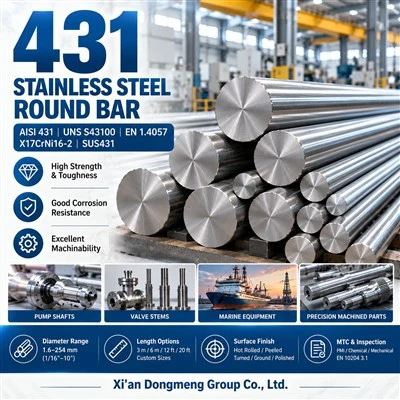


Xi'an Dongmeng Group Co., Ltd. is one of the most reliable manufacturers and suppliers of round bar stainless steel 304 in China, also supports customized service. With abundant experience, we warmly welcome you to wholesale cheap products in stock here and get free sample from our factory. For price consultation, contact us.

304 Stainless Steel Round Bar – ASTM A276 / UNS S30400
304 Stainless Steel Round Bar Manufacturer & Supplier
Xi'an Dongmeng Group Co., Ltd. is a professional manufacturer and exporter of stainless steel products, supplying ASTM A276 304 stainless steel round bars to international distributors, machinery manufacturers, fabrication companies, industrial contractors and OEM customers.
Our 304 stainless steel round bars (UNS S30400 / EN 1.4301) are available in hot-rolled, cold-drawn, peeled, ground and polished forms, depending on diameter and order requirements.
Available nominal diameters range from 6 mm to 300 mm (approximately 0.236–11.811 inches), with standard and customized cutting lengths.
Manufactured and inspected to the applicable material specifications, these solid stainless steel bars are suitable for machined components, equipment shafts, industrial fasteners, structural fittings and corrosion-resistant fabricated parts.
We support specification review, size selection, dimensional inspection, material certification and export packaging for industrial procurement projects.
Request a quotation, technical specification, material certificate or customized cutting solution for your 304 stainless steel round bar requirements.
What Is 304 Stainless Steel Round Bar?
304 stainless steel round bar is a solid cylindrical product manufactured from chromium-nickel austenitic stainless steel.
It typically contains 18–20% chromium and 8–10.5% nickel, providing a useful balance of corrosion resistance, mechanical strength, ductility, weldability and fabrication performance.
Chromium contributes to the formation of a protective passive oxide layer on the metal surface, while nickel helps stabilize the austenitic structure.
Unlike hollow stainless steel tubes, 304 round bars have a solid cross-section and are commonly used as raw material for machining, turning, drilling, threading, forging and fabrication.
304 stainless steel is particularly suitable for components exposed to atmospheric conditions, clean water and many mildly corrosive industrial environments.
However, the material is not universally corrosion-resistant. Chloride concentration, temperature, crevices, cleaning chemicals and operating stress must be considered when selecting 304 for demanding service environments.
ASTM A276 304 Stainless Steel Round Bar Specifications
| Product Form | Nominal Diameter | Length | Surface Condition | Typical Applications |
|---|---|---|---|---|
| Hot-Rolled Round Bar | 6–200 mm | 1–6 m | Hot-Rolled / Pickled | General Fabrication |
| Cold-Drawn Round Bar | 6–150 mm | 1–6 m | Cold-Drawn / Smooth | Machined Components |
| Peeled Round Bar | By Request | Cut to Length | Peeled / Turned | Shaft Blanks |
| Centerless Ground Bar | By Request | Cut to Length | Precision Ground | Precision Machining |
| Bright Polished Round Bar | 6–100 mm | 1–6 m | Bright / Polished | Decorative & Industrial Parts |
| Large-Diameter Round Bar | Up to 300 mm | By Request | Hot-Finished / Machined | Heavy Equipment Components |
The ranges above are indicative commercial supply ranges rather than manufacturing limits established by ASTM. Actual availability, minimum diameter, maximum length and finishing options must be confirmed for each inquiry.
Common Diameter Options
304 stainless steel round bars can be specified in metric and imperial dimensions.
Common metric diameter requests include:
6, 8, 10, 12, 16, 20, 25, 30, 35, 40, 50, 60, 70, 80, 100, 120, 150 and 200 mm.
Common imperial nominal diameters include:
1/4", 3/8", 1/2", 5/8", 3/4", 1", 1-1/4", 1-1/2", 2", 3", 4" and 6".
Metric and imperial sizes should not be treated as automatically interchangeable. The exact diameter, permissible variation and measurement system must be stated in the purchase order.
Diameter Tolerance & Straightness
Dimensional requirements should be selected according to the manufacturing process and intended application.
Hot-Finished Bars
Suitable for general fabrication and subsequent machining where sufficient machining allowance is provided.
Cold-Finished Bars
Suitable for applications requiring improved dimensional consistency, smoother surfaces and reduced machining allowance.
Precision Ground Bars
Suitable for projects requiring controlled diameter, roundness, straightness and surface roughness.
ASTM A484/A484M provides general dimensional requirements for applicable stainless steel bar products.
Where specified by the customer, precision tolerance classes such as h9 or h11 may be evaluated against the drawing and applicable tolerance standard.
Diameter tolerance, ovality, straightness and surface roughness acceptance limits should be confirmed before production.
Chemical Composition of ASTM 304 Stainless Steel
The following chemical composition represents commonly specified Type 304 stainless steel requirements.
| Element | Symbol | 304 Stainless Steel |
|---|---|---|
| Carbon | C | ≤0.08 |
| Manganese | Mn | ≤2.00 |
| Silicon | Si | ≤1.00 |
| Phosphorus | P | ≤0.045 |
| Sulfur | S | ≤0.030 |
| Chromium | Cr | 18.00–20.00 |
| Nickel | Ni | 8.00–10.50 |
| Nitrogen | N | ≤0.10 |
| Iron | Fe | Balance |
Material Note: Type 304 does not have a specified molybdenum addition comparable to Type 316. Its chloride pitting resistance is therefore generally lower than that of appropriately specified 316 or 316L stainless steel.
Chemical compliance must be assessed against the applicable edition of the ordered material standard and the material test certificate.
Mechanical Properties of 304 Stainless Steel Round Bar
Mechanical properties depend on the bar diameter, heat-treatment condition, amount of cold work and applicable material specification.
| Property | Annealed Type 304 Reference |
|---|---|
| Tensile Strength | ≥515 MPa (75 ksi) |
| 0.2% Yield Strength | ≥205 MPa (30 ksi) |
| Elongation | Commonly 30–40% minimum, depending on the specified product condition and diameter |
| Reduction of Area | As required by the applicable standard and bar condition |
| Hardness | Depends on processing condition; confirm against ordered requirements |
| Elastic Modulus | Approximately 193 GPa |
These values are general material-selection references. They are not a substitute for the mechanical-property table in the specified edition of ASTM A276/A276M or ASTM A479/A479M.
Effect of Cold Working
Cold drawing can increase the strength and hardness of 304 stainless steel, but it may reduce ductility and increase work-hardening effects.
For components requiring minimum hardness, controlled strength or specific machining performance, the purchaser should specify the required delivery condition and acceptance criteria.
A polished surface does not, by itself, establish the mechanical condition of a round bar.
For precision shafts or load-bearing components, mechanical properties should be verified using the material certificate and the approved engineering design.
Physical Properties
| Property | Typical Reference Value |
|---|---|
| Density | Approximately 7.93 g/cm³ |
| Elastic Modulus | Approximately 193 GPa |
| Thermal Conductivity at Room Temperature | Approximately 16 W/(m·K) |
| Thermal Expansion Coefficient | Approximately 17 × 10⁻⁶/K |
| Magnetic Characteristics | Generally nonmagnetic in the annealed condition; cold working may introduce magnetic response |
| Crystal Structure | Austenitic |
Values are approximate and may vary with temperature and processing condition.
304 Stainless Steel Round Bar Weight Chart
Theoretical weight is useful when estimating material consumption, shipment weight and purchasing quantities.
For solid 304 stainless steel round bars, using a nominal density of 7.93 g/cm³:
Weight (kg/m) ≈ 0.006228 × Diameter² (mm)
Theoretical Weight by Diameter
| Diameter (mm) | Weight (kg/m) | Weight per 6 m Bar (kg) |
|---|---|---|
| 6 | 0.224 | 1.35 |
| 8 | 0.399 | 2.39 |
| 10 | 0.623 | 3.74 |
| 12 | 0.897 | 5.38 |
| 16 | 1.594 | 9.57 |
| 20 | 2.491 | 14.95 |
| 25 | 3.893 | 23.36 |
| 30 | 5.605 | 33.63 |
| 40 | 9.965 | 59.79 |
| 50 | 15.571 | 93.42 |
| 60 | 22.422 | 134.53 |
| 80 | 39.861 | 239.16 |
| 100 | 62.282 | 373.69 |
These values are theoretical. Actual shipping weight and invoiced weight depend on dimensional tolerances, final length, processing losses and the agreed commercial measurement method.
Surface Finishes & Processing Options
1. Hot-Rolled Stainless Steel Round Bar
Hot-rolled round bars are commonly selected for industrial fabrication, general mechanical parts and machining blanks.
They are suitable when moderate dimensional variation is acceptable or subsequent machining will remove the outer surface.
2. Cold-Drawn Stainless Steel Round Bar
Cold drawing improves surface appearance and dimensional consistency while potentially increasing mechanical strength through work hardening.
Cold-drawn bars are commonly used for turned components, pins, connectors and mechanical assemblies.
3. Peeled Stainless Steel Round Bar
Peeled bars undergo a machining process that removes the outer surface layer.
They are frequently selected for shaft blanks and machined components requiring improved surface condition and dimensional consistency.
4. Centerless Ground Stainless Steel Round Bar
Centerless grinding provides controlled diameter and surface finish for components requiring close dimensional tolerances.
Typical applications include precision shaft blanks, rotating components and automatic machining operations.
5. Polished Stainless Steel Round Bar
Polishing improves surface appearance and can provide a smoother finish.
Decorative, hygienic and industrial applications may require different surface roughness values and inspection methods.
For critical applications, buyers should specify a measurable surface roughness requirement rather than relying only on terms such as "bright" or "mirror."
Machining, Welding & Fabrication Performance
Machinability
304 stainless steel can be machined using conventional turning, drilling, milling and threading processes.
However, the material work-hardens during cutting and generally requires more controlled machining conditions than free-machining stainless steel grades.
Recommended machining considerations include:
Rigid machine setup and suitable cutting tools.
Controlled cutting speed and consistent feed.
Appropriate cooling and lubrication.
Avoiding excessive tool rubbing and repeated cutting on work-hardened surfaces.
For high-volume machining projects, Type 303 may offer improved machinability, although corrosion resistance and welding requirements must also be evaluated.
Weldability
304 stainless steel has generally good weldability using suitable welding processes and procedures.
Commonly used welding methods include TIG, MIG and other qualified processes.
Filler material selection, welding heat input, joint design and post-weld surface cleaning should be considered according to the application.
For welded assemblies where resistance to sensitization is particularly important, 304L may be more appropriate.
Forming & Fabrication
304 stainless steel offers useful ductility and can be processed into a variety of fabricated components.
Cold bending, upsetting, thread rolling and other forming operations require consideration of material condition, work hardening and tool design.
Corrosion Resistance & Service Limitations
304 stainless steel provides good corrosion resistance in many atmospheric, clean-water and mildly corrosive industrial environments.
Its chromium-rich passive layer protects the metal when surface conditions and chemical exposure permit stable passivation.
However, several service limitations should be evaluated.
Chloride Pitting Corrosion
Concentrated chlorides, stagnant seawater and certain cleaning chemicals can initiate localized pitting corrosion.
Crevice Corrosion
Crevices around fasteners, seals, joints and deposits can create localized chemical conditions that accelerate attack.
Stress Corrosion Cracking
Under susceptible combinations of tensile stress, chloride exposure and temperature, austenitic stainless steel can experience stress corrosion cracking.
Acid and Chemical Exposure
Corrosion performance depends on the chemical species, concentration, operating temperature and contamination.
304 stainless steel should not be selected for aggressive chemical processes without reviewing relevant corrosion data.
For applications involving elevated chloride concentrations, marine exposure or particularly aggressive process fluids, alternatives such as 316L or higher-alloy stainless steel may be required.
304 vs 304L vs 316L vs 303 Stainless Steel Round Bar
| Grade | Main Characteristics | Typical Selection Reason |
|---|---|---|
| 304 | General-purpose chromium-nickel austenitic stainless steel | Balanced corrosion resistance, fabrication and cost |
| 304L | Lower carbon content than 304 | Improved resistance to sensitization in applicable welded service |
| 316L | Molybdenum-bearing low-carbon austenitic stainless steel | Improved resistance to chloride-related localized corrosion |
| 303 | Free-machining stainless steel | High-volume machining where its corrosion and welding limitations are acceptable |
How to Choose the Right Grade
Select 304 for general-purpose corrosion-resistant round bar applications.
Consider 304L where welding conditions and resistance to sensitization are important.
Consider 316L where improved resistance to chloride-related localized corrosion is required, subject to an engineering review of the service conditions.
Consider 303 for machining-intensive parts where machinability is the main priority and the application permits its corrosion resistance and weldability limitations.
Material selection should be based on operating conditions, fabrication methods, component design and applicable engineering standards.
Applicable Standards & Material Designations
| Standard / Designation | Description |
|---|---|
| ASTM A276/A276M | Stainless Steel Bars and Shapes |
| ASTM A484/A484M | General Requirements for Stainless Steel Bars, Billets, Shapes and Forgings |
| ASTM A479/A479M | Stainless Steel Bars and Shapes for Boilers and Pressure Vessels |
| ASME SA-479/SA-479M | ASME-adopted bar specification where required by the applicable code |
| EN 10088-3 | Technical Delivery Conditions for Applicable Stainless Steel Long Products |
| JIS G4303 | Stainless Steel Bars |
| JIS G4318 | Cold-Finished Stainless Steel Bars |
| UNS S30400 | Unified Numbering System Designation |
| EN 1.4301 | European Material Number |
| SUS304 | Japanese Grade Designation |
Different standards are not automatically interchangeable.
The material grade, governing product standard, delivery condition, dimensions, test requirements and inspection documentation should be stated in the purchase order.
For pressure-equipment applications, the purchaser must confirm the applicable design code, approved material specification and service requirements.
Industrial Applications of 304 Stainless Steel Round Bar
Industrial Machinery & Mechanical Components
304 round bars are used as raw material for machined shafts, pins, spacers, connectors and other mechanical components where corrosion resistance and fabrication performance are important.
Food & Beverage Processing Equipment
304 stainless steel is commonly used for equipment parts, shafts, supports and fittings in food and beverage processing environments.
Material suitability depends on the operating environment, surface finish, cleaning procedures, hygienic design and applicable food-contact requirements.
Chemical Processing Equipment
304 bars may be used for mechanical components, supports and fittings in compatible chemical-processing environments.
Chemical compatibility must be evaluated before material selection.
Construction & Architectural Fabrication
304 round bars are used for architectural fittings, decorative elements, fabricated supports and other components where corrosion resistance and surface appearance are required.
Structural applications must be designed according to the applicable load and construction requirements.
Automotive & Transportation Components
Machined stainless steel pins, connectors, bushings and selected mechanical components can be produced from 304 round bars.
Selection depends on load, fatigue, wear, corrosion and manufacturing requirements.
OEM Precision Components
Custom-cut and machined 304 stainless steel round bars can serve as feedstock for industrial OEM parts.
Customers may specify dimensions, surface condition, machining allowances, inspection criteria and identification requirements.
304 Stainless Steel Round Bar Price – What Affects the Cost?
The price of 304 stainless steel round bar depends on material specification, diameter, processing method, order volume and current market conditions.
Main Price Factors
1. Raw Material and Alloy Costs
Changes in stainless steel production costs and alloy inputs, particularly nickel, can influence material pricing.
2. Diameter and Bar Length
Diameter affects theoretical weight, material consumption, processing requirements and handling costs.
3. Manufacturing & Surface Finish
Hot-rolled, cold-drawn, peeled, ground and polished round bars involve different processing costs.
4. Dimensional Tolerances
Precision diameters, improved straightness and controlled surface roughness may require additional manufacturing or inspection operations.
5. Order Quantity
Order volume and production-batch requirements can influence the unit price and commercial conditions.
6. Inspection and Documentation
Special testing, third-party inspection, project-specific documentation and additional quality requirements may affect the total quotation.
7. Packaging & International Delivery
The final delivered price depends on packaging, shipment volume, destination and agreed Incoterms.
How to Request an Accurate Price
For a reliable quotation, please specify:
Material grade and governing standard.
Required diameter and length.
Surface finish and delivery condition.
Required tolerance and machining requirements.
Order quantity in kilograms, tons or pieces.
Inspection certificate and additional test requirements.
Delivery destination and preferred Incoterms.
Required delivery schedule.
Pricing can be evaluated on a per-kilogram, per-metric-ton or per-piece basis, according to the agreed order scope.
Contact Xi'an Dongmeng Group Co., Ltd. for a project-specific 304 stainless steel round bar quotation.
Inspection & Quality Assurance
Quality inspection requirements are established according to the applicable material standard, purchase order and customer specifications.
Chemical Composition Verification
Heat analysis and appropriate material verification methods can be used to confirm the specified stainless steel grade.
Positive Material Identification (PMI) may be arranged where required.
Note that handheld XRF identification alone does not establish carbon content or distinguish 304 from 304L by carbon level.
Where carbon verification is necessary, an appropriate laboratory analysis method should be specified.
Mechanical Property Testing
Mechanical testing can include:
Tensile strength.
Yield strength.
Elongation.
Hardness.
Additional mechanical tests where required by the governing specification.
Test reports should identify the relevant heat, test condition and applicable acceptance criteria.
Dimensional Inspection
Inspection may include:
Diameter measurements.
Roundness and ovality.
Bar length.
Straightness.
Surface condition.
Specified surface roughness for precision products.
Surface Quality Inspection
Surface inspection checks for unacceptable defects, including cracks, laps, damage and other discontinuities relevant to the ordered product condition.
Material Traceability
Material identification and inspection documents can be organized according to the required heat number, batch and purchase order.
Material Test Certificates
Documentation options include:
EN 10204 Type 3.1: Inspection certification supplied under the applicable requirements.
EN 10204 Type 3.2: Subject to advance agreement and the involvement of the required independent inspection representatives.
Third-party inspection can be arranged where agreed before production or shipment.
Production, Customization & Delivery
Xi'an Dongmeng Group Co., Ltd. supports stainless steel round bar procurement for industrial and OEM projects.
Available order services may include:
Standard-length round bars.
Customized cut-to-length material.
Diameter and tolerance selection.
Peeled, ground and polished finishes.
Machining allowance requirements.
Material specification review.
Testing and documentation coordination.
Export packing and shipment arrangements.
Packaging & Shipping
Packaging is selected according to bar diameter, weight, surface condition and transportation method.
Common arrangements include secured bundles, protective wrapping, wooden supports and suitable packing for precision-finished material.
Heavy bars require appropriate lifting, securing and handling arrangements.
Heat numbers, material grades and size markings should remain traceable to the relevant shipment documentation.
Stock availability, production lead time, minimum order quantity and final shipping arrangements are confirmed individually at quotation stage.
Why Choose Xi'an Dongmeng Group Co., Ltd.?
Material Specification Support
We help industrial buyers review grades, bar dimensions, surface requirements and inspection documentation before ordering.
Multiple Processing Options
Hot-finished, cold-finished and precision-machined product forms can be evaluated against project requirements.
Quality Documentation
Material verification, mechanical testing and inspection certificates can be coordinated according to the purchase order.
OEM & Project Procurement
Customers can submit technical drawings, cutting lists and inspection requirements for manufacturing feasibility review.
International B2B Supply
We support export-oriented procurement for distributors, fabrication companies, OEM manufacturers and industrial contractors.
Frequently Asked Questions
1. What is ASTM A276 304 stainless steel round bar?
It is a solid cylindrical stainless steel product made from Type 304 austenitic stainless steel and supplied under the applicable ASTM A276/A276M specification.
2. What is the difference between 304 stainless steel round bar and 304 stainless steel rod?
These terms are often used interchangeably in commercial purchasing. However, the actual product form, dimensions and applicable specification should be confirmed when ordering.
3. What diameters are available for 304 stainless steel round bars?
The indicative supply range is 6–300 mm. Common commercial diameters include 10, 12, 16, 20, 25, 30, 40, 50 and 100 mm. Availability depends on the manufacturing process and required finish.
4. What is the weight of a 20 mm 304 stainless steel round bar?
Using a density of approximately 7.93 g/cm³, a 20 mm solid round bar weighs approximately 2.49 kg per meter.
A nominal 6 m bar weighs approximately 14.95 kg before packaging.
5. Is 304 stainless steel round bar magnetic?
Solution-annealed 304 is generally nonmagnetic or only weakly magnetic. Cold working may produce a measurable magnetic response. Magnet testing alone is not a reliable method for confirming the grade.
6. What is the difference between hot-rolled and cold-drawn 304 round bars?
Hot-rolled bars are commonly used for general fabrication and machining blanks. Cold-drawn bars generally offer improved dimensional consistency and surface appearance, while cold work can increase strength and hardness.
7. Can 304 stainless steel round bars be welded?
Yes. Type 304 generally has good weldability when appropriate welding procedures are used. For welded parts exposed to sensitization-sensitive service, 304L may be preferable.
8. Is 304 stainless steel suitable for marine applications?
Its suitability depends on chloride concentration, temperature, exposure conditions and component design. For severe marine or chloride-containing environments, 316L or a more resistant alloy may be needed.
9. What is the difference between ASTM A276 and ASTM A479?
ASTM A276 covers stainless steel bars and shapes for applicable general product requirements. ASTM A479 addresses stainless steel bars and shapes intended for boiler and pressure-vessel applications. The required specification depends on the component and applicable design code.
10. How can I get a quotation for 304 stainless steel round bar?
Send the required material standard, diameter, length, finish, quantity, tolerance, inspection requirements and delivery destination. We can then review the specifications and provide a project-specific quotation.
Request a Quote – ASTM A276 304 Stainless Steel Round Bar
Looking for 304 stainless steel round bars for machining, industrial fabrication or OEM production?
Xi'an Dongmeng Group Co., Ltd. provides stainless steel material procurement support for global B2B buyers.
Contact our team to:
Request a Price Quotation – Submit your required diameters, lengths and order quantities.
Review Technical Specifications – Confirm material standards, delivery conditions and dimensional tolerances.
Request Inspection Documents – Discuss MTC, chemical analysis, mechanical testing and third-party inspection.
Submit OEM Drawings – Request cutting, machining and finishing feasibility evaluation.
Office Information
Company: Xi'an Dongmeng Group Co., Ltd.
Phone: +86 15769214734
WhatsApp: +86 15769214734
Email: office@dongmjd.com
Office Address: Room 4107, Runfeng Building, Sanqiao New Street, Weiyang District, Xi'an City, Shaanxi Province, China.
Send us your technical requirements to receive a customized 304 stainless steel round bar quotation.
Hot Tags: ASTM A276 304 round bar, SS 304 round bar, 304 stainless steel rod, UNS S30400 round bar,304 stainless steel round bar sizes, 304 stainless steel round bar weight, 304 round bar price per kg, 304 bright round bar, 304 cold drawn round bar, 440C Stainless Steel