


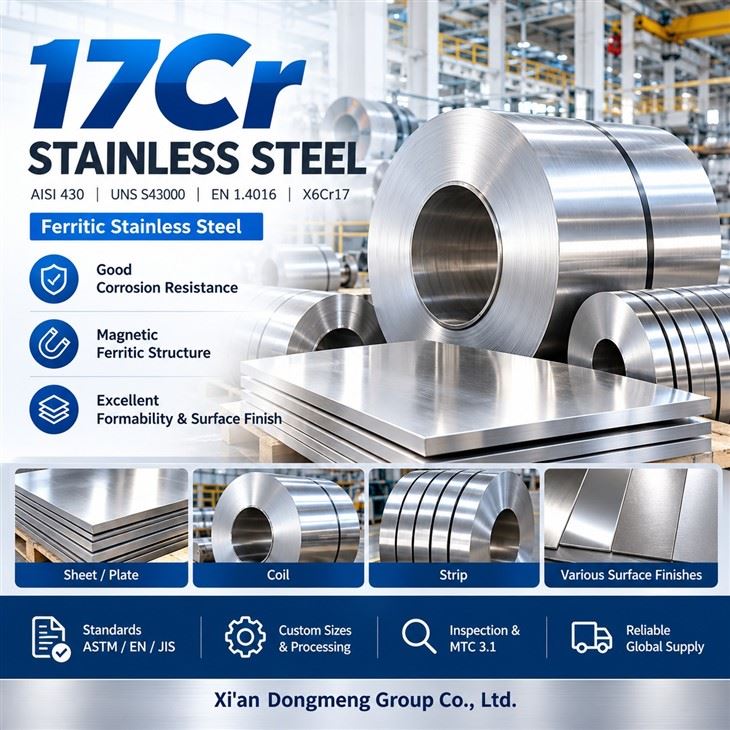
Xi'an Dongmeng Group Co., Ltd. is one of the most reliable manufacturers and suppliers of 17cr stainless steel in China, also supports customized service. With abundant experience, we warmly welcome you to wholesale cheap products in stock here and get free sample from our factory. For price consultation, contact us.

17Cr Stainless Steel – AISI 430 / UNS S43000 / EN 1.4016
Xi'an Dongmeng Group Co., Ltd. is a manufacturer and exporter supplying 17Cr stainless steel, commonly specified as AISI 430 / UNS S43000 / EN 1.4016, for international distributors, metal fabricators, appliance manufacturers, automotive component suppliers and industrial OEM customers.
17Cr stainless steel is a chromium-based ferritic stainless steel containing approximately 16–18% chromium. It provides good corrosion resistance in mild environments, magnetic properties, useful formability and an economical alternative to nickel-containing austenitic stainless steels for suitable applications.
We offer procurement solutions for 17Cr stainless steel sheets, coils, strips and selected custom-processed products. Available services may include precision slitting, cut-to-length processing, surface finishing, protective film application, dimensional inspection and export packaging.
Material grades, delivery standards, surface conditions and inspection requirements are confirmed according to the customer's purchase order.
Request a 17Cr stainless steel quotation, technical datasheet, material certificate or customized size proposal.
What Is 17Cr Stainless Steel?
17Cr stainless steel is a commercial description commonly used for chromium-rich ferritic stainless steels containing approximately 17% chromium.
For many industrial purchasing applications, the term refers to AISI 430 stainless steel, which is internationally recognized by the following designations:
| Standard System | Material Designation |
| AISI | 430 |
| UNS | S43000 |
| EN Material Number | 1.4016 |
| EN Steel Name | X6Cr17 |
| JIS | SUS430 |
| Common Chinese Grade | 10Cr17 |
| Metallurgical Structure | Ferritic |
| Nominal Chromium Content | Approximately 17% |
These designations identify closely corresponding material grades. However, chemical composition limits, mechanical requirements and delivery conditions may differ between individual national standards.
The exact specification should therefore be verified before accepting a material substitution.
Unlike martensitic stainless steels such as 420 and 440C, conventional AISI 430 does not develop high hardness through standard quenching and tempering treatments.
Its ferritic structure provides magnetic behavior and good dimensional stability during many conventional fabrication operations.
Important Material Identification
17Cr stainless steel should not be confused with 17-4 PH stainless steel.
17-4 PH, also known as UNS S17400 or Type 630, is a precipitation-hardening stainless steel containing chromium, nickel, copper and niobium.
These materials have different strengthening mechanisms, mechanical properties, fabrication requirements and industrial applications.
17Cr Stainless Steel Available Specifications
17Cr stainless steel can be supplied in different flat-rolled product forms depending on the required manufacturing process and application.
The following dimensions are indicative procurement ranges rather than guaranteed inventory.
| Product Form | Thickness / Diameter | Width | Length / Delivery |
| Cold Rolled Sheet | 0.3–3.0 mm (0.012–0.118 in) | 1000–1500 mm | Cut to size |
| Stainless Steel Plate | 3.0–12.0 mm (0.118–0.472 in) | Subject to mill availability | Cut to length |
| Stainless Steel Coil | 0.3–3.0 mm (0.012–0.118 in) | 1000 / 1219 / 1250 / 1500 mm | Coil |
| Precision Stainless Strip | 0.1–3.0 mm (0.004–0.118 in) | Customized slit widths | Coil |
| Stainless Steel Bar | According to inquiry | Round / Flat / Square | Cut to length |
| Stainless Steel Tube | According to inquiry | OD and wall thickness specified | Straight lengths |
Procurement Note: Flat-rolled 430 stainless steel is the primary product scope. Bar, tube and nonstandard thickness requirements should be reviewed separately against the appropriate manufacturing standard and available production route.
Common Sheet Sizes
| Metric Size | Approximate Imperial Size |
|---|---|
| 1000 × 2000 mm | 39.37 × 78.74 in |
| 1219 × 2438 mm | 4 × 8 ft |
| 1219 × 3048 mm | 4 × 10 ft |
| 1250 × 2500 mm | 49.21 × 98.43 in |
| 1500 × 3000 mm | 59.06 × 118.11 in |
Sheet thickness, dimensional tolerances, flatness, edge condition and surface finish must be specified according to the applicable delivery standard.
For stainless steel coils, buyers should additionally specify coil inner diameter, maximum coil weight, edge condition and packaging requirements.
Chemical Composition of 17Cr Stainless Steel
The chemical composition of commercially specified 17Cr stainless steel is typically represented by AISI 430 / UNS S43000.
ASTM A240 Type 430 Chemical Composition
| Element | Symbol | Requirement (% by Weight) |
|---|---|---|
| Chromium | Cr | 16.00–18.00 |
| Carbon | C | ≤ 0.12 |
| Manganese | Mn | ≤ 1.00 |
| Silicon | Si | ≤ 1.00 |
| Phosphorus | P | ≤ 0.040 |
| Sulfur | S | ≤ 0.030 |
| Nickel | Ni | ≤ 0.75 |
| Iron | Fe | Balance |
Chromium is the principal alloying element responsible for forming the protective passive oxide film on stainless steel surfaces.
Unlike conventional austenitic stainless steels, AISI 430 does not depend on substantial nickel additions to maintain its ferritic microstructure.
However, low nickel content should not be interpreted as a guarantee of zero nickel.
ASTM 430 vs EN 1.4016 Chemical Requirements
Although AISI 430 and EN 1.4016 are commonly treated as corresponding grades, certain chemical limits differ.
For example, ASTM Type 430 permits a maximum carbon content of 0.12%, whereas EN 1.4016 commonly specifies a maximum carbon content of 0.08%.
EN sulfur limits may also vary by product form.
For international procurement, the governing standard, product form and applicable edition should be specified rather than relying exclusively on an equivalent-grade designation.
Mechanical Properties of 17Cr Stainless Steel
Mechanical properties depend on the applicable material standard, processing route, thickness and delivery condition.
ASTM A240 Type 430 – Annealed Flat Products
| Mechanical Property | Specification Requirement |
|---|---|
| Tensile Strength | ≥ 450 MPa (65 ksi) |
| 0.2% Yield Strength | ≥ 205 MPa (30 ksi) |
| Elongation | ≥ 22% |
| Maximum Hardness | 89 HRB |
| Maximum Brinell Hardness | 183 HB |
| Material Condition | Annealed |
The values above represent commonly specified requirements for ASTM A240 Type 430 flat products. Different elongation requirements may apply to thin products under particular specifications.
These values should not automatically be applied to bars, tubing, heavily cold-worked strip or products supplied under other standards.
Important Engineering Considerations
Formability: Annealed AISI 430 is suitable for many bending, stamping and roll-forming operations.
Cold Working: Cold deformation can increase strength and hardness, but 430 does not respond to conventional quench hardening like martensitic grades.
Impact Toughness: Ferritic stainless steels may become more susceptible to brittle behavior at low temperatures.
High-Temperature Strength: Mechanical strength decreases as operating temperature increases. High-temperature structural design requires appropriate allowable-stress data.
Physical Properties of AISI 430 Stainless Steel
| Physical Property | Typical Reference Value |
|---|---|
| Density | 7.70 g/cm³ |
| Elastic Modulus at 20°C | Approximately 220 GPa |
| Thermal Conductivity at 20°C | Approximately 25 W/m·K |
| Specific Heat Capacity | Approximately 460 J/kg·K |
| Mean Thermal Expansion, 20–100°C | Approximately 10.0 × 10⁻⁶/K |
| Crystal Structure | Body-Centered Cubic Ferrite |
| Magnetic Property | Magnetic |
These values are reference properties for material selection and should not be treated as guaranteed acceptance limits.
The relatively low thermal expansion of ferritic stainless steel can be advantageous in some applications involving temperature changes.
However, selection for high-temperature equipment must also consider oxidation, thermal cycling, creep, thermal fatigue and possible embrittlement.
Key Advantages of 17Cr Stainless Steel
1. Cost-Effective Chromium Stainless Steel
17Cr stainless steel provides corrosion resistance suitable for many mild-service applications without the substantial nickel content associated with common austenitic grades.
This makes AISI 430 an attractive material for cost-sensitive appliance production, architectural components and large-volume fabricated products.
2. Magnetic Ferritic Structure
AISI 430 is magnetic because of its ferritic microstructure.
This characteristic may be useful for components requiring magnetic response or compatibility with magnetic attachment systems.
3. Good Surface Appearance
Properly processed 430 stainless steel offers an attractive surface suitable for decorative products.
Available finishes may include 2B, BA, No.4, hairline and polished surfaces.
4. Suitable for Conventional Forming
Annealed 430 stainless steel can be processed by bending, stamping, roll forming and moderate drawing operations.
The forming process must account for sheet thickness, rolling direction, required deformation and surface protection.
5. Useful Oxidation Resistance
The chromium content provides resistance to oxidation in selected elevated-temperature environments.
However, oxidation resistance does not automatically establish suitability for continuous high-temperature mechanical loading.
17Cr Stainless Steel Surface Finishes
Different surface finishes can be selected according to decorative appearance, processing requirements and end-use conditions.
| Surface Finish | Description | Typical Applications |
|---|---|---|
| 2B | Smooth, cold-rolled, annealed and skin-passed finish | Appliance panels, general fabrication |
| BA | Bright annealed reflective surface | Decorative panels, appliance trim |
| No.1 | Hot-rolled, heat-treated and descaled surface | Industrial fabrication |
| No.4 | Mechanically polished directional finish | Kitchen equipment, interior panels |
| Hairline (HL) | Long directional brushed texture | Architectural decoration |
| Polished | Customized mechanically polished surface | Decorative products |
Surface appearance, roughness, directional pattern and protective-film requirements should be approved using agreed samples where appearance is critical.
Mirror-like finishes may be produced by additional polishing, but their availability and achievable appearance depend on the starting material and processing method.
Corrosion Resistance of 17Cr Stainless Steel
17Cr stainless steel provides useful resistance to atmospheric corrosion and mild chemical exposure through the formation of a chromium-rich passive surface layer.
Its performance is strongly influenced by the surrounding environment.
| Service Environment | General Suitability |
|---|---|
| Dry indoor environments | Suitable |
| Household appliance surfaces | Suitable |
| General indoor architectural panels | Suitable |
| Mild atmospheric exposure | Generally suitable |
| Outdoor industrial exposure | Requires environmental evaluation |
| Coastal environments | Limited suitability |
| Seawater exposure | Generally not recommended |
| Chloride-rich chemical solutions | Requires careful material assessment |
| Strong acids | Generally not recommended without specific compatibility data |
| High-temperature oxidizing environments | Requires temperature and exposure assessment |
Pitting and Crevice Corrosion
Chloride-containing environments can cause localized corrosion, especially where moisture accumulates.
Crevices, deposits and contaminated surfaces may increase corrosion risk.
For demanding chloride-containing applications, higher-alloy stainless steels such as 316L or suitable duplex grades may be preferable.
Stress Corrosion Cracking
Ferritic stainless steels generally offer advantages over conventional austenitic grades in resistance to certain chloride-induced stress corrosion cracking mechanisms.
However, this does not mean they are immune to all forms of stress-assisted corrosion or environmentally assisted cracking.
Surface Maintenance
Contamination from carbon steel tools, grinding particles or aggressive cleaning chemicals may reduce the corrosion performance and appearance of finished components.
Appropriate cleaning and contamination-control procedures are recommended.
Fabrication and Welding Performance
Cutting and Shearing
17Cr stainless steel sheets and strips can be processed by conventional cutting methods, including shearing and laser cutting.
Cutting parameters should be selected according to thickness, edge quality and downstream fabrication requirements.
Bending and Stamping
AISI 430 offers good formability for many conventional sheet-metal operations.
For demanding forming processes, buyers should specify:
Material thickness and forming direction
Minimum bending radius
Deep-drawing or stretching requirements
Surface appearance requirements
Required final component tolerances
Forming trials may be necessary for complex stamped parts.
Welding
AISI 430 can be welded, but its welding performance is generally more limited than that of austenitic 304 stainless steel.
Welding can produce grain growth and changes in the heat-affected zone, potentially reducing ductility or corrosion resistance.
Welding procedures should control heat input, joint preparation, filler selection and post-weld surface condition.
For applications involving extensive welding, stabilized ferritic grades such as 439 or 441 may be evaluated as alternatives.
Heat Treatment
AISI 430 is normally supplied in an annealed condition for flat-rolled applications.
It should not be specified using conventional martensitic hardening procedures involving austenitizing, quenching and tempering to obtain high hardness.
The appropriate annealing cycle depends on product form, section thickness and manufacturing process.
17Cr vs 304 vs 316L Stainless Steel
Selecting the correct stainless steel requires balancing corrosion resistance, fabrication characteristics, environmental exposure and material cost.
| Property | 17Cr / AISI 430 | AISI 304 | AISI 316L |
|---|---|---|---|
| Stainless Steel Family | Ferritic | Austenitic | Austenitic |
| Main Alloying System | Cr | Cr-Ni | Cr-Ni-Mo |
| Magnetic Behavior | Magnetic | Generally nonmagnetic when annealed | Generally nonmagnetic when annealed |
| Corrosion Resistance | Suitable for mild environments | Better general resistance | Better resistance in many chloride environments |
| Formability | Good for suitable operations | Very good | Very good |
| Weldability | More limited | Good | Good |
| Nickel Content | Low | Substantial | Substantial |
| Typical Material Cost | Generally lower | Higher | Higher |
| Common Applications | Appliances, indoor panels, trim | General industrial equipment | Chemical, marine-related and chloride-exposed equipment |
When to Choose 17Cr Stainless Steel
AISI 430 is often suitable when the application requires a stainless steel appearance, moderate corrosion resistance, magnetic properties and cost-effective fabrication.
When to Choose 304 Stainless Steel
304 is usually preferable when improved general corrosion resistance, weldability or more demanding forming performance is required.
When to Choose 316L Stainless Steel
316L should be considered for many applications involving chloride exposure or more demanding chemical conditions, subject to detailed corrosion assessment.
Material selection should always be based on the actual operating environment rather than nominal chromium content alone.
Industrial Applications of 17Cr Stainless Steel
Household Appliance Manufacturing
AISI 430 is widely used in appliance components where decorative appearance, cleanability and moderate corrosion resistance are required.
Examples include appliance housings, interior panels, oven trim and selected kitchen equipment components.
Automotive Components
17Cr stainless steel may be used in automotive trim and selected heat shields or formed components.
Applications involving prolonged high-temperature exhaust exposure, extensive welding or severe thermal cycling may require specialized ferritic grades.
Architectural and Decorative Applications
Polished and brushed 430 stainless steel can be used for interior wall panels, decorative trim, elevator interiors and architectural components.
For coastal or aggressive outdoor environments, corrosion resistance should be evaluated carefully.
Kitchen Equipment and Food-Service Components
430 stainless steel is used in selected equipment housings, appliance surfaces and kitchenware.
Suitability for direct food contact depends on the complete product, surface condition, cleaning requirements and applicable regulations.
Industrial Sheet Metal Fabrication
Custom-cut sheets and strips can be used in formed metal products, enclosures, brackets, equipment panels and other fabricated components.
The grade should be approved against the required mechanical loading and environmental conditions.
International Standards and Delivery Requirements
Different standards cover different product forms and inspection requirements.
| Standard | Application |
|---|---|
| ASTM A240/A240M | Stainless steel plate, sheet and strip |
| ASTM A480/A480M | General requirements for flat-rolled stainless steel |
| ASTM A276/A276M | Stainless steel bars and shapes |
| ASTM A268/A268M | Seamless and welded ferritic/martensitic stainless steel tubing |
| EN 10088-2 | Technical delivery conditions for stainless sheet, plate and strip |
| EN 10088-3 | Technical delivery conditions for stainless bars, rods, wire, sections and bright products |
| JIS G4304 | Hot-rolled stainless steel plate, sheet and strip |
| JIS G4305 | Cold-rolled stainless steel plate, sheet and strip |
| EN 10204 | Types of inspection documents |
Not every standard applies to every available product form.
For example, ASTM A240 should not be used as the governing specification for a stainless steel tube merely because the tube is manufactured from stainless steel.
The required grade, dimensions, mechanical properties, manufacturing method, surface finish and inspection criteria should be defined using the appropriate product standard.
Custom Processing and Supply Capabilities
Xi'an Dongmeng Group Co., Ltd. supports project-based procurement of 17Cr stainless steel materials.
Depending on product availability and order requirements, processing services can be arranged for:
Precision Slitting
Stainless steel coils can be processed into customized strip widths for stamping, roll forming and industrial component production.
Cut-to-Length Processing
Coils and sheets can be cut to specified dimensions according to approved tolerances.
Surface Finishing
Polishing, brushing, protective-film application and selected decorative finishes can be discussed according to application requirements.
OEM Sheet Metal Fabrication
Custom cutting, bending and component fabrication can be evaluated against customer drawings.
Export Packaging
Packing arrangements can be developed according to material form, shipment method and destination.
Production availability, minimum order quantity, processing tolerances and lead time are confirmed during quotation.
Inspection & Quality Assurance
Material traceability and inspection are essential for international industrial procurement.
Chemical Composition Verification
Chemical analysis should verify compliance with the specified material grade.
PMI methods such as XRF can help identify principal alloying elements, including chromium, but XRF alone is not adequate for verifying carbon limits.
Where carbon analysis is required, an appropriate laboratory test method should be specified.
Mechanical Property Testing
Tensile strength, yield strength, elongation and hardness can be verified according to the applicable product standard and delivery condition.
Dimensional Inspection
Inspection can include:
Thickness and width
Length and flatness
Coil dimensions and edge condition
Surface condition
Applicable dimensional tolerances
Material Test Certificates
An EN 10204 Type 3.1 inspection certificate can be specified where supported by the manufacturing and inspection arrangement.
The documentation should identify the material grade, applicable standard, heat number and required test results.
Third-party inspection and additional documentation can be arranged when agreed before production or shipment.
Packaging and International Shipping
Proper packaging helps protect stainless steel from moisture, surface damage and transportation-related deformation.
Stainless Steel Coil Packaging
Coils may be protected with moisture barriers, edge protection and suitable pallets or supports.
Coil orientation, weight and handling requirements should be confirmed before shipment.
Stainless Steel Sheet Packaging
Sheets may be supplied with protective film, interleaving materials and secured export pallets or crates.
Stainless Steel Strip Packaging
Precision strips require packaging suited to coil dimensions, edge quality, surface finish and handling conditions.
Shipping Documentation
Depending on order requirements, documentation may include the commercial invoice, packing list, material test certificate and applicable shipping documents.
Why Choose Xi'an Dongmeng Group Co., Ltd.?
Industrial Material Procurement Support
We help international buyers define suitable material grades, standards, product forms and inspection requirements.
Custom Processing Options
Sheet cutting, coil slitting, surface finishing and dimensional customization can be evaluated for OEM and industrial applications.
Technical Documentation
Material specifications, inspection requirements and certification options can be reviewed before order confirmation.
International Export Services
Packaging and shipping arrangements can be coordinated according to destination and purchase-order requirements.
Application-Oriented Material Selection
Our team can assist customers in comparing 430 stainless steel with alternative grades when corrosion resistance, fabrication requirements or cost are important considerations.
Frequently Asked Questions About 17Cr Stainless Steel
1. What is 17Cr stainless steel?
17Cr stainless steel is a commercial description commonly associated with ferritic stainless steel containing approximately 17% chromium. In many industrial applications, the corresponding grade is AISI 430 / UNS S43000 / EN 1.4016.
2. Is 17Cr stainless steel the same as AISI 430?
In many commercial specifications, 17Cr refers to AISI 430 stainless steel. However, 17Cr alone is not a complete material specification. The required grade and governing standard should be confirmed before purchasing.
3. Is 17Cr stainless steel magnetic?
Yes. Conventional AISI 430 stainless steel has a ferritic microstructure and is magnetic.
4. What is the chromium content of 17Cr stainless steel?
AISI 430 stainless steel typically contains 16.0–18.0% chromium according to its material specification.
5. Is 17Cr stainless steel corrosion resistant?
Yes. It offers useful corrosion resistance in mild atmospheric and indoor environments. However, it is generally less resistant to aggressive chloride-containing environments than 316L stainless steel.
6. Is 17Cr stainless steel better than 304?
Neither grade is universally better. AISI 430 can offer cost and magnetic-property advantages for suitable applications. AISI 304 generally provides better corrosion resistance, weldability and formability for more demanding conditions.
7. Can 17Cr stainless steel be welded?
Yes, but AISI 430 has more limited weldability than common austenitic grades. Welding procedures must account for heat-affected-zone behavior, joint design and service requirements.
8. Can 17Cr stainless steel be hardened by heat treatment?
Conventional AISI 430 cannot be hardened through quenching and tempering in the same manner as martensitic stainless steels. Cold working can increase its strength and hardness.
9. What is the difference between 17Cr and 17-4 PH stainless steel?
17Cr commonly refers to ferritic AISI 430 stainless steel, while 17-4 PH is a precipitation-hardening stainless steel designated UNS S17400. Their chemical compositions, strengthening mechanisms and mechanical properties are different.
10. Can 17Cr stainless steel be used in high-temperature applications?
It may be suitable for selected elevated-temperature environments, but operating temperature alone is insufficient for material selection. Oxidation resistance, thermal cycling, embrittlement, creep and applied stresses must also be evaluated.
11. What surface finishes are available for 17Cr stainless steel?
Commonly requested finishes include 2B, BA, No.1, No.4, hairline and polished surfaces. Availability depends on product form and processing requirements.
12. What information is required for a 17Cr stainless steel quotation?
Please provide the material grade, applicable standard, product form, thickness, width, length or coil dimensions, surface finish, quantity, inspection requirements and delivery destination.
Request a 17Cr Stainless Steel Quotation
Looking for a reliable source of 17Cr stainless steel sheets, coils, strips or custom-processed components?
Xi'an Dongmeng Group Co., Ltd. supports international B2B procurement with material selection assistance, processing options and inspection documentation.
Contact our team to:
Request a Quotation - Submit your required grade, dimensions and quantity.
Send Technical Drawings - Discuss material selection and customized processing.
Request Material Documentation - Confirm applicable standards and MTC requirements.
Discuss Delivery Requirements - Review MOQ, packaging, lead time and international shipment options.
Contact Us
Xi'an Dongmeng Group Co., Ltd.
Phone / WhatsApp: +86 15769214734
Email: office@dongmjd.com
Office Address: Room 4107, Runfeng Building, Sanqiao New Street, Weiyang District, Xi'an City, Shaanxi Province, China
Send your 17Cr stainless steel requirements to receive a project-specific quotation.
Hot Tags: 17Cr Stainless Steel, AISI 430 Stainless Steel, UNS S43000, EN 1.4016, X6Cr17, 17 Percent Chromium Stainless Steel, Ferritic Stainless Steel Supplier, 430 Stainless Steel Sheet, 430 Stainless Steel Coil, 430 Stainless Steel Strip, Magnetic Stainless Steel, 440C Stainless Steel


