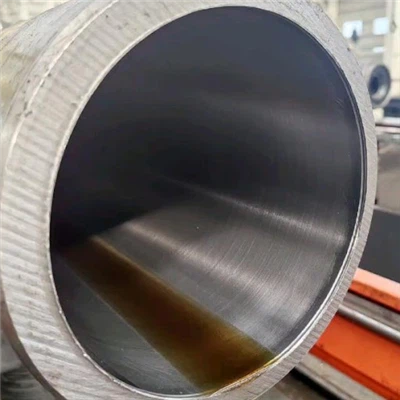


Xi'an Dongmeng Group Co., Ltd. is one of the most reliable manufacturers and suppliers of ASTM A519 Hydraulic Cylinder Tube Manufacturer | Seamless Mechanical Steel Tubing for Hydraulic Cylinders in China, also supports customized service. With abundant experience, we warmly welcome you to wholesale cheap products in stock here and get free sample from our factory. For price consultation, contact us.

ASTM A519 Seamless Hydraulic Cylinder Tube – Honed & SRB
Dongmeng Group supplies ASTM A519 seamless hydraulic cylinder tubes for hydraulic cylinder barrels, telescopic cylinders, industrial actuators and other precision fluid-power applications.
Available material grades include SAE 1020, 1026, 1035, 1045, 4130 and 4140, with cold-finished, stress-relieved, normalized or other specified delivery conditions according to the project.
Finished cylinder bores can be supplied by precision honing or skiving and roller burnishing (SRB) with specified finished ID, H8/H9 tolerance, surface roughness, straightness and inspection requirements.
Unlike ordinary mechanical tubing, a ready-to-machine hydraulic cylinder barrel requires more than an ASTM A519 material designation. Bore tolerance, surface texture, material condition, minimum wall thickness, geometry and inspection level must all be defined according to the cylinder design.
Key Procurement Specifications
| Item | Available Specification |
| Product | Seamless Hydraulic Cylinder Tube |
| Base Standard | ASTM A519/A519M |
| Tube Type | Seamless Mechanical Tubing |
| Common Grades | 1020 / 1026 / 1035 / 1045 / 4130 / 4140 |
| Manufacturing Route | Hot-Finished or Cold-Finished Seamless |
| Common Cylinder Route | Cold Drawn Seamless |
| ID Finishing | Honed / Skived & Roller Burnished |
| Finished Bore Tolerance | H8 / H9 / H10 or drawing requirement |
| Surface Finish | Specified according to seal system and application |
| Length | Cut length or project-specific length |
| Heat Treatment | As-rolled / Annealed / Normalized / Stress Relieved / Q&T where applicable |
| Inspection | Dimensional / Roughness / Mechanical / NDT as specified |
| Certification | EN 10204 3.1 available |
| Third-Party Inspection | SGS / BV / TÜV or other agreed agency |
| Processing | Cutting / Honing / SRB / CNC / End Machining |
| Packaging | Bore protection + export seaworthy packaging |
Need a Technical Quote?

Send us:
Finished Bore ID × OD or Minimum Wall Thickness × Length + Grade + Delivery Condition + Working Pressure + H Tolerance + Surface Roughness + Quantity
and our team can review the specification before quotation.
What Is ASTM A519 Hydraulic Cylinder Tube?
ASTM A519 is a specification covering several grades of seamless carbon and alloy steel mechanical tubing.
For round tubing, ASTM A519 covers seamless hot-finished and cold-finished mechanical tubing up to and including 325 mm outside diameter.
ASTM A519 tubing is widely used as raw material for hydraulic cylinder barrels because seamless mechanical tubing can provide good material uniformity and is available in carbon and alloy grades suitable for machining, heat treatment and precision bore finishing.
However:
ASTM A519 compliance alone does not mean that a tube is a finished hydraulic cylinder barrel.
The cylinder manufacturer or purchaser should separately specify the requirements that affect piston and seal performance.
These normally include:
Finished bore diameter
Bore tolerance class
Surface roughness
Surface texture
Roundness
Cylindricity
Taper
Straightness
Minimum wall thickness
Material grade
Delivery condition
Mechanical properties
NDT requirements
Inspection frequency
Certification
End machining
Bore protection
This distinction is particularly important when comparing quotations from different hydraulic tube suppliers.
ASTM A519 Standard Range vs Our Other Tube Capabilities
ASTM A519 should not be used to describe every seamless mechanical tube regardless of diameter.
ASTM A519 Round Tube Scope
Outside Diameter: Up to and including 325 mm
Larger seamless or honed cylinder tubing may be available under another applicable specification or a project-specific technical agreement, but should not automatically be described as ASTM A519.
For requirements above 325 mm OD, please provide the dimensions, grade, pressure requirement and applicable engineering specification so that the correct manufacturing standard can be confirmed.
Common ASTM A519 Grades for Hydraulic Cylinder Tubes
Material selection should be based on more than grade name alone.
The delivery condition and heat treatment can significantly affect mechanical properties, machinability, welding procedure and cylinder performance.
| Grade | Material Type | Main Characteristics | Typical Selection |
| SAE 1020 | Low-carbon steel | Good machinability and weldability | General industrial cylinders |
| SAE 1026 | Carbon steel | Common mechanical tubing grade with balanced strength and machinability | General and heavy industrial cylinders |
| SAE 1035 | Medium-carbon steel | Higher carbon content than 1026 | Higher-strength mechanical applications |
| SAE 1045 | Medium-carbon steel | Higher strength/hardness potential | More demanding cylinder components |
| SAE 4130 | Cr-Mo alloy steel | Good strength-to-weight potential after suitable heat treatment | Higher-duty hydraulic systems |
| SAE 4140 | Cr-Mo alloy steel | High hardenability and high strength potential | Heavy-duty and highly loaded cylinders |
Important
Do not select a cylinder barrel using statements such as:
"SAE 1026 tensile strength = one fixed value."
The actual mechanical properties depend on:
Tube manufacturing route
Cold work
Heat treatment
Wall thickness
Ordered condition
Applicable purchase requirements
For critical cylinders, the purchase order should specify the required mechanical properties and they should be verified through the MTC.
Typical Chemical Composition Reference
The following table is intended as a grade-selection reference. Final acceptance should be based on the ordered ASTM A519 grade, applicable standard edition and actual Material Test Certificate.
| Grade | C % | Mn % | Cr % | Mo % |
| 1020 | 0.18–0.23 | 0.30–0.60 | - | - |
| 1026 | 0.22–0.28 | 0.60–0.90 | - | - |
| 1045 | 0.43–0.50 | 0.60–0.90 | - | - |
| 4130 | 0.28–0.33 | 0.40–0.60 | 0.80–1.10 | 0.15–0.25 |
| 4140 | 0.38–0.43 | 0.75–1.00 | 0.80–1.10 | 0.15–0.25 |
Other elements and exact acceptance limits should be confirmed against the applicable material specification.
Material Grade Is Not Enough: Specify Delivery Condition
This is one of the most frequently overlooked issues when sourcing hydraulic cylinder tubing.
Two tubes described as:
"ASTM A519 SAE 1026"
may not provide identical mechanical performance if their delivery conditions are different.
Common Conditions
Depending on grade and manufacturing route, tubing may be supplied in conditions such as:
Hot finished
Cold finished
Annealed
Normalized
Stress relieved
Quenched and tempered for applicable alloy grades
The quotation and purchase order should therefore state both:
Material Grade + Required Delivery Condition
For example:
ASTM A519 SAE 1026, cold-finished and stress-relieved, honed to finished ID according to drawing.
For alloy steels such as 4130 or 4140, heat-treatment condition becomes especially important.
Do Not Mix ASTM A519 with BK, BKW, GBK or NBK Without Clarification
Terms such as:
BK / BKW / GBK / NBK
are commonly associated with European precision tube delivery conditions.
They should not simply be inserted into an ASTM A519 specification without explaining which condition and mechanical-property requirement is actually intended.
For international projects, we recommend specifying the actual process or metallurgical condition rather than assuming that different standards are automatically interchangeable.
Finished Bore Tolerance: H8, H9 and H10 Explained
One of the most important corrections to conventional hydraulic tube specifications is that:
H8, H9 and H10 are not fixed ± tolerances.
For an ISO basic hole tolerance zone H, the lower deviation is zero and the permitted positive deviation changes according to the nominal finished bore diameter.
ISO Bore Tolerance Reference
| Finished Bore ID | H8 | H9 | H10 |
| >18–30 mm | 0 / +0.033 mm | 0 / +0.052 mm | 0 / +0.084 mm |
| >30–50 mm | 0 / +0.039 mm | 0 / +0.062 mm | 0 / +0.100 mm |
| >50–80 mm | 0 / +0.046 mm | 0 / +0.074 mm | 0 / +0.120 mm |
| >80–120 mm | 0 / +0.054 mm | 0 / +0.087 mm | 0 / +0.140 mm |
| >120–180 mm | 0 / +0.063 mm | 0 / +0.100 mm | 0 / +0.160 mm |
| >180–250 mm | 0 / +0.072 mm | 0 / +0.115 mm | 0 / +0.185 mm |
| >250–315 mm | 0 / +0.081 mm | 0 / +0.130 mm | 0 / +0.210 mm |
Always confirm the applicable ISO 286 table and project drawing before production.
H8 Hydraulic Cylinder Bore Examples
Ø50 mm H8 Bore
Permitted finished bore:
50.000–50.039 mm
Ø80 mm H8 Bore
Permitted finished bore:
80.000–80.046 mm
Ø100 mm H8 Bore
Permitted finished bore:
100.000–100.054 mm
Ø160 mm H8 Bore
Permitted finished bore:
160.000–160.063 mm
This is why a statement such as:
"H8 = ±0.025 mm"
should not be used for all cylinder tube sizes.
H8 vs H9: Which Bore Tolerance Should You Choose?

The tolerance should be selected according to the piston, guide and sealing system rather than simply specifying the tightest tolerance available.
H8
Typically selected when the application requires tighter finished bore control.
Suitable for:
Precision hydraulic cylinders
OEM cylinder production
Applications with controlled piston/seal clearance
Higher repeatability requirements
H9
Provides a wider dimensional tolerance and may be appropriate where the cylinder design does not require H8 accuracy.
Potential advantages include:
Lower finishing cost
Easier production on some large bore sizes
Suitable for less demanding tolerance requirements
H10
May be used when a wider bore tolerance is acceptable or when additional machining is planned by the customer.
The correct tolerance should always be confirmed against the cylinder drawing and seal design.
Bore Tolerance Is Not the Same as Bore Geometry
A tube can technically meet an ID size tolerance and still create cylinder assembly or seal problems.
Therefore, critical applications may also require limits for:
Roundness
Controls deviation of the bore from a true circular profile.
Cylindricity
Controls the three-dimensional form of the bore along its length.
Taper
Controls unwanted increase or decrease in bore size from one end to the other.
Straightness
Important for long cylinder barrels and long-stroke cylinders.
Eccentricity
Eccentricity can reduce the actual minimum wall thickness, even when nominal OD and ID appear acceptable.
For demanding cylinders, these requirements should be specified separately on the drawing or purchase order.
Honed Hydraulic Cylinder Tube
Honing uses abrasive stones to remove a controlled amount of material from the inside diameter.
The process is commonly selected when the finished bore requires:
Accurate finished ID
Improved bore geometry
Controlled surface texture
Removal of minor internal imperfections
Cross-hatched surface pattern
Good compatibility with reciprocating sealing systems
The amount of stock left before honing should be considered when ordering the mother tube.
Skived & Roller Burnished Hydraulic Cylinder Tube

SRB combines two operations.
Skiving
A cutting tool removes material from the bore.
Roller Burnishing
Rollers plastically smooth the surface peaks and create a finished bore.
SRB is widely used for hydraulic cylinder tubing where production efficiency and repeatable bore finishing are important.
Honed Tube vs Skived & Roller Burnished Tube
| Selection Factor | Honed Tube | SRB Tube |
| Finishing Method | Abrasive material removal | Cutting + roller burnishing |
| Surface Appearance | Characteristic cross-hatch | Burnished circumferential texture |
| Bore Correction | Good ability to correct minor geometry | More dependent on incoming tube condition |
| Production Rate | Generally lower | Generally higher |
| Large Production Runs | Suitable | Particularly attractive |
| Surface Texture | Controlled honed texture | Very smooth burnished surface |
| Final Selection | Based on bore and seal requirement | Based on bore, seal and production requirement |
Neither process should automatically be described as "better."
The correct process depends on:
Seal material
Required Ra/Rz
Bore geometry
Cylinder speed
Lubrication
Duty cycle
Production volume
Cost target
Surface Roughness: Do Not Specify Ra Alone
Many hydraulic tube pages state only:
Ra 0.2–0.4 μm
and treat this as a complete cylinder bore specification.
That is not always sufficient.
For reciprocating hydraulic seals, surface performance may also be influenced by:
Ra
Rz
Rp
Rt
Rmr
Surface direction
Plateau structure
Peaks and valleys
Two surfaces with the same Ra value can behave differently against a hydraulic seal.
Surface Finish and Seal Compatibility
The correct surface specification depends on the seal material and seal supplier recommendations.
As an engineering reference, dynamic sealing surfaces commonly require carefully controlled roughness.
| Seal Family | Typical Dynamic Surface Reference |
| PTFE-based seals | Approximately Ra 0.05–0.20 μm depending on seal design |
| TPU / TPE / Rubber seals | Approximately Ra 0.10–0.40 μm depending on seal design |
Rz and material ratio should also be considered where required.
These values should not replace the specification issued by the seal manufacturer.
Recommendation
When requesting a hydraulic cylinder tube, provide:
Required Ra + Rz + Seal Type
where possible.
This allows a much more reliable surface recommendation than specifying "mirror finish" or Ra alone.
Why an Extremely Smooth Bore Is Not Always Better
A lower Ra number does not automatically produce longer seal life.
An excessively smooth surface may affect lubricant retention and may not be optimal for every rubber or polyurethane seal system.
Likewise, a surface with excessive peaks can accelerate seal wear.
The objective is therefore:
Controlled surface texture appropriate for the chosen reciprocating seal system - not simply the lowest possible Ra value.
Representative ASTM A519 Hydraulic Cylinder Tube Sizes
The following dimensions illustrate common tube combinations. They are not mandatory ASTM sizes.
Final availability should be confirmed according to grade, delivery condition and quantity.
| OD | Finished ID | Nominal Wall | Length |
| 30 mm | 20 mm | 5 mm | Custom |
| 40 mm | 25 mm | 7.5 mm | Custom |
| 50 mm | 35 mm | 7.5 mm | Custom |
| 63 mm | 50 mm | 6.5 mm | Custom |
| 80 mm | 65 mm | 7.5 mm | Custom |
| 100 mm | 80 mm | 10 mm | Custom |
| 125 mm | 100 mm | 12.5 mm | Custom |
| 160 mm | 140 mm | 10 mm | Custom |
| 200 mm | 180 mm | 10 mm | Custom |
| 250 mm | 220 mm | 15 mm | Custom |
Metric and imperial dimensions can be quoted according to drawings.
How to Specify Hydraulic Cylinder Tube Size Correctly
For a finished cylinder barrel, use:
Finished ID × OD × Length
or:
Finished ID × Minimum Required Wall Thickness × Length
Example:
ASTM A519 SAE 1026
Finished ID: 100 mm H8
OD: 125 mm
Length: 2,500 mm
Honed bore
Specified surface finish
Stress-relieved condition
This provides much more useful procurement information than requesting only:
"100 mm hydraulic tube."
Hydraulic Cylinder Wall Thickness and Working Pressure
One of the most common buyer questions is:
"What wall thickness do I need for a 160 bar, 250 bar or 350 bar hydraulic cylinder?"
There is no safe universal answer based only on pressure.
Cylinder barrel design should consider:
Finished bore diameter
Actual minimum wall thickness
Material grade
Delivery condition
Yield strength
Working pressure
Peak pressure
Proof pressure
Fatigue cycles
Stroke
Operating temperature
Hydraulic fluid
End construction
Welded ports
Threads
Machining depth
Stress concentration
Applicable design code
Safety factor
Nominal Wall Thickness
For a simple concentric tube:
Nominal Wall Thickness = (OD − ID) / 2
However, engineering design should consider the minimum actual wall thickness, not only the nominal value.
Eccentricity, OD tolerance, ID tolerance and machining can all reduce the minimum remaining wall.
Why We Do Not Publish One "Maximum Pressure" for Every ASTM A519 Tube
A statement such as:
"ASTM A519 tube maximum pressure = 350 bar"
is technically incomplete.
ASTM A519 identifies the mechanical tubing specification and material grade. It does not give one universal hydraulic cylinder pressure rating for every:
Grade
Bore
Wall thickness
Heat treatment
End design
Duty cycle
For pressure-critical cylinders, the wall thickness should therefore be verified according to the actual cylinder design.
Information Required for Pressure-Related Tube Selection
Please provide:
Finished cylinder bore
OD or available envelope
Material grade
Delivery condition
Normal working pressure
Maximum/peak pressure
Proof test requirement
Stroke
Operating temperature
Hydraulic medium
Expected duty cycle
End connection or welding details
Applicable cylinder design standard
Required safety factor
We can then review the tube manufacturing and material requirements against your specification.
ASTM A519 vs ASTM A513 DOM vs EN 10305-1 vs SAE J524
These standards should not be treated as interchangeable names for the same product.
| Standard | Product Type | Main Scope | Important Difference |
| ASTM A519 | Seamless mechanical tubing | Carbon/alloy mechanical tubing | Seamless; common base material for cylinder barrels |
| ASTM A513 Type 5 | ERW mechanical tubing, drawn over mandrel | Mechanical tubing | DOM is welded tubing that is subsequently drawn |
| EN 10305-1 | Seamless cold-drawn precision tubing | Precision engineering applications | European precision tube specification |
| SAE J524 | Seamless low-carbon pressure tubing | Hydraulic lines requiring bending/flaring | Primarily hydraulic line tubing, not a cylinder-barrel specification |
| DIN 2391 | Legacy precision tubing designation | Older European precision tube projects | For new projects, applicable EN 10305 requirements should normally be clarified |
Is DOM Tube Seamless?
No.
DOM means Drawn Over Mandrel.
Under ASTM A513, Type 5 DOM tubing starts as electric-resistance-welded mechanical tubing and is subsequently drawn over a mandrel.
The drawing process can greatly improve:
Dimensional accuracy
Concentricity
Surface finish
Mechanical consistency
but it does not change the manufacturing route into seamless tubing.
Therefore:
ASTM A519 seamless tube and ASTM A513 DOM tube should not be listed as the same product condition.
ASTM A519 vs SAE J524
SAE J524 covers cold-drawn and annealed seamless low-carbon steel pressure tubing intended for hydraulic lines and applications requiring bending and flaring.
That is a different procurement intent from a precision-finished hydraulic cylinder barrel.
For cylinder barrels, specify the actual mechanical tube standard, material condition, finished bore and geometric requirements.
ASTM A519 vs EN 10305-1
EN 10305-1 covers seamless cold-drawn steel tubes for precision applications.
It places strong emphasis on defined dimensional tolerances and surface characteristics.
A customer drawing may reference either ASTM A519 or EN 10305-1 depending on region and engineering practice.
They should not automatically be considered equivalent.
If a project asks for:
ASTM A519 / E355 / EN 10305 / ST52
our team should first confirm which standard actually controls:
Chemistry
Mechanical properties
Delivery condition
Dimensions
Testing
before quotation.
About "ST52 Equivalent"
"ST52" is frequently used commercially when discussing European hydraulic tubing.
However, ST52, E355 and SAE 1026 should not be described as universally identical materials.
They originate from different material and standard systems.
Substitution should be approved according to:
Chemical composition
Mechanical properties
Delivery condition
Dimensional requirements
Project specification
For technical quotations, we recommend using the exact standard and grade required by the drawing rather than relying only on the word "equivalent."
Manufacturing Process

A typical ASTM A519 seamless hydraulic cylinder tube route may include:
1. Raw Material Verification
Steel chemistry and heat identification are checked against the ordered grade.
2. Seamless Tube Production
Tube hollows are produced through an appropriate seamless manufacturing process.
3. Cold Drawing
Where required, cold drawing improves dimensional control and prepares the tube for subsequent precision finishing.
4. Heat Treatment
Annealing, normalizing, stress relieving or other heat treatment is applied according to grade and ordered condition.
5. Straightening
Tube straightness is controlled before precision internal finishing.
6. Bore Preparation
The bore is prepared with adequate machining allowance for the finishing process.
7. Honing or SRB
The ID is finished to the specified bore dimension, tolerance and surface requirement.
8. Cleaning
The finished bore is cleaned to remove abrasive residue, metal chips, oil contamination or other debris.
9. Inspection
Dimensions, bore tolerance, roughness and other specified characteristics are checked.
10. Bore Protection
Rust preventive oil, clean end caps and protective packaging are used before shipment.
Bore Geometry and Dimensional Inspection
For OEM hydraulic cylinder projects, a complete dimensional inspection plan may include:
| Item | Typical Inspection |
| Outside Diameter | Micrometer / suitable calibrated gauge |
| Finished ID | Bore gauge / internal measuring equipment |
| Wall Thickness | Calibrated measurement / UT where specified |
| Bore Tolerance | Internal diameter measurement |
| Roundness | Multi-position bore measurement |
| Straightness | Straight edge / dedicated inspection setup |
| Taper | Bore measurement along tube length |
| Surface Roughness | Profilometer |
| Length | Calibrated length measurement |
| End Squareness | Inspection where specified |
Inspection method and frequency should be agreed before production for critical projects.
Inspection and Quality Documentation
Hydraulic cylinder tubes should not be purchased based solely on a statement such as:
"Strict Quality Control."
The quotation should identify which inspections will actually be performed.
"performed when specified"
unless the purchase specification requires 100% testing.

01
Raw Material Verification
Heat number verification
Material grade confirmation
Chemical composition
02
Mechanical Testing
According to material specification and purchase requirements:
Tensile strength
Yield strength
Elongation
Hardness where required
03
Dimensional Inspection
OD
ID
Wall thickness
Length
Bore tolerance
Straightness
Geometry where specified
04
Bore Surface Inspection
Ra
Rz where required
Visual finish
Surface defects
Depending on purchase requirements:
Ultrasonic Testing
Eddy Current Testing
Other agreed NDT
Is Hydrostatic Testing Required by ASTM A519?
ASTM A519 is a mechanical tubing specification.
Hydrostatic testing should therefore not automatically be advertised as a standard test performed on every ASTM A519 hydraulic cylinder tube.
Where a project requires hydrostatic, pressure or proof testing, the exact requirement should be agreed separately.
EN 10204 3.1 Material Test Certificate
EN 10204 Type 3.1 inspection documentation can be supplied when specified.
A Type 3.1 certificate is not simply another name for third-party inspection.
It is issued within the manufacturer's authorized inspection system according to the applicable EN 10204 requirements.
Typical information may include:
Manufacturer
Purchase order
Material specification
Grade
Heat number
Chemical composition
Mechanical test results
Product identification
Inspection authorization
EN 10204 3.1 vs 3.2
EN 10204 3.1
Inspection certificate issued under the manufacturer's authorized inspection system according to the standard requirements.
EN 10204 3.2
Includes independent validation involving the purchaser's authorized representative or an officially designated inspection representative, as applicable.
If independent third-party inspection is required, please state this during RFQ.
Possible inspection agencies include:
SGS
Bureau Veritas
TÜV
Other buyer-nominated inspection organization
Traceability
For projects requiring traceability, the inspection plan can link the supplied tube to:
Purchase Order → Grade → Heat/Lot → Inspection Record → MTC
Additional marking and traceability requirements should be specified before production.
For cut lengths, customers should clarify whether individual pieces must retain heat or lot identification after cutting.
Welding ASTM A519 Hydraulic Cylinder Tubing
Welding procedure depends on:
Grade
Carbon content
Alloy content
Wall thickness
Heat-treatment condition
Joint design
Restraint
Required post-weld properties
1020 / 1026
Low-carbon grades generally offer better weldability than medium-carbon or Cr-Mo grades.
The qualified welding procedure should still reflect the actual cylinder design.
1045
The higher carbon content requires more careful welding procedure control.
4130 / 4140
Cr-Mo grades require particular attention to:
Preheat
Heat input
Filler material
Cooling rate
Hardness
Hydrogen cracking
Post-weld treatment where required
Do not use a universal preheat or PWHT temperature without reviewing the actual grade, wall thickness and welding procedure.
Custom Processing
Dongmeng Group can support project-specific processing requirements subject to drawing review.
Available services can include:
Precision honing
Skiving and roller burnishing
Cut-to-length
End facing
Chamfering
CNC turning
Threading
Drilling
Port preparation
External machining
Custom packaging
For machined parts, provide STEP, DWG or dimensioned PDF drawings where available.
Applications
ASTM A519 seamless hydraulic cylinder tubing is commonly considered for:
Construction Machinery
Excavators
Loaders
Bulldozers
Cranes
Concrete equipment
Agricultural Equipment
Tractors
Harvesters
Agricultural implements
Lift systems
Material Handling
Forklifts
Lift tables
Scissor lifts
Loading equipment
Mining Equipment
Heavy-duty actuators
Mining machinery
Support systems
Industrial Hydraulic Systems
Hydraulic presses
Automation equipment
Production machinery
Machine tools
Mobile Equipment
Dump trucks
Trailers
Refuse equipment
Utility vehicles
Marine and Offshore Equipment
For marine environments, corrosion protection and material selection should be specified according to service conditions.
Packaging for Honed Cylinder Tubes
The finished bore is one of the most valuable surfaces of a hydraulic cylinder tube.
Packaging should therefore protect against:
Corrosion
Moisture
Dust
Steel particles
Mechanical impact
Damage to tube ends
Typical Export Protection
Clean finished bore
Rust preventive oil
Plastic end caps
Protective wrapping
Steel bundles
Wooden cases or plywood crates where required
Custom seaworthy packaging
Special cleanliness requirements should be stated before ordering.
Why Choose Dongmeng Group for Hydraulic Cylinder Tubing?
1. Specification Review Before Production
We focus on the complete cylinder tube requirement rather than quoting only by grade and OD.
Important parameters such as:
Finished ID
H tolerance
Surface requirement
Delivery condition
Length
Inspection
Certification
can be reviewed before production.
2. Multiple Material Options
Carbon and alloy steel options can be selected according to the application rather than applying one material to every cylinder.
3. Honed and SRB Options
Different internal finishing processes allow customers to specify the most suitable bore finish for their production system.
4. Inspection Based on Purchase Requirements
Dimensional inspection, surface roughness testing, mechanical testing and NDT can be included according to the agreed inspection plan.
5. Material Traceability
MTC and heat/lot traceability can be supplied according to the purchase specification.
6. Processing Support
Cutting, honing, SRB and further machining can reduce the amount of processing required after delivery.
7. Export Packaging
Finished bores are protected against corrosion, contamination and handling damage during international shipment.
How to Request an Accurate Quote
For the fastest technical review, please send the following information.
| RFQ Item | Example |
| Standard | ASTM A519 |
| Grade | SAE 1026 |
| Delivery Condition | Stress Relieved |
| Finished ID | Ø100 mm |
| Bore Tolerance | H8 |
| OD | Ø125 mm |
| Length | 2500 mm |
| Surface Requirement | Ra/Rz according to drawing |
| Finishing Process | Honed |
| Working Pressure | 250 bar |
| Peak Pressure | Provide if known |
| Inspection | MTC + dimensional + roughness |
| NDT | UT if required |
| Quantity | 100 pcs |
| End Processing | Cut / chamfer / machined |
| Packaging | Export seaworthy |
Best RFQ Format
ASTM A519 SAE 1026 / Stress Relieved / 125 OD × 100 ID H8 × 2500 mm / Honed / Surface Finish per Drawing / 100 pcs
If working pressure is important, also provide the cylinder design conditions.
Frequently Asked Questions
1. What is ASTM A519 hydraulic cylinder tube?
ASTM A519 is a seamless carbon and alloy steel mechanical tubing specification. Suitable grades can be used as raw material for hydraulic cylinder barrels and subsequently honed or SRB-finished to the required bore specification.
ASTM A519 itself does not define every finished hydraulic cylinder bore requirement.
2. What is the most common ASTM A519 grade for hydraulic cylinder tubing?
SAE 1026 is commonly selected for general mechanical and hydraulic cylinder applications because it offers a practical balance of strength, machinability and processing characteristics.
However, the correct grade depends on required strength, heat treatment, welding, wall thickness and cylinder duty.
3. When should I use ASTM A519 4140?
4140 may be selected when the cylinder design requires the properties achievable from a Cr-Mo alloy steel and suitable heat treatment.
The required heat-treatment condition and mechanical-property limits should be clearly specified rather than ordering only "4140."
4. What is the H8 tolerance for a 100 mm hydraulic cylinder bore?
A nominal 100 mm H8 hole falls in the >80–120 mm size range.
The H8 limits are approximately:
100.000–100.054 mm
subject to the applicable ISO 286 specification.
5. Is H8 always ±0.025 mm?
No.
H8 is an ISO tolerance class whose tolerance width changes according to nominal size.
For an H hole, the lower deviation is zero.
For example:
Ø50 H8: 50.000–50.039 mm
Ø80 H8: 80.000–80.046 mm
Ø100 H8: 100.000–100.054 mm
6. Which is better, H8 or H9?
H8 is tighter than H9, but tighter is not automatically better for every cylinder.
The bore tolerance should match:
Piston design
Seal dimensions
Guide system
Manufacturing capability
Assembly clearance
7. Should I choose honed tube or SRB tube?
Choose according to surface texture, bore geometry, seal system, production volume and cost.
Honing offers excellent geometry correction and a traditional cross-hatched surface.
SRB offers high production efficiency and a characteristic burnished surface.
Neither process is universally superior.
8. Is a lower Ra always better for hydraulic seals?
No.
Seal life depends on the complete surface profile, not only Ra.
Rz, peaks, valleys, material ratio and surface texture can also influence lubrication, leakage and wear.
Always review the requirements of the selected seal supplier.
9. Is ASTM A513 DOM tube seamless?
No.
ASTM A513 DOM tubing is electric-resistance-welded mechanical tubing that is subsequently drawn over a mandrel.
ASTM A519 tubing is seamless mechanical tubing.
10. Is SAE J524 the same as ASTM A519 hydraulic cylinder tube?
No.
SAE J524 is intended for seamless low-carbon pressure tubing used in hydraulic lines and other applications requiring bending and flaring.
ASTM A519 is a mechanical tubing specification.
They should not be treated as equivalent standards.
11. Are ST52, E355 and SAE 1026 equivalent?
They may be compared in commercial discussions, but they should not automatically be treated as identical grades.
Each belongs to a different standard system.
Any substitution should be checked against chemistry, mechanical properties, delivery condition and project requirements.
12. Is EN 10204 3.1 a third-party inspection certificate?
No.
EN 10204 Type 3.1 is issued under the manufacturer's authorized inspection system according to the standard.
Independent third-party validation should be specified separately; EN 10204 Type 3.2 may be required depending on the project.
13. Are UT, ET and hydrostatic testing performed on every ASTM A519 tube?
Not automatically.
The inspection requirement and frequency should be defined in the purchase order.
UT, ET or other additional inspection can be arranged where specified.
Hydrostatic testing should not be assumed to be a standard ASTM A519 requirement.
14. What wall thickness do I need for a 250 bar hydraulic cylinder?
Working pressure alone is not enough to determine the correct wall thickness.
The design should also consider:
Bore
Material grade
Yield strength
Delivery condition
Minimum actual wall
Peak pressure
Fatigue
End construction
Welding
Machining
Safety factor
Applicable design standard
Send the complete operating data for technical review.
15. Can you supply custom finished bore sizes?
Yes, project-specific ID, OD, length, bore tolerance and internal finishing requirements can be quoted subject to size, material and production feasibility.
16. Can you cut the tube to finished cylinder length?
Cut-to-length services can be provided.
For precision production, specify:
Finished length
Length tolerance
End squareness
Chamfer
Machining allowance
17. Can you provide heat-number traceability?
Heat or lot traceability can be maintained according to the agreed inspection and marking requirement.
If each cut piece must retain individual traceability, specify this before production.
18. What information should I send with my RFQ?
At minimum send:
Standard + Grade + Delivery Condition + Finished ID + OD/Wall + Length + H Tolerance + Surface Finish + Quantity
For pressure-critical applications, also provide working pressure, peak pressure and cylinder design conditions.
ASTM A519 Hydraulic Cylinder Tube Supplier
Choosing the correct cylinder tube requires more than selecting a steel grade.
The final hydraulic cylinder performance depends on the relationship between:
Material + Heat Treatment + Minimum Wall + Finished Bore + Bore Geometry + Surface Texture + Seal System + Inspection
Dongmeng Group supplies ASTM A519 seamless mechanical tubing and precision-finished hydraulic cylinder tube solutions for OEMs, hydraulic cylinder manufacturers, repair companies and industrial equipment projects.
Send your drawing or specification for a technical quotation.
Contact Dongmeng Group
Xi'an Dongmeng Group Co., Ltd.
Phone:
+86 157 6921 4734
WhatsApp:
Dong: +86 157 6921 4734
Email:
office@dongmjd.com
Office Address:
Room 4107, Runfeng Building, Sanqiao New Street, Weiyang District, Xi'an City, Shaanxi Province, China
Website:
www.cndmmetal.com
Request a Quote
Please send:
Finished ID × OD × Length + Grade + Delivery Condition + H Tolerance + Surface Finish + Quantity
For hydraulic cylinder engineering projects, please also include:
Working Pressure + Peak Pressure + Stroke + Application + Drawing
Our team will review the material, bore finishing and inspection requirements before quotation.
Hot Tags: ASTM A519 Hydraulic Cylinder Tube Manufacturer | Seamless Mechanical Steel Tubing for Hydraulic Cylinders, China ASTM A519 Hydraulic Cylinder Tube Manufacturer | Seamless Mechanical Steel Tubing for Hydraulic Cylinders manufacturers, suppliers, factory, EN 10305 1 E215 Honed Seamless Steel Tube, ASTM A519 4130 Honed Seamless Steel Tube For Hydraulic Cylinder, JIS G 3473 Hydraulic Cylinder Tube, DIN 2391 1 St52 Honed Seamless Steel Tube, ISO H8 Tolerance Cylinder Tubes, ASTM A519 Hydraulic Cylinder Tube