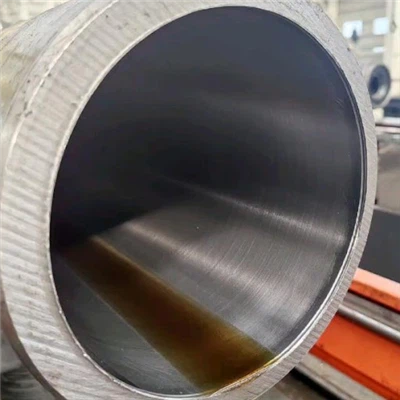


Xi'an Dongmeng Group Co., Ltd. is one of the most reliable manufacturers and suppliers of ASTM A519 4140 Honed Tube for Hydraulic Cylinders in China, also supports customized service. With abundant experience, we warmly welcome you to wholesale cheap products in stock here and get free sample from our factory. For price consultation, contact us.

ASTM A519 4140 Honed Seamless Steel Tube for Hydraulic Cylinders
Dongmeng Group supplies ASTM A519 SAE 4140 honed seamless steel tubes for hydraulic cylinder barrels, heavy-duty rams, telescopic cylinders and high-load mechanical components.
SAE 4140 is a chromium-molybdenum alloy steel that can be heat treated to achieve a controlled combination of strength, hardness, toughness and fatigue resistance.
The tubes can be supplied cold drawn, stress relieved, annealed, normalized or quenched and tempered. The internal diameter can be finished by precision honing or skiving and roller burnishing according to the required seal system, ID tolerance and surface roughness.
What Is ASTM A519 4140 Honed Tube?
ASTM A519/A519M is the standard specification for seamless carbon and alloy steel mechanical tubing.
The current ASTM A519/A519M-24a covers hot-finished and cold-finished seamless mechanical tubing. Round tubing is covered up to and including 12¾ inches, or 325 mm, outside diameter. The standard also covers square, rectangular and special sections when specified by the purchaser.
A 4140 honed tube combines three separate requirements:
ASTM A519 defines the seamless mechanical-tubing product.
SAE 4140 defines the chromium-molybdenum alloy-steel grade.
Honing or SRB defines the precision finishing process applied to the internal diameter.
Compliance with ASTM A519 alone does not automatically guarantee:
H8 or H9 inside-diameter tolerance
Ra 0.2 or 0.4 μm surface finish
A specific yield strength
A specific hardness
A hydraulic-cylinder working pressure
A quenched-and-tempered condition
These requirements must be stated separately in the purchase order.
Material: SAE 4140 / ASTM A519 Grade 4140
Product Type: Seamless Mechanical Tube / Hydraulic Cylinder Barrel
Manufacturing Route: Hot Pierced / Cold Drawn / Precision Finished
ID Processing: Honed / Skived and Roller Burnished
ID Tolerance: H8 / H9 / H10 or Drawing-Specific
Typical ID Roughness: Ra 0.2–0.4 μm, subject to process and specification
Heat-Treatment Options: Annealed / Normalized / Stress Relieved / Quenched and Tempered
Typical Supply Range: OD 40–260 mm / Wall 5–25 mm, subject to mill confirmation
Length: Up to 12 m, subject to outside diameter, wall and straightness requirements
Testing: Chemical Analysis / Hardness / Tensile / UT / Eddy Current / Dimensional Inspection
Documents: EN 10204 3.1 MTC / NDT Report / Inspection Report
Processing: Cutting / Honing / SRB / Turning / Boring / Threading / Port Machining
ASTM A519 Standard Scope
| Requirement | ASTM A519/A519M |
| Product Type | Seamless mechanical tubing |
| Steel Types | Carbon and alloy steel grades |
| Manufacturing Condition | Hot finished or cold finished |
| Maximum Round-Tube OD | 325 mm |
| Available Shapes | Round, square, rectangular and special |
| Heat Analysis | Required according to the specified grade |
| Optional Requirements | Must be stated in the purchase order |
| Primary Application | Mechanical and engineering components |
| Automatic Pressure Rating | Not provided |
ASTM A519 describes the mechanical tubing product and manufacturing requirements. Hydraulic-cylinder design pressure must be calculated separately according to material condition, tube geometry, end construction, ports, cyclic loading and the applicable engineering design rules.
SAE 4140 Material Characteristics
SAE 4140 is a medium-carbon chromium-molybdenum alloy steel designed for heat treatment.
Its main advantages include:
Good hardenability
High strength after quenching and tempering
Useful toughness
Good fatigue performance
Ability to receive induction hardening
Suitability for heavy mechanical components
Ovako describes 42CrMo4 and SAE 4140-related variants as steels for quenching and tempering with a useful combination of strength and toughness. The final through-hardening response depends on section size and heat-treatment conditions.
Representative SAE 4140 Chemical Composition
| Element | Typical Range |
| Carbon, C | 0.38–0.43% |
| Silicon, Si | 0.15–0.35% |
| Manganese, Mn | 0.75–1.00% |
| Phosphorus, P | 0.035% maximum |
| Sulfur, S | 0.040% maximum |
| Chromium, Cr | 0.80–1.10% |
| Molybdenum, Mo | 0.15–0.25% |
| Iron, Fe | Balance |
These are commonly used SAE 4140 composition limits. Final material acceptance must be based on the ASTM A519 heat analysis and the heat-specific Mill Test Certificate.
SAE J404 is the SAE standard covering chemical compositions of SAE alloy steels. The purchase order should state both ASTM A519/A519M and Grade 4140 rather than using "4140 steel" alone.
4140 vs 42CrMo4
| Item | SAE 4140 | EN 42CrMo4 |
| Main Designation System | SAE / ASTM purchasing system | European EN system |
| Common Material Number | - | 1.7225 |
| Material Family | Chromium-molybdenum Q&T steel | Chromium-molybdenum Q&T steel |
| Typical Use | Mechanical tubing, shafts and heavy components | Tubes, bars, shafts and engineering parts |
| Automatic Equivalence | No | No |
| Purchase Requirement | ASTM A519 + Grade 4140 | Relevant EN product standard + 42CrMo4 |
4140 and 42CrMo4 are commonly cross-referenced because they belong to the same chromium-molybdenum steel family. However, their permitted chemistry, heat treatment, testing and product-standard requirements are not automatically identical.
Ovako lists AISI 4140 and 42CrMo4 as similar designations while also providing variants with specific chemistry, cleanliness and heat-treatment requirements.
Do not substitute 42CrMo4 for ASTM A519 Grade 4140 without purchaser approval.
Typical Supply Specifications
| Parameter | Typical Supply Option |
| Material | ASTM A519 Grade 4140 |
| Product | Seamless hydraulic cylinder tube |
| Manufacturing Route | Hot pierced and cold drawn |
| Typical Outside Diameter | 40–260 mm |
| Typical Wall Thickness | 5–25 mm |
| Maximum ASTM Scope | 325 mm OD for round tube |
| Standard Length | 5.8 / 6 / 11.8 / 12 m |
| Custom Length | Saw-cut fixed lengths |
| ID Condition | Honed or SRB |
| ID Tolerance | H8, H9, H10 or custom |
| Surface Roughness | Ra 0.2–0.4 μm typical |
| OD Condition | As-drawn, turned, ground or machined |
| Straightness | Agreed according to length and processing |
| Heat Treatment | Annealed, normalized, stress relieved or Q&T |
| End Condition | Plain, faced, beveled or machined |
| Protection | Internal oil and external rust protection |
| Documentation | MTC, NDT and dimensional inspection report |
The exact manufacturing range depends on the relationship between outside diameter, inside diameter, wall thickness, length, heat-treatment condition and final tolerance.
Do not combine the existing page's conflicting 4–260 mm and 12.7–304.8 mm ranges. Every published size must be supported by the actual qualified mill route.
Honed Tube vs SRB Tube
| Item | Honed ID | Skived and Roller Burnished ID |
| Process | Controlled abrasive finishing | Cutting followed by roller burnishing |
| Material Removal | Gradual and relatively low | Faster controlled stock removal |
| Geometry Correction | Strong capability | Depends on incoming-tube geometry |
| Surface Texture | Fine cross-hatch pattern | Smooth roller-burnished texture |
| Typical Roughness | Ra approximately 0.2–0.4 μm | Can reach maximum Ra approximately 0.30 μm |
| Typical Use | Precision cylinders and repair barrels | High-volume hydraulic cylinder production |
| ID Tolerance | H8, H9 or specified tolerance | H8, H9 or specified tolerance |
| Main Buying Factor | Geometry and finish control | Productivity and smooth finished bore |
Tenaris specifies that skived and roller-burnished hydraulic cylinder tubes can be supplied to ISO 286-2 ID tolerance classes, with a maximum worked-surface roughness of approximately Ra 0.30 μm when the option is specifically ordered.
The buyer should not order only "honed tube." The specification should state:
Finished internal diameter
ID tolerance class
Surface roughness Ra
Surface roughness Rz when required
Roundness
Cylindricity
Straightness
Required stock allowance
Honed or SRB process
Seal and piston application
Understanding H8 and H9 ID Tolerances
H8 and H9 are ISO tolerance classes for holes under ISO 286-2.
They are not fixed tolerances such as "±0.02 mm" for every diameter. The permitted tolerance changes according to the nominal internal-diameter range.
For this reason, quotations should state:
Finished ID + ISO tolerance class
Example:
100 mm H8
or
100.000 / 100.054 mm, when the exact limits have been calculated and agreed.
Avoid publishing one universal H8 tolerance for every tube size.
Heat-Treatment Conditions
ASTM A519 4140 tubing can be supplied in different manufacturing and heat-treatment conditions.
As Hot Finished
Suitable when substantial machining or additional heat treatment will be carried out by the buyer.
Cold Finished
Provides improved dimensional control and surface condition compared with hot-finished tubing.
Annealed
Reduces hardness and improves machinability. The actual annealing cycle and hardness must be agreed.
Normalized
Produces a refined structure and controlled mechanical condition before machining or additional heat treatment.
Stress Relieved
Reduces residual stresses generated by cold drawing and machining while retaining much of the existing strength.
Quenched and Tempered
Used when the finished cylinder barrel requires higher strength and hardness.
The final mechanical properties depend on:
Austenitizing temperature
Quenching medium
Tempering temperature
Tube wall thickness
Section size
Heating uniformity
Final machining allowance
Manufacturing Process
A typical production route includes:
Alloy-steel billet and heat-number verification
Rotary piercing or hot extrusion
Hot rolling to hollow tube form
Pickling and surface preparation
Cold drawing to improve dimensions and wall control
Heat treatment according to the ordered condition
Straightening
Preliminary ID boring or skiving when required
Precision honing or roller burnishing
OD turning or grinding when specified
Fixed-length cutting
Dimensional and surface inspection
Nondestructive testing
Rust protection and export packaging
ASTM A519 defines seamless tubing as tubing manufactured without a welded seam, generally by hot working and, when required, subsequent cold finishing to achieve the specified dimensions and properties.
Inspection and Quality Control
Inspection can be arranged according to the purchase order and cylinder drawing.
Material Inspection
Heat-number verification
Chemical analysis
Mill Test Certificate review
PMI when specified
Hardness testing
Tensile testing
Impact testing when required
Tube Inspection
Outside-diameter measurement
Finished inside-diameter measurement
Wall-thickness inspection
Wall-eccentricity inspection
Ovality and roundness
Straightness
Length
End squareness
Visual surface inspection
Finished-Bore Inspection
ID tolerance
Ra surface roughness
Rz surface roughness when specified
Honing pattern
Bore waviness
Taper
Cylindricity
Local scratches, chatter and spiral marks
Cleanliness and preservation
Nondestructive Testing
Ultrasonic testing
Eddy-current testing
Magnetic-particle testing for machined ends when required
Customer-specific NDT
Available Documentation
EN 10204 3.1 Mill Test Certificate
Chemical composition report
Mechanical test report
Hardness report
Heat-treatment record
Ultrasonic test report
Eddy-current test report
ID dimensional report
Surface-roughness report
Straightness report
Certificate of Conformity
Third-party inspection report
Heat-number and packing list
Typical Applications
ASTM A519 4140 honed tubes are used for:
Excavator hydraulic cylinders
Crane boom cylinders
Mobile-crane telescopic cylinders
Mining-equipment cylinders
Hydraulic presses
Injection-molding machinery
Forging and forming equipment
Industrial lifting systems
Agricultural machinery
Forklifts
Marine deck machinery
Offshore handling equipment
Heavy-duty rams
Accumulator shells
Mechanical sleeves
High-load actuator components
Seamless hydraulic-cylinder tubes are widely used in earth-moving machinery, cranes and energy-sector equipment where dimensional control, fatigue resistance and mechanical reliability are important.
4140 vs 4130 Honed Tube
| Item | SAE 4140 | SAE 4130 |
| Carbon Level | Higher | Lower |
| Heat-Treated Strength Potential | Higher | Moderate |
| Hardenability | Higher | Lower |
| Welding Sensitivity | Higher | Generally easier to manage |
| Typical Selection | Heavy-load and higher-strength barrels | Welded structures and moderate-strength cylinders |
| Final Selection | Based on design calculations | Based on design calculations |
4140 should not automatically replace 4130. The cylinder designer must review strength, toughness, weldability, wall thickness and heat-treatment requirements.
4140 vs Carbon-Steel Cylinder Tube
| Item | SAE 4140 | Carbon Steel Honed Tube |
| Alloying | Chromium-molybdenum alloy steel | Low- or medium-carbon steel |
| Heat-Treatment Capability | High | More limited |
| Strength Potential | Higher | Lower to moderate |
| Welding Procedure | More demanding | Generally simpler |
| Material Cost | Higher | Lower |
| Typical Application | Heavy-load and compact high-strength designs | General industrial hydraulic cylinders |
The lowest material price does not necessarily provide the lowest completed-cylinder cost. Machining, welding, heat treatment, fatigue life and required wall thickness must also be considered.
Packaging and Corrosion Protection
Finished honed tubes require internal-surface protection during storage and shipment.
Packaging options include:
Rust-preventive oil inside and outside
Plastic end caps
Individual plastic sleeves
Waterproof wrapping
Foam or paper separators
Steel-strapped bundles
Reinforced wooden cases
Desiccant for sea shipment
Heat-number labels
Custom shipping marks
Tenaris specifies internal and external oiling as temporary rust protection for hydraulic-cylinder tubes stored in covered conditions.
The preservation period depends on packaging, humidity, storage conditions and transport duration.
Why Choose Dongmeng Group?
Dongmeng Group provides seamless tube supply, precision processing, inspection and international delivery support.
The company profile reports five manufacturing centers, 18 production lines and 10 warehouses. Its manufacturing network includes a seamless steel pipe production center using piercing and extrusion processes, together with material inspection and export-logistics capabilities.
Customers can receive:
ASTM A519 4140 tube supply
Honed and SRB internal finishes
Custom ID tolerance
Multiple heat-treatment conditions
Fixed-length cutting
Drawing-based machining
MTC and NDT documentation
Third-party inspection
Internal rust protection
Export wooden-case packaging
FOB, CFR, CIF and DDP shipping support
Request a 4140 Honed Tube Quote
For an accurate quotation, please provide:
Material grade
ASTM edition
Finished outside diameter
Finished inside diameter
Minimum wall thickness
Length
Quantity
Honed or SRB finish
ID tolerance class
Required Ra and Rz
Straightness requirement
Heat-treatment condition
Required hardness
Mechanical-property requirements
NDT requirements
End machining drawing
Cylinder working environment
Destination port or delivery address
Company: Dongmeng Group
Email: office@dongmjd.com
Phone / WhatsApp: +86 157 6921 4734
Website: www.cndmmetal.com
Frequently Asked Questions
Is ASTM A519 a hydraulic pressure-pipe standard?
No. ASTM A519 is a seamless mechanical-tubing standard. The allowable cylinder pressure must be calculated from the finished component geometry, mechanical properties and applicable design rules.
Is 4140 honed tube always quenched and tempered?
No. It can be supplied hot finished, cold finished, annealed, normalized, stress relieved or quenched and tempered. The required condition must be stated in the order.
What is the difference between seamless and honed?
Seamless describes how the tube body is manufactured without a longitudinal weld. Honed describes the precision finishing process applied to the internal diameter.
What is the difference between honing and SRB?
Honing uses abrasive stones to refine bore geometry and surface texture. SRB combines skiving with roller burnishing and is commonly used for efficient production of smooth hydraulic-cylinder bores.
Can you supply an H8 internal diameter?
Yes. H8, H9 and other ISO tolerance classes can be quoted. The numerical tolerance depends on the nominal internal diameter under ISO 286-2.
Is Ra 0.4 μm suitable for hydraulic cylinders?
Ra 0.4 μm is commonly specified for honed hydraulic-cylinder bores, but the final requirement must match the piston seal, operating pressure, speed, lubrication and service-life target.
Does ASTM A519 specify Ra 0.4 μm?
No. ASTM A519 does not automatically specify the finished honed-bore roughness. Ra, Rz and ID tolerance must be added to the purchase order.
Are BK and NBK ASTM A519 conditions?
No. BK, GBK and NBK are associated with DIN/EN precision-tube delivery-condition terminology. ASTM orders should use clearly defined manufacturing and heat-treatment conditions.
Is SAE 4140 the same as 42CrMo4?
They are similar chromium-molybdenum steels but are not automatically interchangeable. The exact chemistry, product standard, heat treatment and testing must be checked.
Can 4140 tube be welded?
Yes, but welding requires a qualified procedure with appropriate preheat, consumables, heat-input control and post-weld evaluation.
What tests can be supplied?
Available tests include chemical analysis, tensile testing, hardness, UT, eddy current, dimensional inspection, surface-roughness measurement and third-party inspection.
Can you machine cylinder ports and ends?
Yes. Dongmeng Group can review fixed-length cutting, facing, boring, threading, grooves, ports and drawing-based end machining.
Hot Tags: 4140 hydraulic cylinder tube, 4140 honed seamless tube, SAE 4140 cylinder barrel, SRB 4140 tube, H8 honed tube, chrome moly hydraulic cylinder tube, ASTM A519 mechanical tubing, ASTM A519 1035 Honed Seamless Steel Tube For Hydraulic Cylinder, ASTM A519 4140 Honed Seamless Steel Tube For Hydraulic Cylinder, EN 10305 1 E255 Honed Seamless Steel Tube, EN 10305 1 E215 Honed Seamless Steel Tube, ASTM A519 Hydraulic Cylinder Tube, DIN2391 1 Honing Tube