

Xi'an Dongmeng Group Co., Ltd. is one of the most reliable manufacturers and suppliers of c35600 phosphor bronze in China, also supports customized service. With abundant experience, we warmly welcome you to wholesale cheap products in stock here and get free sample from our factory. For price consultation, contact us.
C35600 Extra High Leaded Brass Rod & Plate | Dongmeng Group
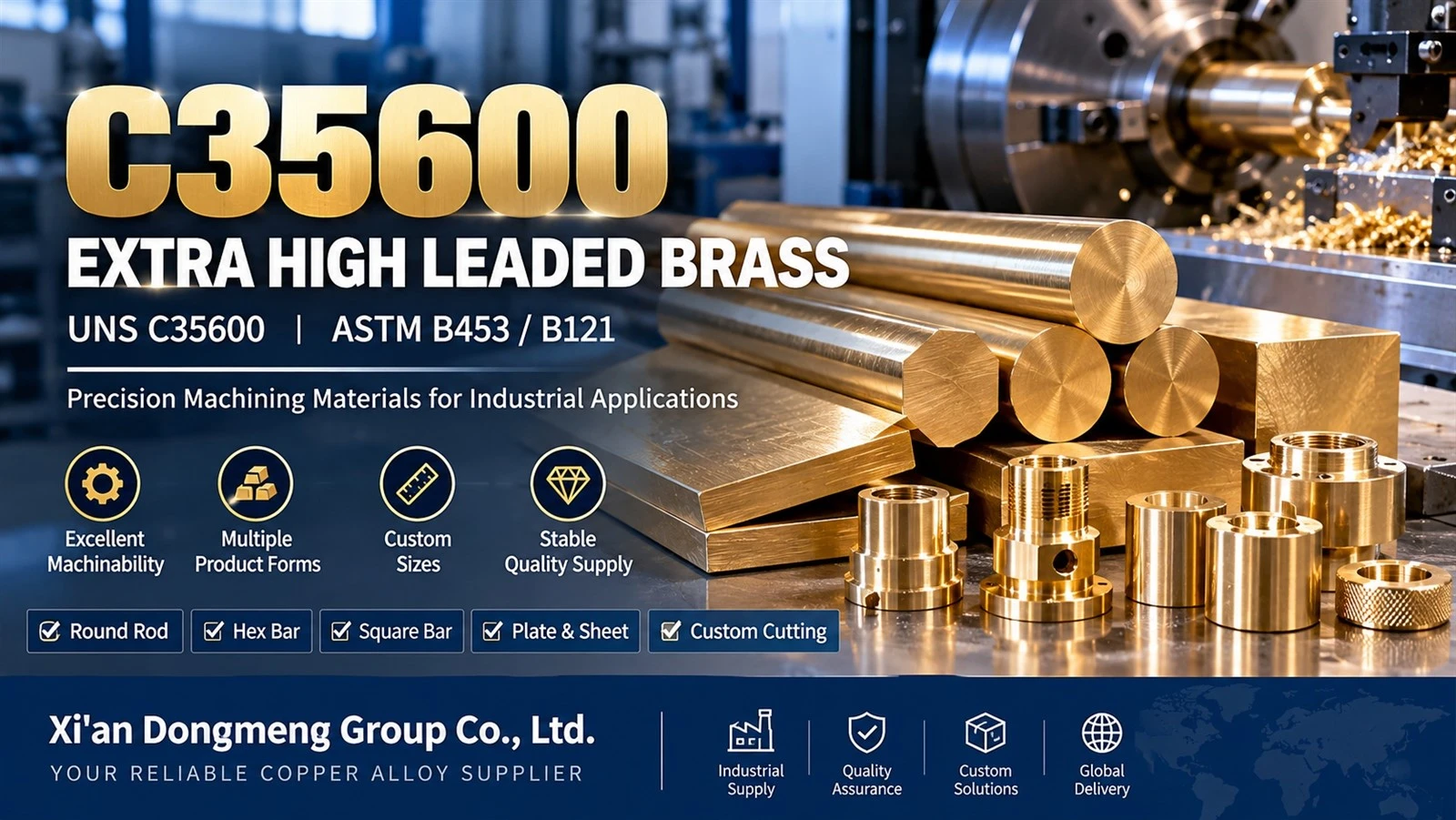
Xi'an Dongmeng Group Co., Ltd. supplies UNS C35600 extra high leaded brass in rod, bar, plate, sheet and other specified product forms for industrial machining, OEM component manufacturing and international metal distribution.
C35600 is a wrought copper-zinc-lead alloy recognized for its excellent machinability, consistent chip-breaking characteristics and suitability for precision-machined components. With a nominal chemical composition of approximately 61.5% copper, 36.0% zinc and 2.5% lead, this alloy is particularly suitable for high-volume machining operations requiring controlled dimensions and repeatable surface quality.
Our C35600 brass supply solutions support customers manufacturing threaded components, precision fittings, mechanical hardware, engraved parts and other machined industrial products.
Materials can be specified according to applicable ASTM standards, temper conditions, dimensional tolerances and inspection requirements.
Request a quotation for C35600 brass rods, bars, plates or custom-cut materials based on your engineering specifications.
What Is C35600 Extra High Leaded Brass?
C35600 is a copper-zinc-lead alloy belonging to the wrought brass family. It contains approximately 2.0–3.0% lead, which substantially improves its machining characteristics compared with many lower-lead brass alloys.
The lead phase contributes to chip segmentation during cutting operations, helping manufacturers achieve efficient machining, consistent dimensional control and reduced tool loading under appropriate cutting conditions.
C35600 is also commonly referred to as engraving brass because it can produce clean, detailed machined surfaces suitable for nameplates, plaques and precision decorative hardware.
Unlike phosphor bronze, which is primarily based on copper, tin and phosphorus, C35600 is a copper-zinc-lead alloy developed for applications where machinability is a major material-selection requirement.
Key Material Advantages
Excellent Machinability
C35600 has a commonly published machinability rating of 100 relative to C36000 free-cutting brass. It is particularly well suited to turning, drilling, threading and other chip-forming operations.
Reliable Dimensional Accuracy
Its free-cutting characteristics support repeatable machining of precision parts when suitable tooling, machining parameters and quality controls are used.
Good Surface Finish
The alloy can be machined and polished to produce attractive surfaces for technical and decorative components.
Suitable for High-Volume Component Manufacturing
Efficient chip control makes C35600 a practical option for automatic screw machines, CNC turning centers and repetitive production operations.
Multiple Supply Forms
Rod, bar and flat products allow manufacturers to select raw material according to finished-part geometry and machining requirements.
Established Material Standards
C35600 is included in recognized ASTM specifications covering leaded brass products, supporting grade identification and procurement documentation.
C35600 Brass Product Specifications
The following specifications describe typical procurement configurations. Exact availability, production ranges and tolerances must be confirmed for each order.
| Parameter | Specification |
|---|---|
| Alloy | UNS C35600 |
| Material Type | Extra High Leaded Brass |
| Rod Standard | ASTM B453/B453M |
| Plate and Sheet Standard | ASTM B121/B121M |
| Round Bar | Solid cylindrical bar |
| Hexagonal Bar | Six-sided solid bar |
| Square Bar | Solid square-section bar |
| Flat Bar | Rectangular solid bar |
| Plate / Sheet | Flat rolled brass products |
| Temper | O60 / H01 / H02, as applicable |
| Processing | Hot Working, Cold Working, Annealing and Machining |
| Surface | Mill, Machined or Polished |
| Cutting | Standard or Custom Lengths |
| Dimensional Tolerance | According to Applicable Standard or Agreed Drawing |
| Inspection Documents | Available According to Purchase Requirements |
C35600 Brass Round Bar Sizes
| Diameter (mm) | Approx. Diameter (inch) |
|---|---|
| 6 mm | 0.236 in |
| 8 mm | 0.315 in |
| 10 mm | 0.394 in |
| 12 mm | 0.472 in |
| 16 mm | 0.630 in |
| 20 mm | 0.787 in |
| 25 mm | 0.984 in |
| 30 mm | 1.181 in |
| 40 mm | 1.575 in |
| 50 mm | 1.969 in |
These are reference enquiry sizes, not a statement of available stock. Other diameters and finished lengths can be evaluated against production availability.
Custom Material Supply
For projects requiring nonstandard dimensions, please provide:
Outside diameter or cross-sectional dimensions
Required length and length tolerance
Material temper
Surface finish requirements
Straightness and dimensional tolerances
Annual or project quantity
Drawing or applicable machining specifications
For hexagonal bars, specify the across-flats dimension. For flat products, specify thickness, width and length.
C35600 Chemical Composition
The chemical composition of UNS C35600 is controlled within the limits associated with the applicable copper alloy designation.
Chemical Composition – Weight Percentage
| Element | Symbol | Content (%) |
|---|---|---|
| Copper | Cu | 60.0–63.0 |
| Lead | Pb | 2.0–3.0 |
| Zinc | Zn | Remainder |
| Iron | Fe | 0.15 Max |
Nominal Alloy Composition
| Element | Nominal Content |
|---|---|
| Copper | 61.5% |
| Zinc | 36.0% |
| Lead | 2.5% |
Technical Note: Nominal values are representative compositions used for alloy identification. Acceptance criteria should be based on the specified ASTM standard and the agreed purchase requirements.
Role of Alloying Elements
Copper (Cu)
Copper provides the primary metallic matrix and contributes to thermal conductivity, corrosion performance and the characteristic appearance of the alloy.
Zinc (Zn)
Zinc modifies strength, hardness and manufacturing characteristics. The copper-zinc balance influences the alloy's microstructure and forming behavior.
Lead (Pb)
Lead improves free-cutting behavior by promoting chip segmentation and reducing resistance during machining.
However, the lead content requires careful evaluation where environmental, occupational or product-specific regulations apply.
C35600 Mechanical Properties
Mechanical properties depend on product form, temper, section size and processing history.
The following values are selected published reference data for C35600 products. They are provided for preliminary engineering comparison and must not be treated as universal guaranteed values.
Representative Mechanical Properties – Rod Products
| Temper | Section Size | Tensile Strength | Yield Strength | Elongation |
|---|---|---|---|---|
| O60 – Soft Annealed | Below 12.7 mm | 317 MPa | 110 MPa | 20% |
| H01 – Quarter Hard | Below 12.7 mm | 358 MPa | 172 MPa | 10% |
| H02 – Half Hard | Below 12.7 mm | 393 MPa | 172 MPa | 7% |
Values are published reference figures for the indicated conditions. Actual specified limits depend on the governing material standard, product dimensions and temper.
Representative Flat Product Properties
For approximately 1 mm thick C35600 sheet or strip in H02 condition, published typical properties include:
| Property | Typical Value |
|---|---|
| Tensile Strength | 421 MPa |
| 0.2% Yield Strength | 345 MPa |
| Elongation | 20% |
| Rockwell Hardness | Approximately 70 HRB |
The mechanical properties of flat products must not be automatically applied to round bars or other cross-sections.
Temper Selection
O60 – Soft Annealed
Suitable for applications requiring comparatively greater ductility or subsequent forming operations.
H01 – Quarter Hard
Provides an intermediate balance of strength and formability.
H02 – Half Hard
Offers increased strength and hardness for applications where dimensional stability and machining performance are important.
Harder flat-product tempers may be specified under the applicable flat-product standard, subject to availability.
C35600 Physical Properties
The following values are representative room-temperature material properties.
| Property | Typical Value |
|---|---|
| Density | Approximately 8.50 g/cm³ |
| Density (Imperial) | Approximately 0.307 lb/in³ |
| Electrical Conductivity | Approximately 26% IACS |
| Thermal Conductivity | Approximately 115 W/(m·K) |
| Modulus of Elasticity | Approximately 97 GPa |
| Shear Modulus | Approximately 37 GPa |
| Thermal Expansion Coefficient | Approximately 20.5 × 10⁻⁶/K |
| Specific Heat Capacity | Approximately 380 J/(kg·K) |
| Solidus Temperature | Approximately 885°C |
| Liquidus Temperature | Approximately 900–905°C |
| Magnetic Characteristics | Essentially Nonmagnetic |
These properties are intended for preliminary material evaluation. Project-specific engineering calculations should use appropriate certified or validated design data.
C35600 Machinability and Manufacturing Characteristics
One of the principal advantages of C35600 brass is its excellent free-cutting performance.
Its high lead content promotes chip breakage during machining, helping manufacturers process components with complex geometries and tight dimensional requirements.
CNC Turning
C35600 is suitable for machining cylindrical components, including threaded fittings, bushings, precision hardware and other turned parts.
Under suitable machining conditions, the alloy supports efficient chip formation and consistent surface finish.
Drilling and Boring
The alloy's chip-breaking characteristics are advantageous in drilling and internal machining operations.
Hole tolerances and internal surface quality depend on tool geometry, cutting conditions and inspection methods.
Threading and Tapping
C35600 can be used for machined internal and external threads.
For threaded components, buyers should specify thread type, pitch, tolerance class and inspection requirements.
Milling and Engraving
C35600 is suitable for engraving and milling operations used to manufacture nameplates, identification plates, decorative hardware and precision mechanical parts.
Cold Forming
Cold-forming performance is more limited than that of many low-lead brass alloys.
Where bending, severe swaging, flaring or other forming operations are required, the temper and manufacturing sequence should be evaluated before material selection.
Joining and Welding
| Process | General Suitability |
|---|---|
| Machining | Excellent |
| Soldering | Excellent |
| Brazing | Good |
| Polishing | Good |
| Cold Working | Poor |
| Hot Working | Fair |
| Conventional Fusion Welding | Generally Not Recommended |
Important: Conventional fusion welding is generally unsuitable because lead can contribute to cracking and other weld-quality problems.
For assemblies requiring joining, soldering, brazing or mechanical fastening should be evaluated against the application requirements.
C35600 Corrosion Resistance and Application Limitations
C35600 brass offers useful corrosion resistance in many indoor and atmospheric environments.
Its performance, however, depends on exposure conditions, mechanical stress, operating temperature and the surrounding chemical environment.
Suitable Environments
C35600 may be considered for components used in:
Indoor industrial equipment
General mechanical assemblies
Dry atmospheric environments
Decorative hardware
Controlled industrial operating conditions
Potential Corrosion Risks
Dezincification
In certain aggressive aqueous environments, zinc may be selectively removed from brass, weakening the remaining material.
Stress Corrosion Cracking
Brass alloys may be susceptible to stress corrosion cracking in environments containing ammonia or certain amine compounds, particularly when tensile stresses are present.
Chloride-Rich Environments
Exposure to seawater or aggressive chloride-containing solutions requires careful evaluation.
Lead-Related Restrictions
C35600 contains approximately 2.0–3.0% lead and should not be described as lead-free.
It should not be selected as a wetted material for regulated drinking-water applications without a specific, documented compliance assessment.
For corrosion-sensitive applications, material selection should be reviewed against the actual service environment rather than based on the alloy designation alone.
C35600 Leaded Brass Applications
C35600 is primarily selected where precise machining, good surface quality and efficient component production are important.
1. Precision CNC Machined Components
C35600 brass rods and bars are suitable for manufacturing precision-turned and milled components.
Typical applications include:
Small precision hardware
Threaded components
Machined bushings
Instrument components
Custom mechanical fittings
2. Industrial Fasteners and Threaded Parts
The alloy can be machined into nuts, threaded inserts, screw-machine parts and other mechanical hardware.
Its chip-breaking characteristics are useful where multiple machining operations are required.
3. Engraving and Identification Plates
C35600 is commonly used for engraved metal components due to its machinability and attractive polished appearance.
Applications include:
Industrial nameplates
Engraved identification plaques
Equipment labels
Decorative metal hardware
4. Clock, Lock and Instrument Components
C35600 can be used for accurately machined components in mechanical instruments, locks and related assemblies.
Material and temper selection should be based on the loading and dimensional requirements of the finished component.
5. General Mechanical Hardware
Potential applications include furniture hardware, equipment fittings and other components requiring good machinability and surface finish.
6. OEM and Custom-Designed Parts
For custom manufacturing projects, C35600 can be supplied as raw material for subsequent CNC machining, milling, engraving and other secondary operations.
Buyers should provide technical drawings to confirm the required material form, temper and dimensions.
C35600 vs C36000 vs C35300 Brass
Selecting the correct free-machining brass grade depends on material composition, component geometry, mechanical requirements and applicable regulations.
| Feature | C35600 | C36000 | C35300 |
|---|---|---|---|
| Alloy Family | Leaded Brass | Free-Cutting Brass | High-Leaded Brass |
| Nominal Copper | 61.5% | 61.5% | 61.5% |
| Nominal Lead | 2.5% | 3.0% | 2.0% |
| Primary Advantage | Excellent Machinability | Widely Used Screw-Machine Brass | High Machinability |
| Common Product Forms | Rod, Bar, Plate | Rod, Bar, Shapes | Rod, Bar, Shapes |
| Typical Applications | Engraving, CNC Parts, Hardware | High-Volume Machined Parts | Machined Components |
| Material Selection | Based on Drawing and Standard | Based on Drawing and Standard | Based on Drawing and Standard |
When Should You Choose C35600?
C35600 is a suitable candidate when the project requires:
Excellent free-cutting machinability
Precision-machined brass components
Consistent surface finish
A recognized copper alloy designation
A material specification explicitly requiring UNS C35600
C36000 is another common choice for screw-machine applications, while C35300 may be considered where its composition and properties better match the engineering specification.
These materials should not be treated as automatically interchangeable. Chemical composition, mechanical properties, product standards and end-use compliance requirements must be checked before substitution.
C35600 Product Standards and Material Identification
C35600 is covered by established ASTM specifications for leaded brass products.
| Standard | Product Scope | Application |
|---|---|---|
| ASTM B453/B453M | Copper-Zinc-Lead Alloy Rod, Bar and Shapes | Machining Stock |
| ASTM B121/B121M | Leaded Brass Plate, Sheet, Strip and Rolled Bar | Flat Products |
| UNS C35600 | Alloy Identification | Chemical Composition and Grade Identification |
ASTM B453/B453M
ASTM B453/B453M covers specified copper-zinc-lead alloy rods, bars and shapes.
Procurement requirements include product designation, temper, dimensions, applicable mechanical properties and chemical composition.
ASTM B121/B121M
ASTM B121/B121M covers leaded brass plate, sheet, strip and rolled bar.
Depending on the ordered product and temper, relevant requirements may include mechanical properties, hardness and dimensional characteristics.
Important Material Identification Note
UNS C35600 should not be confused with phosphor bronze grades such as C51000, C52100 or C52400.
The alloy designation and chemical composition should always be verified before approving a material substitution.
Where an EN, DIN, JIS or GB material is proposed as an alternative, exact equivalence must be confirmed through chemical, mechanical and product-standard comparison.
Inspection & Quality Assurance
Xi'an Dongmeng Group Co., Ltd. supports material procurement with inspection requirements defined according to the applicable specification and purchase agreement.
Chemical Composition Verification
Chemical analysis can be specified to verify copper, zinc, lead and other controlled elements.
The test method should be suitable for the relevant alloying elements and required accuracy.
Dimensional Inspection
Depending on the ordered product, dimensional checks may include:
Diameter
Width and thickness
Across-flats dimensions
Length
Straightness
Surface condition
Mechanical Testing
Applicable testing may include tensile strength, yield strength, elongation and hardness.
The test requirements depend on the product form, temper and governing standard.
Surface Quality Inspection
Visual or agreed surface inspections help identify unacceptable mechanical damage, oxidation, handling marks or other surface defects.
Surface acceptance criteria should be defined for components requiring polishing, engraving or precision machining.
Material Traceability
Heat or lot identification can be specified where traceability is required.
Inspection Documentation
Documentation options may include:
Chemical Analysis Reports
Mechanical Test Reports
Dimensional Inspection Records
Material Test Certificates
Third-Party Inspection Reports, where agreed
Inspection scope and document type should be confirmed before production or order acceptance.
Custom Cutting, Processing and Supply
Industrial buyers frequently require C35600 brass in dimensions suitable for downstream machining.
Supply requirements can be evaluated according to:
Custom-Length Cutting
Raw material lengths can be specified to reduce unnecessary cutting operations at the customer's facility.
Special Cross-Sections
Round, hexagonal, square and rectangular sections can be evaluated against available manufacturing routes.
Surface Requirements
Mill finish, machined finish and polishing requirements can be incorporated into the purchase specification.
Drawing-Based Procurement
Engineering drawings help determine material dimensions, tolerances, machining allowance and inspection requirements.
Bulk Procurement
For distributors and OEM manufacturers, order quantities and delivery arrangements can be evaluated based on the material form, size and production requirements.
Packaging and International Shipment
Appropriate packaging helps protect C35600 brass materials during storage, handling and transportation.
Depending on product form and order quantity, packaging may include:
Bundled bars and rods
Protective wrapping
Wooden cases or pallets
Moisture-resistant packing materials
Product identification labels
Batch or lot identification
Export packaging according to shipping requirements
Special packaging requirements should be specified when requesting a quotation.
Why Choose Xi'an Dongmeng Group Co., Ltd.?
Industrial Material Sourcing
We focus on supplying industrial metal materials for manufacturers, distributors and engineering procurement customers.
Technical Specification Review
Our team can review material designations, dimensions, temper requirements and purchase specifications to support accurate product selection.
Custom Procurement Solutions
We support enquiries involving nonstandard dimensions, custom cutting and project-specific material requirements.
Quality Documentation
Material inspection and documentation requirements can be incorporated into the procurement process according to the purchase agreement.
International B2B Supply
We serve international customers purchasing materials for manufacturing, distribution and industrial applications.
Application-Oriented Communication
We help customers clarify the technical details needed for an accurate quotation, including grade, dimensions, product form, tolerances, inspection scope and delivery conditions.
Frequently Asked Questions About C35600 Brass
1. What is UNS C35600 brass?
UNS C35600 is an extra high leaded brass alloy containing approximately 61.5% copper, 36.0% zinc and 2.5% lead. It is widely associated with free-machining applications.
2. Is C35600 phosphor bronze?
No. C35600 is a copper-zinc-lead brass alloy, not phosphor bronze. Phosphor bronze grades typically contain copper, tin and phosphorus.
3. What is the main advantage of C35600 brass?
Its principal advantage is excellent machinability. The alloy is particularly suitable for precision turning, drilling, threading and engraving.
4. What ASTM standards cover C35600?
ASTM B453/B453M covers specified leaded brass rods, bars and shapes, while ASTM B121/B121M covers specified leaded brass flat products.
5. What is the lead content of C35600?
The lead content is typically specified between 2.0% and 3.0% by weight.
6. Can C35600 brass be used for CNC machining?
Yes. C35600 is suitable for CNC turning, milling, drilling and other machining operations. Its free-cutting characteristics are useful for producing precision components.
7. Can C35600 be welded?
Conventional fusion welding is generally not recommended because of the alloy's lead content. Soldering and brazing may be more suitable, depending on the joint design and application.
8. Is C35600 suitable for drinking-water applications?
C35600 contains a relatively high percentage of lead. It should not be assumed suitable for regulated potable-water components. Buyers should select materials that meet the applicable product and legal requirements.
9. What is the difference between C35600 and C36000?
Both are free-machining brass alloys. C35600 has a nominal lead content of approximately 2.5%, while C36000 typically contains approximately 3.0% lead. Grade selection should also consider the relevant product standard, required properties and available material form.
10. What are the available C35600 brass tempers?
Common specified tempers for rod and bar products include O60, H01 and H02. Flat-product temper availability depends on the applicable standard and production route.
11. Can C35600 brass be supplied in custom dimensions?
Custom dimensions can be evaluated according to the required product form, manufacturing feasibility, quantity and tolerances.
12. What information is needed for a C35600 brass quotation?
Please provide the alloy grade, product form, dimensions, temper, required standard, quantity, inspection requirements and delivery destination. Drawings are recommended for custom applications.
Contact Us – C35600 Extra High Leaded Brass Supplier
Looking for C35600 extra high leaded brass rods, bars, plates or custom material supply?
Xi'an Dongmeng Group Co., Ltd. supports industrial customers seeking copper alloy materials for precision machining, component manufacturing and international distribution.
Our team can assist with material specification review, dimensional requirements, inspection documentation and quotation preparation.
For an accurate quotation, please provide:
Required material grade: UNS C35600
Product form: Rod / Bar / Plate / Sheet / Strip
Dimensions and tolerances
Temper or mechanical requirements
Quantity and delivery destination
Required material standard
Material certificates and inspection requirements
Contact Xi'an Dongmeng Group Co., Ltd. to request pricing, available dimensions, technical information and supply options for your C35600 brass project.
Company Name: Xi'an Dongmeng Group Co., Ltd.
Phone: +86 157 6921 4734
Email: office@dongmjd.com
WhatsApp: Dong: +86 157 6921 4734
Office Address:
Room 4107, Runfeng Building,
Sanqiao New Street, Weiyang District,
Xi'an City, Shaanxi Province, China.
Hot Tags: C35600 leaded brass, UNS C35600, C35600 brass rod, C35600 brass bar, C35600 brass plate, C35600 copper alloy, extra high leaded brass, ASTM B453 brass rod, ASTM B121 brass plate, free machining brass, C35600 chemical composition, C35600 mechanical properties, precision machining brass., ASTM B75 Seamless Copper Tube, UNS C17200 Beryllium Copper Alloys, UNS C46400 Naval Brass Copper Alloy, ASTM B42 Seamless Copper Pipe, UNS C70600 Copper Nickel Alloy, UNS C17500 Beryllium Copper Alloys