


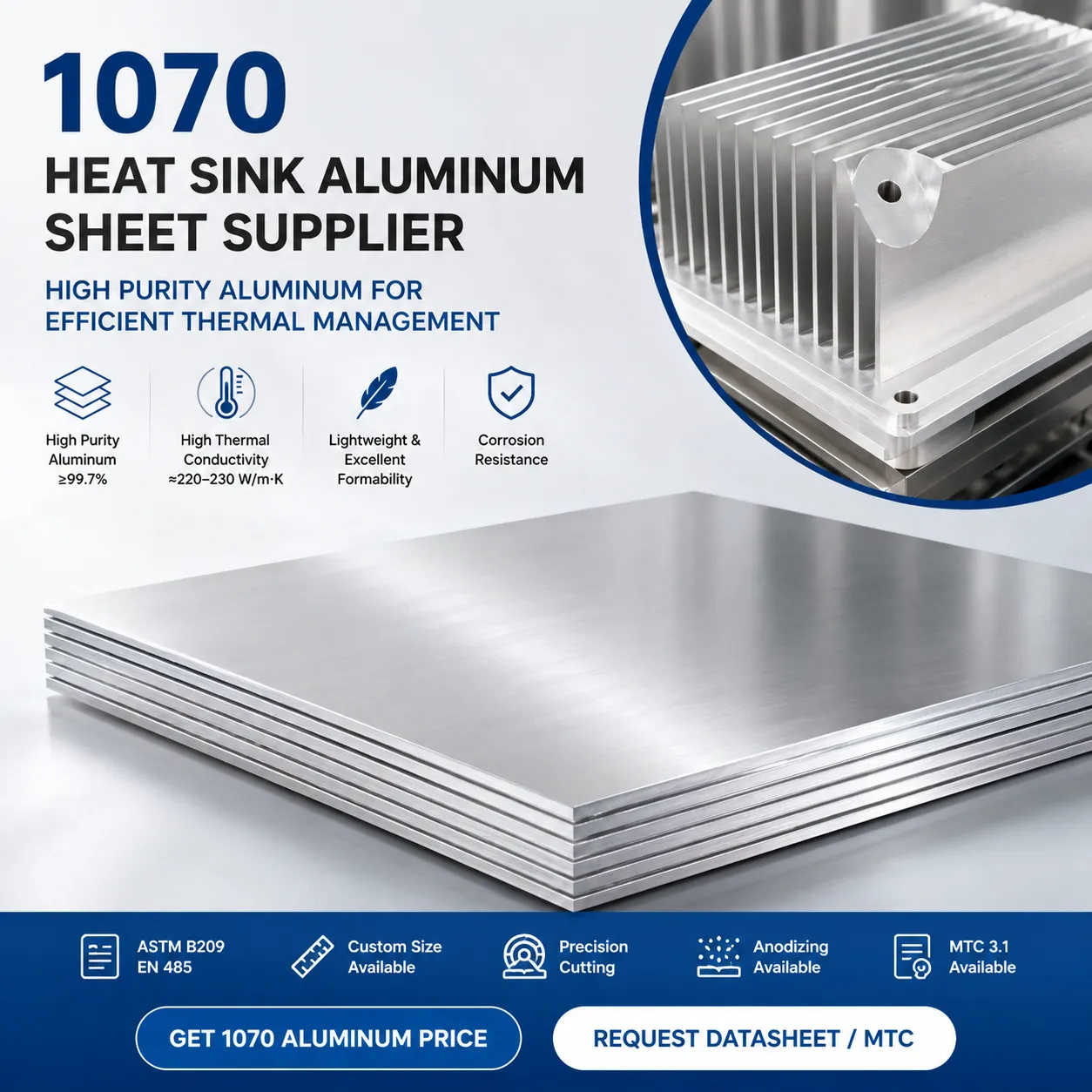
Xi'an Dongmeng Group Co., Ltd. is one of the most reliable manufacturers and suppliers of 1070 aluminum heat sink sheet supplier | high thermal conductivity aluminum plate price in China, also supports customized service. With abundant experience, we warmly welcome you to wholesale cheap products in stock here and get free sample from our factory. For price consultation, contact us.
1070 heat sink aluminum is a high-purity 1xxx series aluminum alloy with a minimum aluminum content of approximately 99.7%. Compared with many structural aluminum alloys, 1070 aluminum contains fewer alloying elements, which helps reduce thermal resistance and improve heat transfer efficiency. This makes it especially suitable for heat sinks, cooling plates, LED lighting components, power electronic modules, transformer parts and precision thermal management systems.
As a non-heat-treatable aluminum alloy, 1070 aluminum cannot obtain high strength through precipitation hardening like 6061 or 6063. Instead, it offers excellent ductility, formability, corrosion resistance and stable thermal conductivity. For applications where heat dissipation is more important than structural strength, 1070 aluminum is one of the most cost-effective pure aluminum materials.
Xi'an Dongmeng Group supplies 1070 aluminum sheet, plate, coil and strip in custom thicknesses, widths and lengths. We support cutting, slitting, leveling, surface protection, anodizing, packaging and export documentation for B2B buyers, distributors, heat sink manufacturers and electronic component suppliers.

01
High Quality
02
Advanced Equipment
03
Professional Team
04
Custom Service
Why Choose 1070 Aluminum for Heat Sinks?
1. High Thermal Conductivity
1070 aluminum has a typical thermal conductivity of around 220–230 W/m·K, allowing heat to transfer quickly from the heat source to the dissipation surface. This is important for LED lighting, power supply modules, industrial cooling plates and electronic housings where stable temperature control is required.
2. High Purity, Low Thermal Resistance
The higher aluminum purity of 1070 helps reduce impurity-related resistance inside the material. For thermal management parts, this provides better heat spreading performance than many alloyed aluminum grades.
3. Lightweight and Easy to Fabricate
1070 aluminum is much lighter than copper and steel while still offering strong thermal conductivity. It can be cut, stamped, bent, punched, formed and anodized, making it suitable for mass production of heat sink fins, cooling panels and electronic enclosure parts.
4. Excellent Corrosion Resistance
The natural oxide film on aluminum gives 1070 good atmospheric and moisture corrosion resistance. For outdoor LED lamps, electronic housings and cooling systems, anodizing or surface coating can further improve durability.
5. Cost-effective Alternative to Copper
Copper has higher thermal conductivity, but it is heavier and more expensive. 1070 aluminum provides a practical balance of heat dissipation, light weight, machinability and material cost for many industrial applications.
Product Specifications
| Item | Specification |
|---|---|
| Product Name | 1070 Heat Sink Aluminum Sheet / Plate / Coil |
| Alloy | 1070 / 1070A |
| Aluminum Content | ≥99.7% |
| Temper | O, H12, H14, H16, H18, H22, H24, H26 |
| Standard | ASTM B209, EN 485, ISO 6361, GB/T 3880 |
| Thickness | 0.2–10 mm, custom available |
| Width | 100–2500 mm |
| Length | 500–12000 mm or cut to size |
| Coil ID | 76 / 150 / 305 / 405 / 508 mm |
| Surface | Mill finish, brushed, anodized, coated, protective film |
| Processing | Cutting, slitting, leveling, punching, bending, stamping |
| Certificate | MTC 3.1, SGS / BV / TÜV inspection available |
| Packing | Export wooden pallet, moisture-proof wrapping, edge protection |
Products Description
Product: 1070 Heat Sink Aluminum
Alloy: 1070
Temper: O · H14 · H24
Standard: ASTM B209 · EN 485 · ISO 6361
Thickness: 0.5–6 mm
Form: Sheet · Plate · Coil
Key Features: High Thermal Conductivity · Lightweight · Corrosion Resistant · Machinable
Applications: LED Heat Sinks · Power Electronics · Industrial Cooling · Electronic Housings
Chemical Composition (Typical, %)
| Element | Si | Fe | Cu | Mn | Mg | Cr | Zn | Ti | Al |
|---|---|---|---|---|---|---|---|---|---|
| Content | ≤0.05 | ≤0.20 | ≤0.03 | ≤0.03 | ≤0.03 | ≤0.03 | ≤0.03 | ≤0.03 | ≥99.7 |
Mechanical Properties (Typical)
| Temper | Tensile Strength (MPa) | Yield Strength (MPa) | Elongation (%) |
|---|---|---|---|
| O | ≥70 | ≥35 | ≥35 |
| H14 | ≥95 | ≥55 | ≥20 |
| H24 | ≥110 | ≥60 | ≥15 |
Typical Mechanical Properties
| Temper | Tensile Strength MPa | Yield Strength MPa | Elongation % | Recommended Use |
|---|---|---|---|---|
| O | 60–95 | ≥20 | High | Deep drawing, bending, forming |
| H12 | 80–110 | ≥45 | Medium | Light stamping, heat sink fins |
| H14 | 95–125 | ≥55 | Medium | General sheet parts, cooling plates |
| H18 | 120–160 | ≥100 | Lower | Parts requiring higher hardness |
| H24 | 100–130 | ≥60 | Medium | Flat panels, electronic components |
Physical Properties
| Property | Typical Value |
|---|---|
| Density | 2.70 g/cm³ |
| Thermal Conductivity | Approx. 220–230 W/m·K |
| Electrical Conductivity | Approx. 61% IACS |
| Melting Point | Approx. 640°C |
| Thermal Expansion | Approx. 23 × 10⁻⁶ /K |
| Modulus of Elasticity | Approx. 69 GPa |
1070 vs 1050 vs 1060 vs 3003 vs 6063 Aluminum for Heat Sink
| Alloy | Aluminum Purity | Thermal Conductivity | Strength | Heat Sink Suitability |
|---|---|---|---|---|
| 1050 | ≥99.5% | High | Low | General thermal parts |
| 1060 | ≥99.6% | High | Low | Cost-effective heat sink sheet |
| 1070 | ≥99.7% | Very High | Low | Best for high-conductivity sheet heat sinks |
| 3003 | Al-Mn alloy | Medium | Medium | Better strength, lower conductivity |
| 6063 | Al-Mg-Si alloy | Medium-High | Medium | Extruded heat sink profiles |
| 6061 | Al-Mg-Si alloy | Medium | High | Structural parts, not best for pure heat transfer |
Selection Guide:
Choose 1070 aluminum when the priority is thermal conductivity, electrical conductivity and formability.
Choose 6063 aluminum when extrusion profile strength and shape complexity are more important.
Choose 3003 aluminum when moderate strength and general corrosion resistance are required.
Choose 6061 aluminum when load-bearing performance is more important than thermal conductivity.
Why 1070 Aluminum Performs Better in Heat Dissipation?
The heat dissipation performance of 1070 aluminum is based on three fundamental engineering principles:
1️⃣ High Thermal Conductivity (Core Factor)
1070 aluminum has a thermal conductivity of:
👉 220 – 230 W/m·K
This means:
Heat can be rapidly transferred from the source to the surface
Ideal for high-power electronic cooling systems
📌 Comparison:
3003 aluminum: ~160 W/m·K
5052 aluminum: ~138 W/m·K
👉 1070 aluminum provides significantly better heat transfer efficiency.
2️⃣ High Purity = Low Thermal Resistance
1070 aluminum contains:
👉 ≥ 99.7% Aluminum
Engineering significance:
Fewer alloying elements → reduced phonon scattering
Lower internal thermal resistance
Higher heat transfer efficiency
👉 This explains why pure aluminum outperforms alloyed aluminum in thermal conductivity.
3️⃣ Thermal Stability & Expansion Control
Thermal expansion coefficient:
👉 ~23.6 ×10⁻⁶ /K
Engineering benefits:
Reduces thermal deformation
Maintains dimensional stability in electronic systems
Prevents warping in heat sink assemblies
Why 1070 Aluminum is NOT Heat-Treatable?
1070 aluminum belongs to the 1xxx series (non-heat-treatable alloys).
👉 Strength mechanism: work hardening (cold working)
Unlike alloys such as 6061, which rely on precipitation hardening.
Engineering Impact:
| Property | Effect |
|---|---|
| Strength | Low |
| Thermal Conductivity | Very High |
| Ductility | Excellent |
👉 Conclusion:
Strength is sacrificed to achieve superior thermal conductivity - a typical trade-off in heat sink materials.
Why Engineers Choose 1070 Instead of Stronger Alloys?
| Material | Thermal Conductivity | Strength | Application |
|---|---|---|---|
| 1070 | ⭐ 220–230 W/m·K | Low | Heat sink |
| 6063 | ~200 W/m·K | Medium | Structure + cooling |
| 6061 | ~167 W/m·K | High | Structural |
Engineering Logic:
Higher thermal conductivity → lower alloy content
Higher strength → reduced thermal conductivity
📌 Selection Guide:
✔ Heat dissipation priority → 1070
✔ Balanced performance → 6063
✔ Structural strength → 6061
Heat Sink Design Recommendations
Best Practices for 1070 Aluminum Heat Sink Design
✅ Surface Treatment
Anodizing improves corrosion resistance
Minimal impact on thermal conductivity
1070 offers excellent anodizing performance
✅ Thickness Optimization
Too thick → heat accumulation
Too thin → insufficient mechanical stability
👉 Recommended:
1–5 mm for electronic devices
5–20 mm for industrial cooling systems
✅ Contact Efficiency
Use thermal interface materials (TIM)
Minimize air gaps between components
👉 Heat dissipation efficiency depends not only on material, but also on interface design.
Engineering Limitations
Limitations of 1070 Aluminum
❗ Low Mechanical Strength
Tensile strength: 60 – 95 MPa
❗ Not Heat Treatable
Strength cannot be significantly improved via heat treatment
❗ Limited Structural Capability
Not suitable for load-bearing applications
👉 Conclusion:
Best used for thermal applications, not structural components
Products Advantages
High Thermal Conductivity – Excellent heat transfer for electronic and industrial cooling applications.
Lightweight – Reduces weight in electronic housings and heat sink assemblies.
Corrosion Resistant – Pure aluminum resists rust and environmental degradation.
Good Machinability – Can be cut, bent, or extruded without losing thermal performance.
Non-Magnetic & Non-Toxic – Safe for electronic and industrial environments.
Forming & Fabrication Friendly – Suitable for extrusion, bending, rolling, and anodizing.
Products Applications
LED Heat Sinks – Efficient cooling of high-power LED modules
Power Electronics & Transformers – Thermal management for high-current devices
Industrial Cooling Systems – Fins, panels, and housings requiring high heat dissipation
Electronic Enclosures & Housings – Lightweight, corrosion-resistant casings
Consumer Electronics & Appliances – Laptops, power supplies, and other heat-sensitive devices
Inspection & Quality Assurance
Chemical composition verification per ASTM / EN standards
Mechanical property testing (tensile, yield, elongation)
Surface finish inspection for scratches or defects
Thermal conductivity testing for heat sink applications
Mill Test Certificate (EN 10204 3.1) included
Optional third-party inspection (SGS / BV / TUV)
Packaging & Delivery Standards
Protective PVC film or interleaving paper
Moisture-proof wrapping for export shipment
Export-grade wooden pallets or crates
Edge and corner protection to prevent deformation
Suitable for containerized shipping or project cargo
Contact Us
For high-performance 1070 heat sink aluminum sheets with certified thermal performance, custom sizes, and global delivery, contact us today for samples, technical support, and project-specific solutions.
Our address
Room 4107, Runfeng Building, Sanqiao New Street, Weiyang District, Xi'an City, Shaanxi Province
Phone Number
+86 15769214734

FAQ – 1070 Heat Sink Aluminum
Q1: Why is 1070 aluminum ideal for heat sinks?
1070 aluminum has very high thermal conductivity (~230 W/m·K), allowing efficient heat dissipation in electronic and industrial applications.
Q2: What tempers are available for 1070 aluminum sheet?
Commonly supplied in O, H14, and H24, balancing strength, formability, and thermal performance.
Q3: Can 1070 aluminum be anodized or coated?
Yes. Anodizing improves surface corrosion resistance and aesthetics, commonly used in LED heat sinks and enclosures.
Q4: What thicknesses are available?
Typically from 0.5 mm to 6 mm, with custom sizes available for specific thermal designs.
Q5: Is 1070 aluminum machinable and formable?
Yes. It is easy to cut, bend, and extrude, making it suitable for complex heat sink profiles and electronic housings.
Q6: Can 1070 aluminum be used outdoors?
Yes. It has excellent corrosion resistance, suitable for both indoor and outdoor thermal management components.
Q7: Are small orders or custom dimensions supported?
Yes. Trial orders and custom-cut sheets are available to meet project requirements.
Q8: Are inspection reports available?
Yes. Mill Test Certificates, chemical composition, mechanical testing, and optional third-party inspection are provided.
Expert Summary
1070 aluminum is one of the most efficient materials for heat dissipation due to:
High purity (≥99.7%)
Thermal conductivity up to 230 W/m·K
Excellent corrosion resistance
Superior formability
Engineering Perspective:
✔ Best suited for:
Heat sinks
Electronic cooling plates
Heat exchangers
❌ Not suitable for:
Structural components
High-load applications
👉 From an engineering standpoint, 1070 aluminum remains one of the best cost-effective materials for high-efficiency heat dissipation in modern electronics and thermal management systems.
Hot Tags: 1070 aluminum heat sink sheet supplier | high thermal conductivity aluminum plate price, China 1070 aluminum heat sink sheet supplier | high thermal conductivity aluminum plate price manufacturers, suppliers, factory, Aluminium Sheet, 6061 Aluminium Sheet, Patterned Aluminum Plate


