


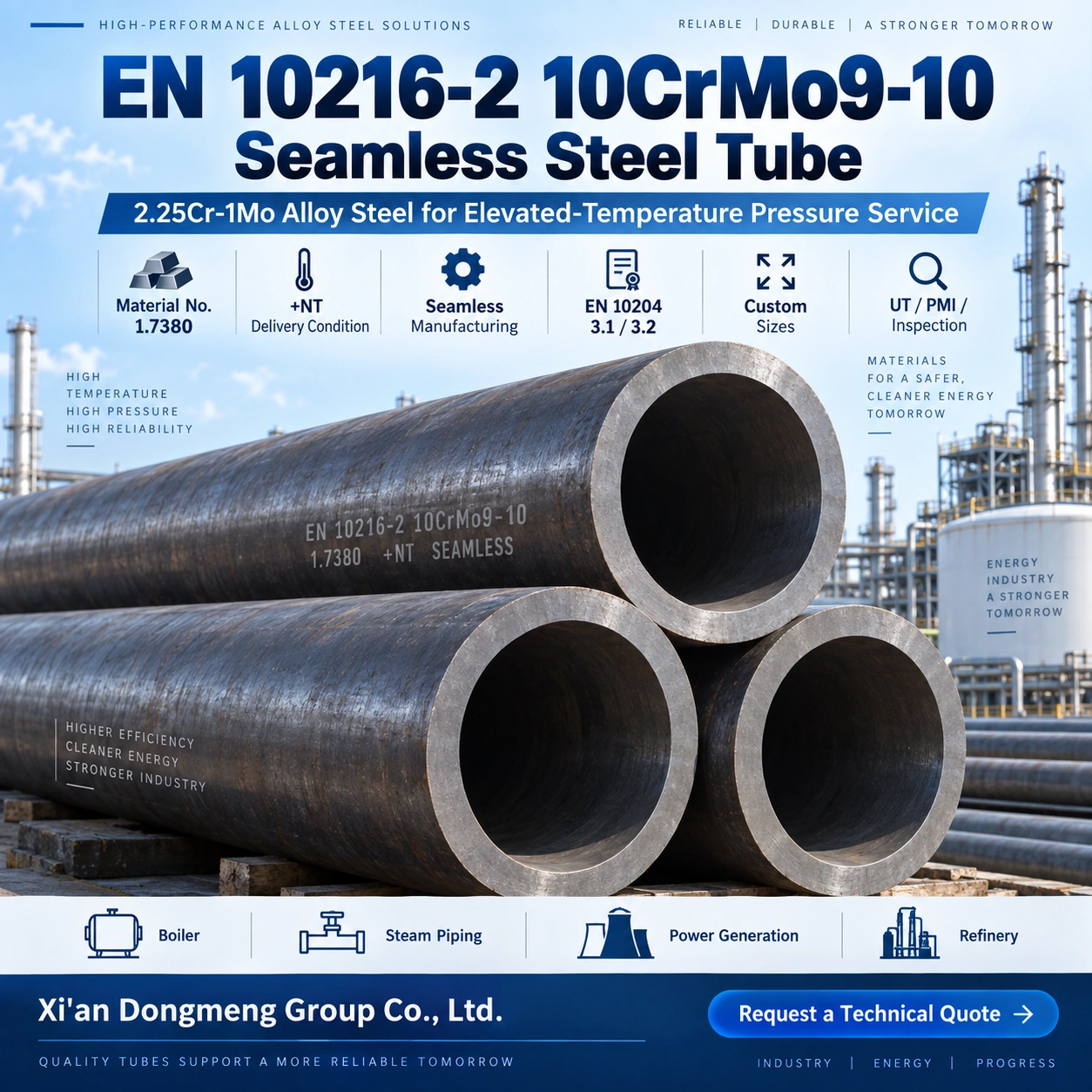
Xi'an Dongmeng Group Co., Ltd. is one of the most reliable manufacturers and suppliers of en 10216-2 10crmo9-10 seamless steel tube in China, also supports customized service. With abundant experience, we warmly welcome you to wholesale cheap products in stock here and get free sample from our factory. For price consultation, contact us.
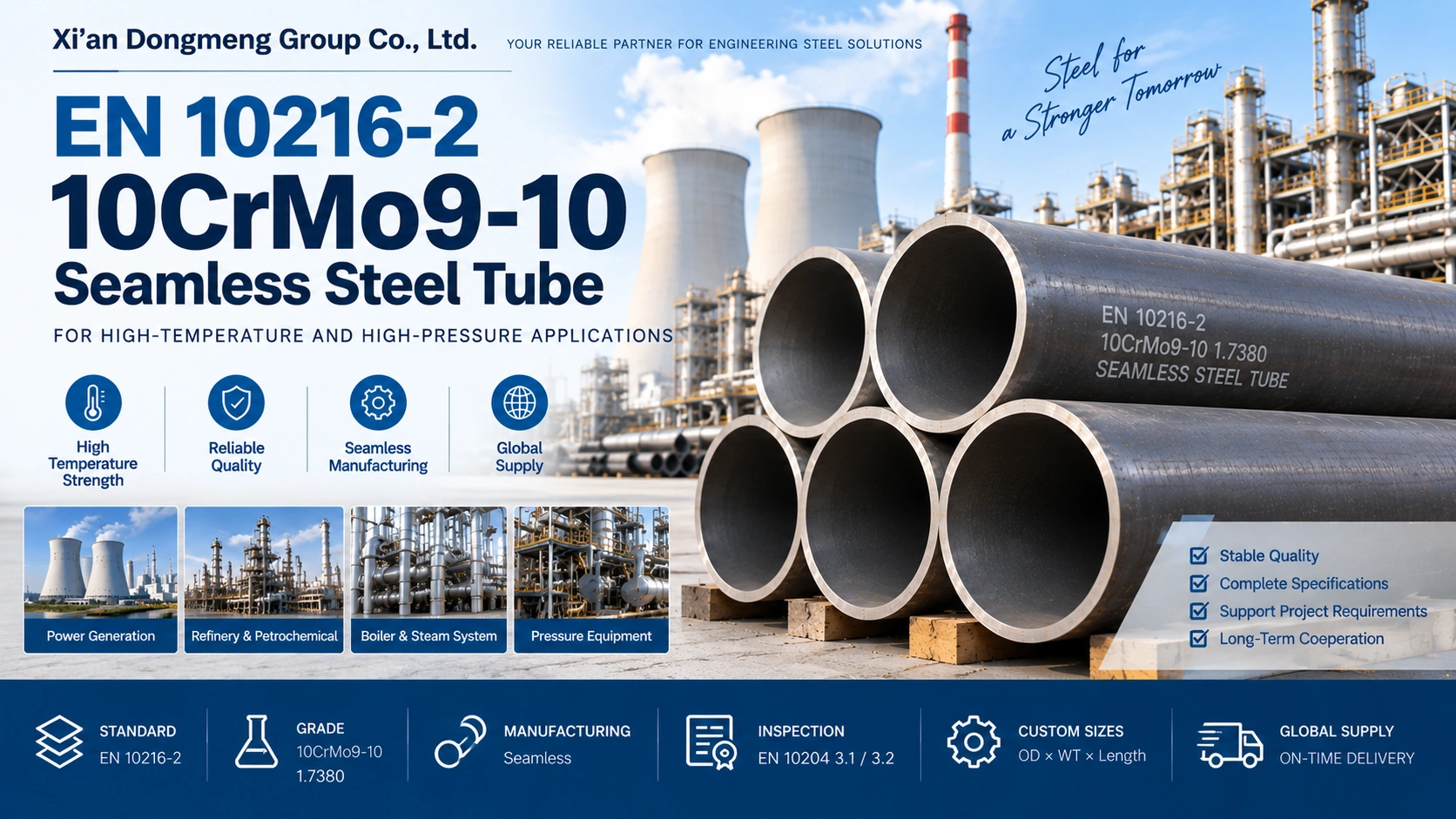
EN 10216-2 10CrMo9-10 Seamless Steel Tube
Xi'an Dongmeng Group Co., Ltd. supplies EN 10216-2 10CrMo9-10 Seamless Steel Tube for boilers, power-generation systems, high-temperature steam piping, refinery units, petrochemical equipment and other pressure applications requiring reliable elevated-temperature strength. Also identified by material number 1.7380, 10CrMo9-10 is a 2.25Cr-1Mo chromium-molybdenum alloy steel designed for pressure service at elevated temperatures.
Manufactured by the seamless process, 10CrMo9-10 tubes are normally supplied in the normalized and tempered (+NT) condition, with +QT treatment considered for certain heavy-wall configurations where required by EN 10216-2 and the purchase specification. Dongmeng Group supports project-specific OD × WT combinations, fixed lengths, beveling, UT/NDT, PMI, leak-tightness testing, EN 10204 3.1/3.2 documentation and third-party inspection.
EN 10216-2:2024 is the current European standard covering seamless non-alloy and alloy steel tubes with specified elevated-temperature properties for pressure purposes.
EN 10216-2 10CrMo9-10 Specifications
| Item | Specification |
| Product | EN 10216-2 10CrMo9-10 Seamless Steel Tube |
| Standard | EN 10216-2:2024 |
| Steel Grade | 10CrMo9-10 |
| Material Number | 1.738 |
| Material Family | Chromium-Molybdenum Alloy Steel |
| Nominal Alloy System | 2.25Cr-1Mo |
| Manufacturing | Seamless |
| Finish Before Heat Treatment | Hot Finished / Cold Finished |
| Standard Delivery Condition | +NT – Normalized & Tempered |
| Austenitizing Temperature | 900–960°C |
| Tempering Temperature | 680–750°C |
| End Finish | Plain / Beveled / Machined |
| Length | Random / Fixed / Project-Specified |
| Documentation | EN 10204 3.1 / 3.2 when specified |
| Optional Inspection | UT / PMI / Leak-Tightness / Additional NDT / Third-Party Inspection |
| Main Applications | Boilers, Steam Lines, Power Plants, Refinery & Petrochemical Pressure Systems |
EN 10216-2 requires these tubes to be manufactured by a seamless process. Tubes may be hot- or cold-finished before final heat treatment. For 10CrMo9-10, the specified standard heat-treatment condition is +NT, with austenitizing at 900–960°C followed by tempering at 680–750°C.
What Is 10CrMo9-10 / 1.7380?
10CrMo9-10 is an alloy special steel developed for pressure components exposed to elevated temperatures.
Its EN material number is:
1.7380
Its chemistry contains approximately:
2.00–2.50% Chromium + 0.90–1.10% Molybdenum
This puts 10CrMo9-10 within the well-established 2.25Cr-1Mo material family.
Compared with lower-alloy grades such as 13CrMo4-5, the higher chromium and molybdenum content provides improved elevated-temperature performance and makes 10CrMo9-10 particularly relevant to demanding boiler, steam and power-generation applications.
The material should nevertheless be selected according to the actual:
Design Temperature · Design Pressure · Wall Thickness · Allowable Stress · Design Code · Process Medium · Required Service Life
-not simply by comparing alloy percentages.
Chemical Composition of 10CrMo9-10
The EN 10216-2:2024 ladle-analysis limits for 10CrMo9-10 include:
| Element | Composition (%) |
| Carbon C | 0.08–0.14 |
| Silicon Si | ≤ 0.50 |
| Manganese Mn | 0.30–0.70 |
| Phosphorus P | ≤ 0.020 |
| Sulfur S | ≤ 0.010 |
| Chromium Cr | 2.00–2.50 |
| Molybdenum Mo | 0.90–1.10 |
| Nickel Ni | ≤ 0.30 |
| Aluminum Al total | ≤ 0.040 |
| Copper Cu | ≤ 0.30 |
These limits are consistent with current EN 10216-2 material data published for 10CrMo9-10 / 1.7380.
Why 2.25Cr-1Mo?
Chromium
Chromium improves:
oxidation resistance;
hardenability;
elevated-temperature stability.
Molybdenum
Molybdenum helps improve:
elevated-temperature strength;
creep resistance;
resistance to loss of strength during prolonged thermal exposure.
The combined Cr-Mo system makes 10CrMo9-10 considerably more suitable for elevated-temperature pressure duty than conventional carbon pressure steels.
Mechanical Properties
The room-temperature requirements of EN 10216-2 vary according to wall thickness.
| Wall Thickness | Minimum Rp0.2 | Tensile Strength Rm |
| T ≤ 16 mm | 280 MPa | 480–630 MPa |
| 16 < T ≤ 40 mm | 280 MPa | 480–630 MPa |
| 40 < T ≤ 60 mm | 270 MPa | 480–630 MPa |
Elongation
Longitudinal: ≥ 22%
Transverse: ≥ 20%
Impact Energy
At 20°C:
Longitudinal: ≥ 40 J
Transverse: ≥ 27 J
EN 10216-2:2024 gives these room-temperature requirements for 10CrMo9-10 and requires impact verification for relevant thicker-wall tubes under the conditions specified by the standard.
Elevated-Temperature Strength
A major purchasing reason for selecting 10CrMo9-10 is its defined mechanical performance at elevated temperature.
For wall thicknesses up to 60 mm, EN 10216-2 lists the following minimum Rp0.2 values:
| Temperature | Minimum Rp0.2 |
| 100°C | 249 MPa |
| 150°C | 241 MPa |
| 200°C | 234 MPa |
| 250°C | 224 MPa |
| 300°C | 219 MPa |
| 350°C | 212 MPa |
| 400°C | 207 MPa |
| 450°C | 193 MPa |
| 500°C | 180 MPa |
These values are specified in the current EN 10216-2 elevated-temperature property table.
Important Engineering Note
A listed proof-strength value at 500°C does not mean that every 10CrMo9-10 tube can automatically be used continuously at 500°C.
The allowable operating condition must be established from:
applicable design code + allowable stress + creep data + pressure + dimensions + corrosion allowance + fabrication history + expected design life.
Long-term high-temperature design may be governed by creep rather than room-temperature tensile properties.
Heat Treatment: 10CrMo9-10 +NT
The standard delivery condition is:
+NT - Normalized and Tempered
Normalizing / Austenitizing:
900–960°C followed by air cooling
Tempering:
680–750°C followed by air cooling
This heat treatment develops the microstructure required for the specified room- and elevated-temperature mechanical properties.
When Can +QT Be Required?
This is an important technical point for 10CrMo9-10 procurement.
EN 10216-2 notes that for grades subject to the relevant heat-treatment footnote, quenching and tempering may become necessary where wall thickness exceeds 10 mm or T/D exceeds 0.15 in order to obtain the required microstructure and material properties.
Where such treatment is required, it must be agreed at the enquiry and order stage and the material designation is supplemented with +QT.
Therefore, buyers should not assume that every heavy-wall order should automatically be quoted simply as:
10CrMo9-10 +NT
For heavy-wall tubes, the mill should review:
OD · WT · T/D ratio · required properties · heat-treatment route
before final production.
Seamless Manufacturing Process
A typical production route includes:
1. Steelmaking & Billet Verification
Steel chemistry and heat number are verified against EN 10216-2 requirements.
2. Billet Heating
Qualified alloy steel billets are heated to the required piercing temperature.
3. Rotary Piercing
The solid billet is pierced into a hollow shell.
4. Elongation & Rolling
The hollow shell is rolled to achieve the required tube geometry.
5. Sizing / Reducing
Outside diameter and wall thickness are brought within the specified dimensional tolerance.
6. Heat Treatment
The tube is normally normalized and tempered, or treated according to the agreed condition for heavy-wall material.
7. Straightening
Heat-treated tubes are straightened before final inspection.
8. Cutting & End Preparation
Fixed-length cutting, plain ends or beveling can be specified.
9. Inspection & NDT
Mechanical properties, dimensions, leak-tightness and applicable NDT requirements are verified.
10. Marking & Traceability
Material grade, heat identification and inspection documentation are checked before packing.
Because EN 10216-2 uses a seamless manufacturing route, the tube does not contain a longitudinal fusion weld seam.
Inspection and Testing
For critical high-temperature piping, purchasing decisions should consider inspection requirements as carefully as chemistry.
Available project inspection may include:
ladle and product chemical analysis;
tensile testing;
impact testing;
elevated-temperature tensile verification;
dimensional inspection;
wall-thickness verification;
visual examination;
ultrasonic testing;
leak-tightness testing;
hydrostatic testing where specified;
PMI;
material identification;
third-party inspection.
EN 10216-2:2024 specifically provides ordering options for elevated-temperature verification, NDT, special end preparation, exact lengths, hydrostatic test pressure, positive material identification and EN 10204 3.2 certification.
EN 10204 3.1 and 3.2 Documentation
For B2B power, boiler and pressure-equipment projects, material traceability is essential.
Typical documentation can include:
EN 10204 3.1
Manufacturer-issued inspection certificate containing actual specified inspection and test results.
EN 10204 3.2
Inspection certificate involving validation by an independent inspection representative as required by the applicable purchasing arrangement.
EN 10216-2 specifically provides 3.2 certification as an ordering option.
For critical pressure applications, the required certificate type should always appear directly on the RFQ and purchase order.
Typical Applications
Power Generation
10CrMo9-10 is well established for elevated-temperature power applications including:
steam piping;
boiler connections;
superheater and reheater-related systems;
high-temperature headers;
pressure components.
Boiler Systems
The combination of Cr and Mo supports applications exposed to prolonged thermal loading.
Typical uses include:
boiler tubes;
steam lines;
boiler pressure parts;
high-temperature connecting piping.
Refineries
Possible applications include:
high-temperature process piping;
heater-related systems;
process transfer lines;
pressure equipment connections.
Petrochemical Plants
10CrMo9-10 can be considered for process piping and pressure components where design calculations require a Cr-Mo alloy with elevated-temperature properties.
Pressure Equipment
Typical requirements may include:
pressure vessel connection piping;
headers;
heat exchanger connections;
high-temperature process equipment.
Actual suitability must always be confirmed by the plant designer or pressure-equipment manufacturer.
10CrMo9-10 vs 13CrMo4-5
These are two important Cr-Mo grades in EN 10216-2.
| Property | 13CrMo4-5 | 10CrMo9-10 |
| Material Number | 1.7335 | 1.738 |
| Cr | 0.70–1.15% | 2.00–2.50% |
| Mo | 0.40–0.60% | 0.90–1.10% |
| Alloy Family | Approx. 1Cr-0.5Mo | Approx. 2.25Cr-1Mo |
| Tensile Strength | 440–590 MPa | 480–630 MPa |
| Standard Condition | +NT | +NT |
| Typical Position | Intermediate Cr-Mo service | More demanding elevated-temperature service |
10CrMo9-10 contains substantially more Cr and Mo, but that does not mean it should automatically replace 13CrMo4-5.
The correct material must follow the engineering design specification.
10CrMo9-10 vs ASTM A335 P22
10CrMo9-10 and ASTM A335 P22 are widely cross-referenced because both belong to the 2.25Cr-1Mo family. Tubacex, for example, places EN 10216-2 10CrMo9-10 and ASTM A335 P22 in the same international material-equivalency group for power-generation applications.
However:
10CrMo9-10 is not automatically interchangeable with A335 P22.
| Item | EN 10216-2 10CrMo9-10 | ASTM A335 P22 |
| Standards System | EN | ASTM / ASME |
| Grade | 10CrMo9-10 | P22 |
| Material No. | 1.738 | ASTM designation system |
| Alloy System | Approx. 2.25Cr-1Mo | Approx. 2.25Cr-1Mo |
| Manufacturing | Seamless | Seamless |
| Main Use | Pressure Tube | High-Temperature Pipe |
| Heat Treatment | EN-defined +NT/+QT conditions | ASTM-defined treatment |
| Certification | EN 10204 system commonly used | ASTM/ASME documentation |
| Direct Substitution | Engineering approval required | Engineering approval required |
Chemical ranges may be similar, but:
mechanical requirements, heat treatment, tolerances, testing, certification and dimensional standards are not identical.
If a project specifies EN 10216-2 10CrMo9-10, it should not be replaced by P22 based only on an equivalency table.
Recommended RFQ Information
For accurate quotation, send:
Standard: EN 10216-2:2024
Grade: 10CrMo9-10 / 1.7380
Delivery Condition: +NT / +QT if required
Outside Diameter: ___ mm
Wall Thickness: ___ mm
Length: ___ mm
Quantity: ___ pcs / m / tons
End Preparation: PE / BE / Special
Impact Test: Required / Not Required
Elevated-Temperature Test: Required / Not Required
UT / NDT: ___
Leak-Tightness Test: ___
PMI: Required / Not Required
Certificate: EN 10204 3.1 / 3.2
Third-Party Inspection: ___
Application: Boiler / Power / Refinery / Petrochemical
Design Code: ___
Delivery Destination: ___
The current standard itself gives an ordering example for 10CrMo9-10 with a minimum ID of 240 mm, minimum wall thickness of 40 mm and EN 10204 3.2 certification, demonstrating why dimensions and inspection documentation should be clearly defined at RFQ stage.
Why Source 10CrMo9-10 Tube from Xi'an Dongmeng Group Co., Ltd.?
Standards-Based Supply
Xi'an Dongmeng Group Co., Ltd. reviews material grade, dimensions, delivery condition and inspection requirements before quotation for pressure-service alloy tubes.
Heat Number Traceability
Material identification can be maintained through heat-number marking and corresponding inspection documentation.
Inspection Support
Available project requirements may include:
UT · PMI · Mechanical Testing · Leak-Tightness Testing · Dimensional Inspection · Third-Party Inspection
Processing Support
Project-specific processing can include:
Fixed-Length Cutting · Beveling · End Machining · Surface Protection · Export Packing
Technical RFQ Review
For heavy-wall 10CrMo9-10, we recommend reviewing the OD × WT, T/D ratio and required heat-treatment condition before final production.
This is more reliable than purchasing only by material name.
FAQ - EN 10216-2 10CrMo9-10 Seamless Steel Tube
1. What is 10CrMo9-10?
10CrMo9-10 is a Cr-Mo alloy special steel, material number 1.7380, used for seamless pressure tubes with elevated-temperature properties.
2. What standard covers 10CrMo9-10 seamless tube?
It is specified under EN 10216-2:2024 for seamless pressure tubes with elevated-temperature properties.
3. Is 10CrMo9-10 seamless?
Yes. EN 10216-2 requires the tubes covered by the standard to be manufactured using a seamless process.
4. What is the material number?
1.7380.
5. What is the Cr and Mo content?
Chromium is 2.00–2.50% and molybdenum is 0.90–1.10%.
6. What is the normal delivery condition?
The standard condition is +NT - normalized and tempered.
7. What are the heat-treatment temperatures?
Normalizing is 900–960°C and tempering is 680–750°C.
8. When may +QT be needed?
EN 10216-2 notes that quenching and tempering may be necessary for applicable grades where wall thickness exceeds 10 mm or T/D exceeds 0.15 to achieve the intended structure and properties. The condition should be agreed during enquiry and ordering.
9. What is the tensile strength?
The specified tensile-strength range is 480–630 MPa for the applicable dimensional ranges.
10. Is 10CrMo9-10 the same as P22?
No. They belong to a similar 2.25Cr-1Mo material family and are frequently cross-referenced, but EN 10216-2 10CrMo9-10 and ASTM A335 P22 are separate specifications.
11. Can EN 10204 3.2 certification be supplied?
Yes. EN 10204 3.2 is explicitly available as an ordering option under EN 10216-2.
12. Can PMI and UT be specified?
Yes. Positive material identification and nondestructive testing can be included according to the agreed order requirements.
13. Can fixed-length tubes be supplied?
Yes. Exact length is an ordering option within EN 10216-2.
14. Is 10CrMo9-10 suitable for 500°C service?
EN 10216-2 provides a minimum Rp0.2 value of 180 MPa at 500°C for wall thickness up to 60 mm. However, actual allowable operating temperature must be determined from the governing design code, pressure, creep requirements and service life.
Request a Technical Quote
For EN 10216-2 10CrMo9-10 Seamless Steel Tube, send your MTO, tube schedule or technical specification to Xi'an Dongmeng Group Co., Ltd.
For faster technical review, provide:
OD × WT × Length · Quantity · +NT/+QT · NDT · Inspection Certificate · Application · Destination
Office Information
Phone: +86 157 6921 4734
Email: office@dongmjd.com
WhatsApp: Dong: +86 157 6921 4734
Office Address:
Room 4107, Runfeng Building, Sanqiao New Street, Weiyang District, Xi'an City, Shaanxi Province
Hot Tags: en 10216-2 10crmo9-10 seamless steel tube, China en 10216-2 10crmo9-10 seamless steel tube manufacturers, suppliers, factory


